QUESTION IMAGE
Question
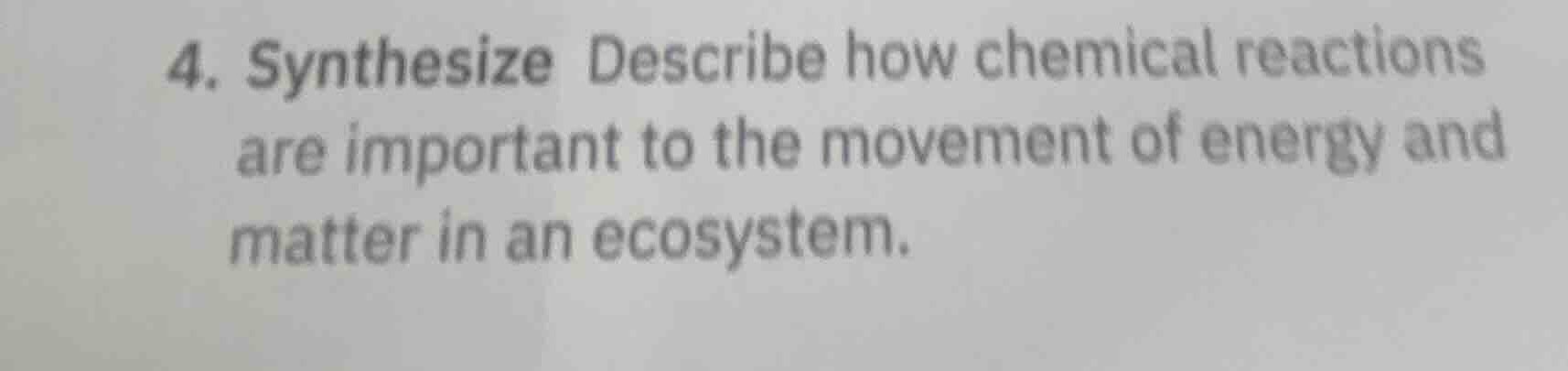
- synthesize describe how chemical reactions are important to the movement of energy and matter in an ecosystem.
- Photosynthesis (a chemical reaction: \(6CO_2 + 6H_2O \xrightarrow[\text{Chlorophyll}]{\text{Sunlight}} C_6H_{12}O_6 + 6O_2\)): Producers (like plants) use this reaction to convert light energy into chemical energy (stored in glucose) and transform inorganic matter (\(CO_2\), \(H_2O\)) into organic matter (glucose). This captures energy from the sun and introduces organic matter into the ecosystem.
- **Cellular Respiration (chemical reaction: \(C_6H_{12}O_6 + 6O_2
ightarrow 6CO_2 + 6H_2O + \text{Energy}\))**: Organisms (producers, consumers, decomposers) use this to break down organic matter (like glucose) and release the stored chemical energy (used for life processes: growth, movement, reproduction). It also recycles matter (releases \(CO_2\), \(H_2O\) back into the environment to be used again in photosynthesis).
- Decomposition Reactions: Decomposers (bacteria, fungi) break down dead organisms/waste via chemical reactions. This releases nutrients (like nitrogen, phosphorus, carbon) from organic matter back into the soil/water/air. These nutrients are then taken up by producers, continuing the matter cycle. For example, breaking down a dead plant into simpler inorganic compounds that plants can absorb.
- Energy Flow Link: Chemical reactions (photosynthesis stores energy, respiration releases it) drive the one - way flow of energy in an ecosystem. Energy enters as light, is stored as chemical energy in organic matter, and is released as heat (from respiration) at each trophic level (producers → primary consumers → secondary consumers...). Matter, however, is recycled because of reactions like photosynthesis (reusing inorganic to make organic) and respiration/decomposition (releasing organic back to inorganic).

Snap & solve any problem in the app
Get step-by-step solutions on Sovi AI
Photo-based solutions with guided steps
Explore more problems and detailed explanations
Chemical reactions are vital for energy and matter movement in ecosystems:
- Photosynthesis (\(6CO_2 + 6H_2O \xrightarrow[\text{Chlorophyll}]{\text{Sunlight}} C_6H_{12}O_6 + 6O_2\)): Producers convert light energy to chemical energy (stored in glucose) and transform inorganic matter (\(CO_2\), \(H_2O\)) into organic matter, capturing energy and introducing new organic matter.
- Cellular Respiration (\(C_6H_{12}O_6 + 6O_2
ightarrow 6CO_2 + 6H_2O + \text{Energy}\)): Organisms break down organic matter (e.g., glucose) to release stored chemical energy (for life processes) and recycle matter (\(CO_2\), \(H_2O\) return to the environment).
- Decomposition Reactions: Decomposers break down dead organic matter via chemical reactions, releasing nutrients (e.g., nitrogen, carbon) back into the environment. These nutrients are reused by producers, sustaining the matter cycle.
- Energy Flow: Reactions drive energy flow (light → chemical energy in organic matter → heat from respiration). Matter is recycled (inorganic → organic via photosynthesis; organic → inorganic via respiration/decomposition) due to these reactions.