QUESTION IMAGE
Question
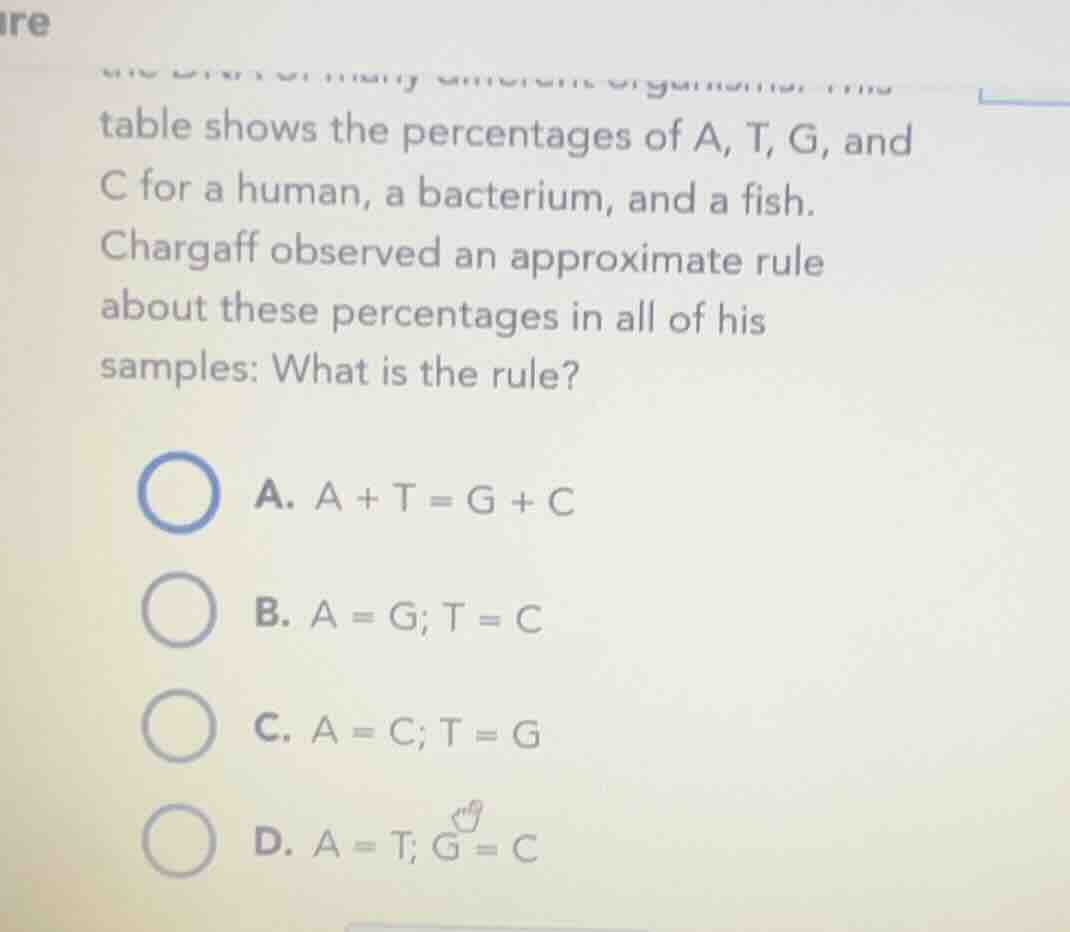
table shows the percentages of a, t, g, and c for a human, a bacterium, and a fish. chargaff observed an approximate rule about these percentages in all of his samples: what is the rule? a. $a + t = g + c$ b. $a = g$; $t = c$ c. $a = c$; $t = g$ d. $a = t$; $g = c$
Brief Explanations
Chargaff's rule is based on complementary base pairing in DNA. In double-stranded DNA, adenine (A) pairs only with thymine (T), and guanine (G) pairs only with cytosine (C). This means the percentage of A equals the percentage of T, and the percentage of G equals the percentage of C across samples.

Snap & solve any problem in the app
Get step-by-step solutions on Sovi AI
Photo-based solutions with guided steps
Explore more problems and detailed explanations
D. A = T; G = C