QUESTION IMAGE
Question
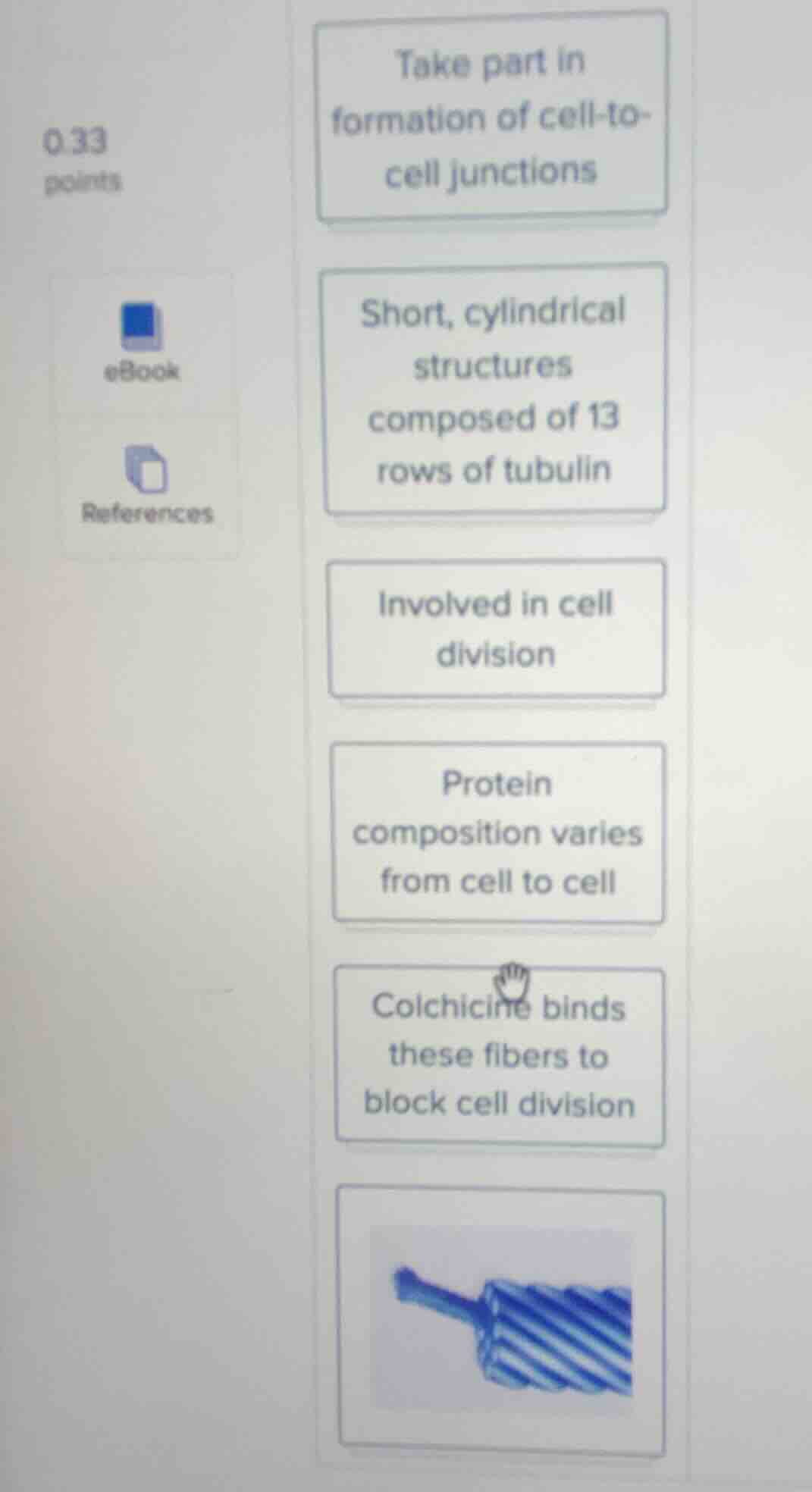
take part in formation of cell - to - cell junctions; short, cylindrical structures composed of 13 rows of tubulin; involved in cell division; protein composition varies from cell to cell; colchicine binds these fibers to block cell division
To solve this, we analyze each option based on the characteristics of centrioles (or related structures, but here likely centrioles/ microtubule - organizing centers, or maybe microtubules? Wait, the "short, cylindrical structures composed of 13 rows of tubulin" is a key. Let's recall:
- Take part in formation of cell - to - cell junctions: Cell - to - cell junctions are formed by structures like desmosomes, tight junctions, etc. Centrioles (or the structures in question here) are not involved in cell - to - cell junctions. So this is incorrect.
- Short, cylindrical structures composed of 13 rows of tubulin: Centrioles are short, cylindrical structures and are composed of tubulin (in a 9 + 0 arrangement, but the "13 rows" might be a way to describe the microtubule arrangement in the centriole or basal body; microtubules in centrioles have a 9 - triplet arrangement, but maybe the question is using a simplified description). This matches the structure of centrioles (or basal bodies).
- Involved in cell division: Centrioles are involved in cell division (they help in the formation of the spindle apparatus). But let's check other options too.
- Protein composition varies from cell to cell: The protein composition of centrioles (or the tubulin - based structures) is relatively consistent (tubulin is a major component and is not highly variable from cell to cell in terms of the core structure's protein). So this is incorrect.
- Colchicine binds these fibers to block cell division: Colchicine binds to microtubules (not centrioles directly). Centrioles are not the target of colchicine in the same way. Microtubules are the target, and colchicine prevents their polymerization. But the "short, cylindrical structures composed of 13 rows of tubulin" is more characteristic of centrioles (or basal bodies) than the other options. Also, centrioles are involved in cell division, but the structural description is more specific.
We evaluate each statement:
- Cell - cell junction formation is not a function of the structure described (centriole - like).
- The description "short, cylindrical structures composed of 13 rows of tubulin" matches the structural features of centrioles (or related tubulin - based organelles).
- While centrioles are involved in cell division, the structural description is more definitive.
- Protein composition of centriole - like structures is not highly variable.
- Colchicine targets microtubules, not centrioles directly.

Snap & solve any problem in the app
Get step-by-step solutions on Sovi AI
Photo-based solutions with guided steps
Explore more problems and detailed explanations
Short, cylindrical structures composed of 13 rows of tubulin