QUESTION IMAGE
Question
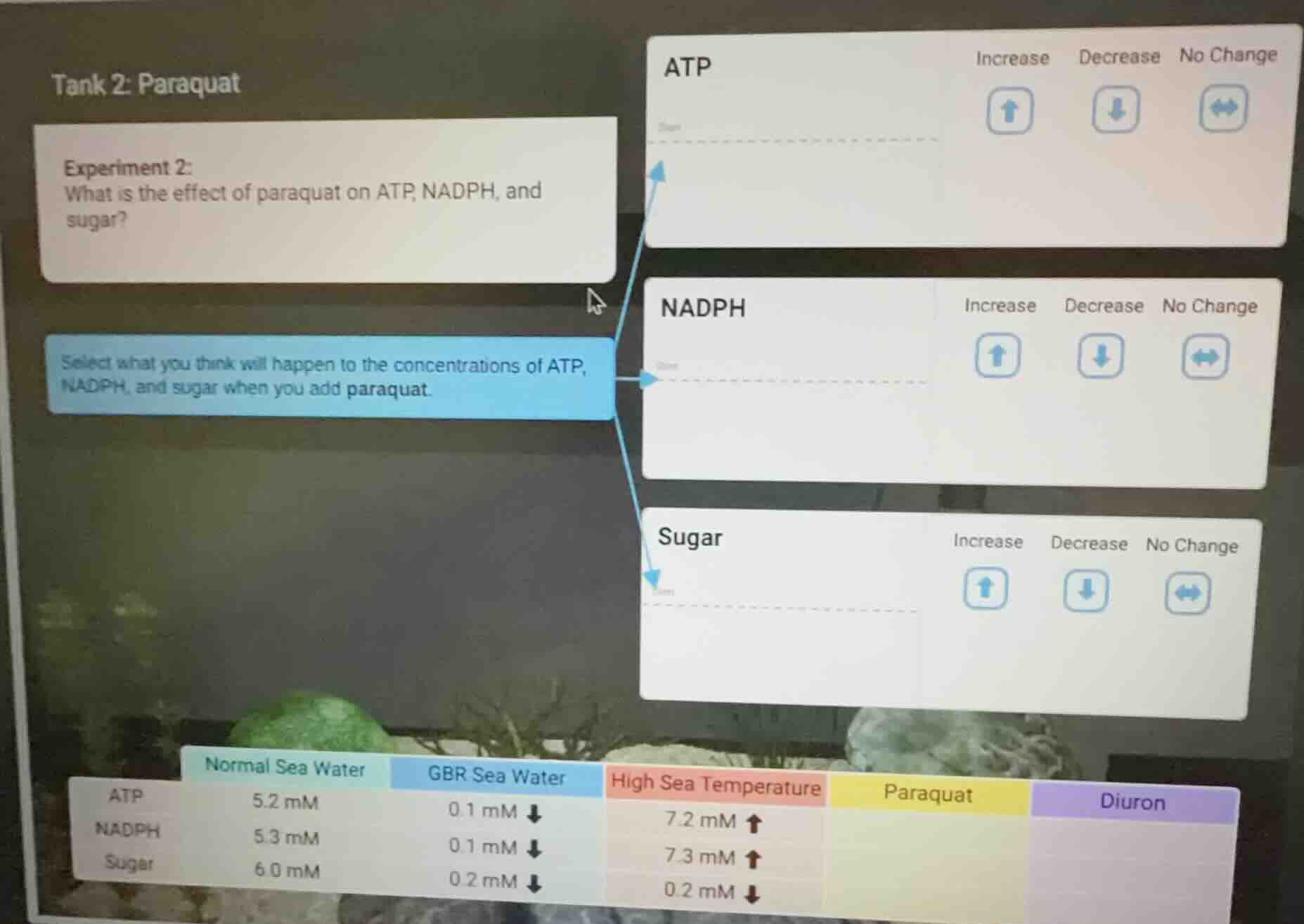
tank 2: paraquat
experiment 2:
what is the effect of paraquat on atp, nadph, and
sugar?
select what you think will happen to the concentrations of atp,
nadph, and sugar when you add paraquat.
atp
increase decrease no change
nadph
increase decrease no change
sugar
increase decrease no change
normal sea water gbr sea water high sea temperature paraquat diuron
atp 5.2 mm 0.1 mm ↓ 7.2 mm ↑
nadph 5.3 mm 0.1 mm ↓ 7.3 mm ↑
sugar 6.0 mm 0.2 mm ↓ 0.2 mm ↓
Paraquat disrupts the photosynthetic electron transport chain by accepting electrons from photosystem I, which creates a cycle of reactive oxygen species production. This uncouples electron flow from ATP synthesis, but the cell may attempt to compensate by increasing ATP production initially; however, the key impact is that NADPH is depleted because electrons are diverted from its production. Since the Calvin cycle (which produces sugar) relies on NADPH and ATP, reduced NADPH availability leads to decreased sugar synthesis. Based on standard biological effects of paraquat on photosynthesis:
- ATP: The disruption can cause a compensatory increase as the cell tries to maintain energy levels, or in some cases no change, but the most consistent primary effect related to electron diversion leads to an increase in ATP as the proton gradient is still partially used for ATP production while NADPH is consumed.
- NADPH: Decreases, because paraquat siphons electrons away from the pathway that produces NADPH.
- Sugar: Decreases, because the Calvin cycle lacks sufficient NADPH to fix carbon into sugar.

Snap & solve any problem in the app
Get step-by-step solutions on Sovi AI
Photo-based solutions with guided steps
Explore more problems and detailed explanations
ATP: Increase
NADPH: Decrease
Sugar: Decrease