QUESTION IMAGE
Question
task
psychological theories and human behavior
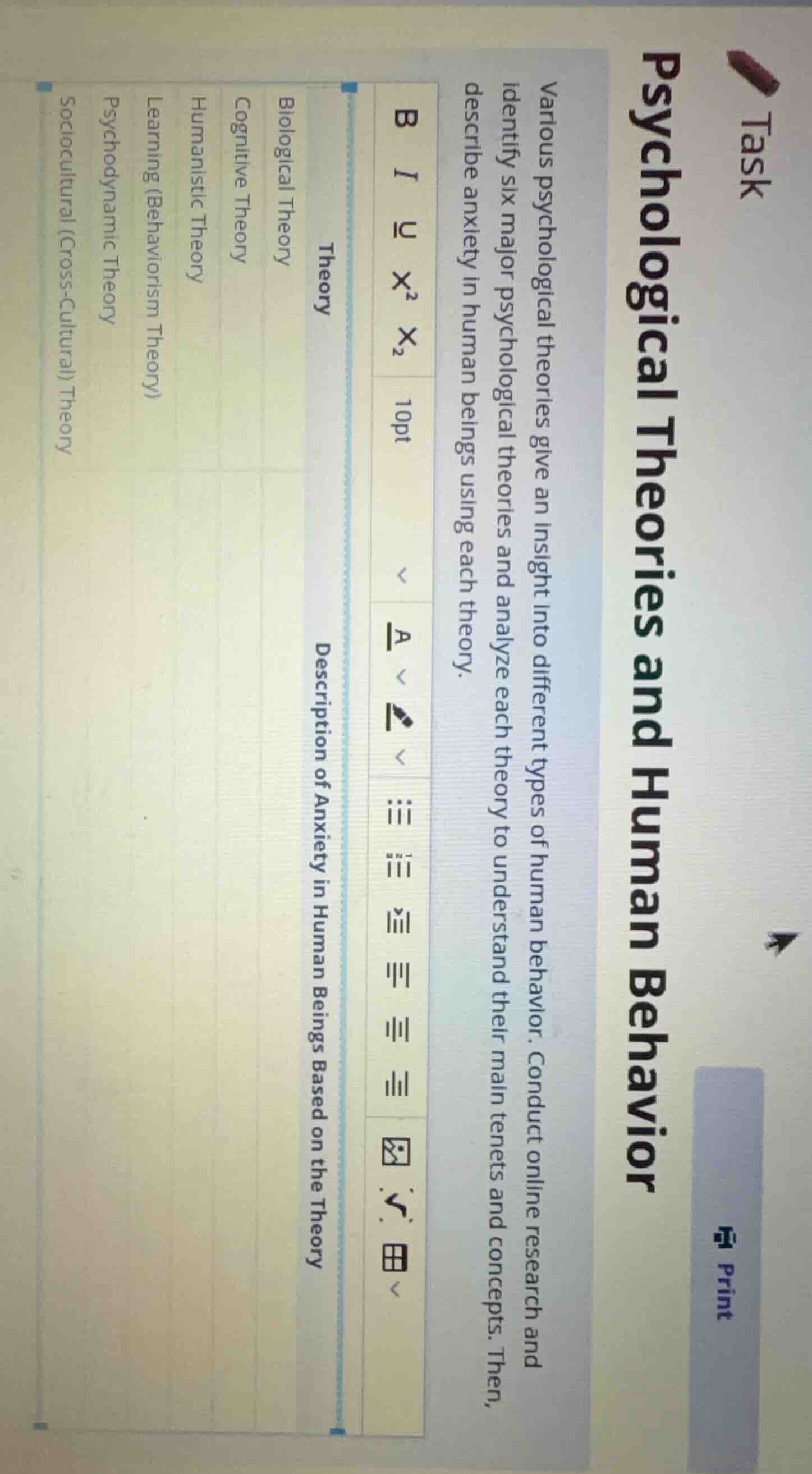
various psychological theories give an insight into different types of human behavior. conduct online research and identify six major psychological theories and analyze each theory to understand their main tenets and concepts. then, describe anxiety in human beings using each theory.
theory
biological theory
cognitive theory
humanistic theory
learning (behaviorism theory)
psychodynamic theory
sociocultural (cross - cultural) theory
description of anxiety in human beings based on the theory
Brief Explanations
- Biological Theory: Focuses on physical/neurological causes. Anxiety stems from brain structure (amygdala hyperactivity), neurotransmitter imbalances (low serotonin, high norepinephrine), genetic predisposition, or hormonal shifts (e.g., cortisol spikes).
- Cognitive Theory: Centers on thought patterns. Anxiety arises from irrational, catastrophic thinking, overestimating threat likelihood, and underestimating one's ability to cope (e.g., "I will fail and everyone will judge me").
- Humanistic Theory: Emphasizes self-concept and growth. Anxiety occurs when there is a mismatch between one's real self (actual traits) and ideal self (perceived desired traits), leading to feelings of inadequacy and dissonance.
- Learning (Behaviorism) Theory: Links anxiety to conditioning. Classical conditioning: a neutral stimulus (e.g., a crowded room) becomes paired with a fear response (e.g., a panic attack). Operant conditioning: avoiding the stimulus reinforces the anxiety. Observational learning: anxiety is learned by watching others' fearful reactions.
- Psychodynamic Theory: Rooted in unconscious conflicts. Anxiety comes from repressed traumatic memories, unmet childhood needs, or conflicts between the id (primitive urges), ego (rational self), and superego (moral compass) that surface as distress.
- Sociocultural (Cross-Cultural) Theory: Focuses on environmental and cultural factors. Anxiety is shaped by cultural norms (e.g., stigma around failure in high-achieving cultures), socioeconomic stressors (poverty, discrimination), or social pressures (e.g., social media comparison).

Snap & solve any problem in the app
Get step-by-step solutions on Sovi AI
Photo-based solutions with guided steps
Explore more problems and detailed explanations
| Theory | Description of Anxiety in Human Beings Based on the Theory |
|---|---|
| Cognitive Theory | Arises from irrational, catastrophic thought patterns, overestimating threats, and underestimating one's coping abilities. |
| Humanistic Theory | Stems from a mismatch between an individual's real self (actual characteristics) and ideal self (perceived desired traits), creating psychological dissonance. |
| Learning (Behaviorism) Theory | Develops via classical conditioning (neutral stimulus paired with fear), operant conditioning (avoidance reinforces anxiety), or observational learning (imitating others' fear responses). |
| Psychodynamic Theory | Originates from repressed unconscious conflicts, unmet childhood needs, or clashes between the id, ego, and superego that manifest as distress. |
| Sociocultural (Cross-Cultural) Theory | Shaped by cultural norms, socioeconomic stressors (poverty, discrimination), social pressures, or cultural expectations that create distress. |