QUESTION IMAGE
Question
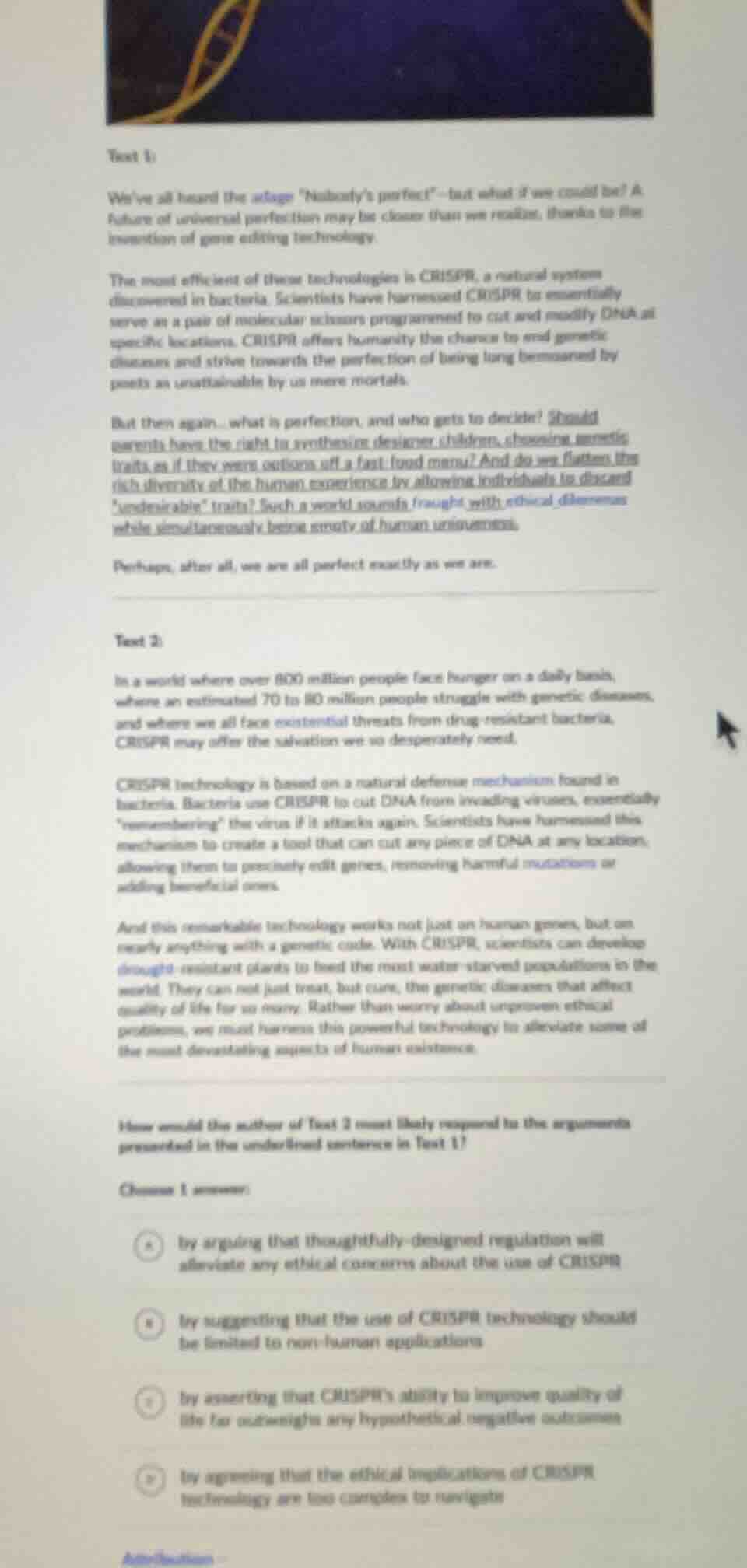
text 1:
weve all heard the adage
obodys perfect\—but what if we could be? a future of universal perfection may be closer than we realize, thanks to the invention of gene - editing technology.
the most efficient of these technologies is crispr, a natural system discovered in bacteria. scientists have harnessed crispr to essentially serve as a pair of molecular scissors programmed to cut and modify dna at specific locations. crispr offers humanity the chance to end genetic diseases and strive towards the perfection of being long - bemoaned by poets as unattainable by us mere mortals.
but then again... what is perfection, and who gets to decide? should parents have the right to synthesize designer children, choosing genetic traits as if they were options off a fast - food menu? and do we flatten the rich diversity of the human experience by allowing individuals to discard \undesirable\ traits? such a world would be fraught with ethical dilemmas while simultaneously being empty of human uniqueness.
perhaps, after all, we are all perfect exactly as we are.
text 2:
in a world where over 800 million people face hunger on a daily basis, where an estimated 70 to 80 million people struggle with genetic diseases, and where we all face existential threats from drug - resistant bacteria, crispr may offer the solution we so desperately need.
crispr technology is based on a natural defense mechanism found in bacteria. bacteria use crispr to cut dna from invading viruses, essentially
emembering\ the virus if it attacks again. scientists have harnessed this mechanism to create a tool that can cut any piece of dna at any location, allowing them to precisely edit genes, removing harmful mutations or adding beneficial ones.
and this remarkable technology works not just on human genes, but on nearly anything with a genetic code. with crispr, scientists can develop drought - resistant plants to feed the most water - starved populations of the world. they can not just treat, but cure, the genetic diseases that affect the quality of life for so many. rather than worry about unproven ethical problems, we must harness this powerful technology to alleviate some of the most devastating aspects of human existence.
how would the author of text 2 most likely respond to the arguments presented in the underlined sentence in text 1?
choose 1 answer:
a by arguing that thoughtfully - designed regulation will alleviate any ethical concerns about the use of crispr
b by suggesting that the use of crispr technology should be limited to non - human applications
c by asserting that crisprs ability to improve quality of life far outweighs any hypothetical negative outcomes
d by agreeing that the ethical implications of crispr technology are too complex to navigate
- Analyze Text 2's stance: Text 2 emphasizes CRISPR's benefits (curing genetic diseases, creating drought - resistant plants, alleviating human suffering) and downplays ethical concerns, stating we should harness it.
- Analyze the underlined part in Text 1: It raises ethical concerns about designer children and loss of human diversity.
- Evaluate each option:
- Option A: Text 2 doesn't focus on regulation to solve ethical concerns; it focuses on the benefits outweighing concerns. Eliminate A.
- Option B: Text 2 says CRISPR works on humans (to cure genetic diseases) and non - humans (plants). It doesn't suggest limiting to non - human applications. Eliminate B.
- Option C: Text 2's argument that CRISPR's ability to improve quality of life (cure diseases, feed populations) far outweighs any hypothetical negative outcomes (like the ethical concerns in Text 1) matches. This option is correct.
- Option D: Text 2 doesn't agree that ethical implications are too complex; it says we should use CRISPR despite them. Eliminate D.

Snap & solve any problem in the app
Get step-by-step solutions on Sovi AI
Photo-based solutions with guided steps
Explore more problems and detailed explanations
C. by asserting that CRISPR's ability to improve quality of life far outweighs any hypothetical negative outcomes