QUESTION IMAGE
Question
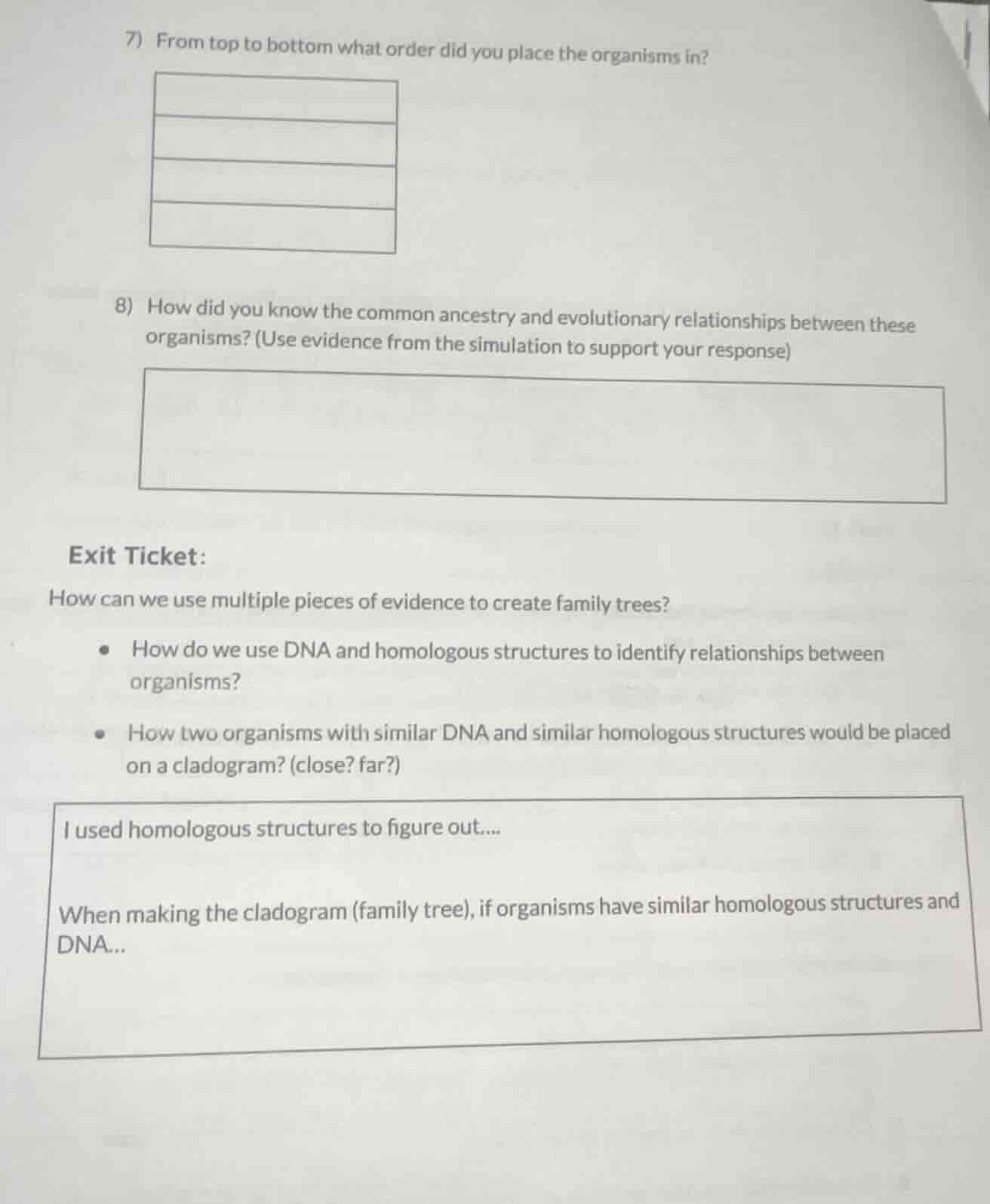
- from top to bottom what order did you place the organisms in?
- how did you know the common ancestry and evolutionary relationships between these organisms? (use evidence from the simulation to support your response)
exit ticket:
how can we use multiple pieces of evidence to create family trees?
- how do we use dna and homologous structures to identify relationships between organisms?
- how two organisms with similar dna and similar homologous structures would be placed on a cladogram? (close? far?)
i used homologous structures to figure out....
when making the cladogram (family tree), if organisms have similar homologous structures and dna...
For Question 7 (assuming a common organism - ordering context like from most to least related or based on complexity/evolutionary stage, e.g., if it's a typical cladogram - building with organisms like fish, amphibian, reptile, mammal):
Step1: Recall evolutionary order
Organisms are ordered from more primitive to more advanced (or based on shared traits). For example, if organisms are fish, amphibian, reptile, mammal (top to bottom could be mammal, reptile, amphibian, fish if considering closeness to human, but usually in cladogram - building for common ancestry, we order from most distantly related to most closely or vice - versa. Let's assume a common case: from top (most recent common ancestor - related in a way) to bottom (more distantly related) or based on trait acquisition. Suppose the organisms are [Organism A, Organism B, Organism C, Organism D] and we order them based on the number of shared derived traits. Let's say we have Organism 1 (e.g., Human), Organism 2 (e.g., Chimp), Organism 3 (e.g., Gorilla), Organism 4 (e.g., Orangutan). The order from top to bottom (assuming closer to human at top) would be Human, Chimp, Gorilla, Orangutan. But since the original problem doesn't specify organisms, we'll give a general approach.
Step2: Determine based on simulation evidence
In a typical simulation (like a cladogram - building simulation), we look at shared characteristics (homologous structures, DNA similarity). Organisms with more shared derived traits are placed closer together (higher up if we consider the top as more closely related to a focal organism). So if in the simulation, Organism X has the most shared traits with the reference, then Organism Y, then Z, then W, we place X at top, Y below X, Z below Y, W at bottom.
To determine common ancestry and evolutionary relationships, we analyze evidence from the simulation. Homologous structures (structures with similar anatomy but maybe different functions, like a human arm and a bat wing) suggest a common ancestor as they are inherited from a shared ancestor. DNA evidence: organisms with more similar DNA sequences have a more recent common ancestor (since DNA changes over time, less change means closer relationship). For example, in the simulation, if Organism A and Organism B had very similar DNA sequences and shared homologous limb structures, while Organism C had more divergent DNA and different homologous structures, we conclude A and B are more closely related, sharing a more recent common ancestor than with C.
To create family trees (cladograms), we combine multiple types of evidence. Homologous structures show structural similarities inherited from a common ancestor (e.g., vertebrate forelimbs). DNA evidence: comparing DNA sequences; more similar sequences mean a more recent common ancestor. Fossil evidence (if in the simulation) shows transitional forms. Behavioral evidence (if applicable) can also help. By overlaying these evidences, we identify shared derived traits (traits unique to a group and its descendants) to group organisms. For example, using both homologous limb structures and DNA similarity, we can place organisms with both similar structures and DNA closer on the family tree, indicating a closer evolutionary relationship.

Snap & solve any problem in the app
Get step-by-step solutions on Sovi AI
Photo-based solutions with guided steps
Explore more problems and detailed explanations
(The answer would depend on the specific organisms in the simulation. For example, if the organisms were Bird, Mammal, Reptile, Amphibian (and we order based on evolutionary relatedness to a common ancestor, say from most derived to least in a certain context), the order could be Mammal, Bird, Reptile, Amphibian. But without specific organism details from the simulation, a general answer is: The order is determined by the degree of shared derived characteristics (from the simulation) such as homologous structures, DNA similarity, or other evolutionary traits, with organisms having more shared traits placed closer (in the top - to - bottom order depending on the cladogram - building logic of the simulation).)