QUESTION IMAGE
Question
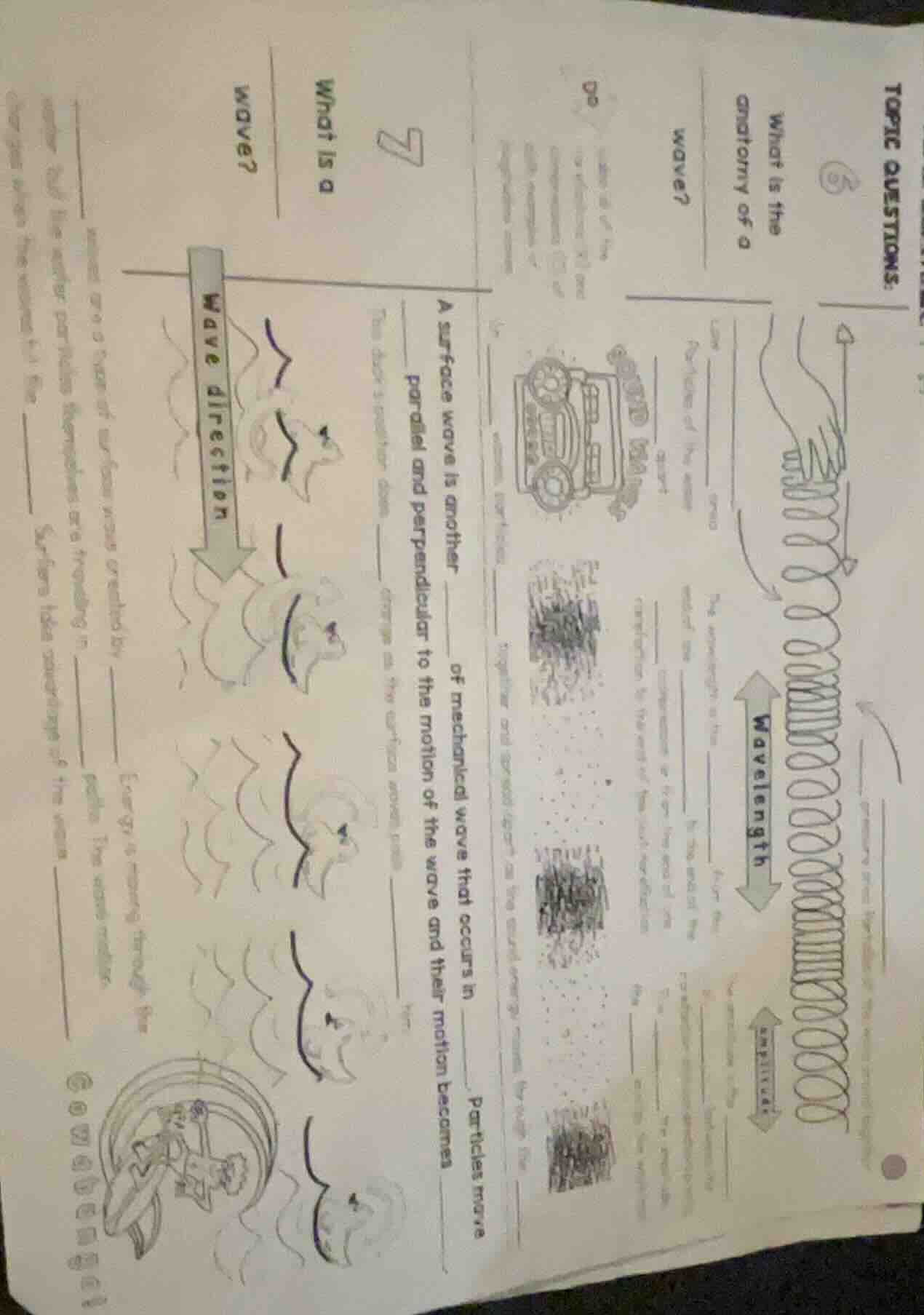
topic questions:6what is theanatomy of awave?wavelengthamplitudethe wavelength is the ____ from thestart of one __ to the end of the__ compression or from the end of onerarefaction to the end of the next rarefaction.the amplitude is the __ from the__ to the crest or the__ to the trough of the wave.particles of the water__ apart__ areas, particles __ together and spread apart as the sound energy moves through the__7what is awave?wave direction__ waves are a type of surface wave created by __. energy is moving through thewater but the water particles themselves are traveling in __ paths. the wave motionchanges when the waves hit the __. surfers take advantage of the wave __a surface wave is another __ of mechanical wave that occurs in __. particles move__ parallel and perpendicular to the motion of the wave and their motion becomes __the ducks position does __ change as the surface waves pass ____ him.
Step1: Fill wave anatomy labels
- Top blank (curved arrow): $\text{Crest}$ (highest point of a wave)
- Middle blank (Wavelength): $\text{distance between identical points}$ (e.g., crest to crest)
- Bottom blank (Amplitude): $\text{maximum displacement from rest position}$
- Left blank (wave type): $\text{Transverse}$ (particles move perpendicular to wave direction)
- Water particle motion: $\text{circular}$ (for surface waves)
Step2: Fill sound wave (longitudinal) blanks
- Top left (sound wave type): $\text{Longitudinal wave}$
- Sound particle motion: $\text{vibrate back and forth}$
- Wavelength for longitudinal: $\text{distance between two consecutive compressions/rarefactions}$
- Compression definition: $\text{region where particles are close together}$
- Rarefaction definition: $\text{region where particles are spread apart}$
Step3: Fill surface wave blanks
- Surface wave classification: $\text{type}$
- Surface wave medium: $\text{interfaces (e.g., air-water)}$
- Surface wave motion change: $\text{not}$; $\text{circular}$
Step4: Fill general wave definition blanks
- Surface wave cause: $\text{wind (or disturbances like earthquakes)}$
- Water particle path: $\text{circular}$
- Wave energy transfer: $\text{medium (water)}$
- Wave breaks when hitting: $\text{shore (shallow water)}$
- Surfer uses wave: $\text{energy to propel forward}$

Snap & solve any problem in the app
Get step-by-step solutions on Sovi AI
Photo-based solutions with guided steps
Explore more problems and detailed explanations
Question 6 (Wave Anatomy & Types)
- Top curved arrow: $\text{Crest}$
- Wavelength: $\text{distance between identical points on a wave (e.g., crest to crest)}$
- Amplitude: $\text{maximum distance a particle moves from its rest position}$
- Left wave type label: $\text{Transverse}$
- Water particle motion: $\text{circular}$
- Sound wave type: $\text{Longitudinal wave}$
- Sound particle motion: $\text{vibrate back and forth}$
- Longitudinal wavelength: $\text{distance between two consecutive compressions (or rarefactions)}$
- Compression: $\text{region where wave particles are packed close together}$
- Rarefaction: $\text{region where wave particles are spread far apart}$
Question 7 (Surface & General Waves)
- Surface wave classification: $\text{type}$
- Surface wave medium: $\text{the boundary between two media (e.g., air and water)}$
- Surface wave motion change: $\text{not}$; $\text{circular}$
- Surface wave creation: $\text{wind (or large disturbances like seismic activity)}$
- Water particle path: $\text{circular}$
- Wave energy transfer: $\text{water (the medium)}$
- Wave breaks on: $\text{shore (shallow coastal water)}$
- Surfer uses wave: $\text{energy to move across the water}$