QUESTION IMAGE
Question
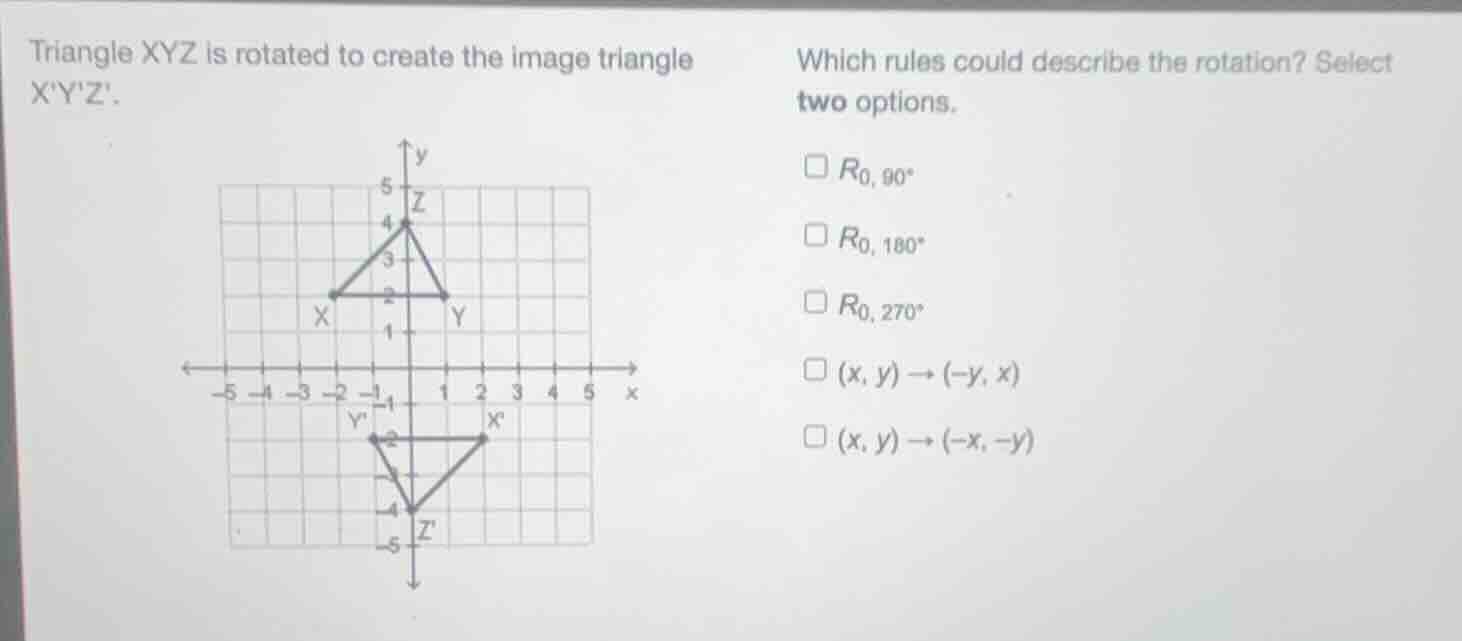
triangle xyz is rotated to create the image triangle xyz.
which rules could describe the rotation? select two options.
$r_{0, 90\degree}$
$r_{0, 180\degree}$
$r_{0, 270\degree}$
$(x, y) \to (-y, x)$
$(x, y) \to (-x, -y)$
Step1: Identify coordinates of original points
First, find coordinates of \( X, Y, Z \):
- \( X(-2, 2) \), \( Y(1, 2) \), \( Z(0, 4) \)
Coordinates of \( X', Y', Z' \):
- \( X'(2, -2) \), \( Y'(-1, -2) \), \( Z'(0, -4) \)
Step2: Analyze rotation rules
Rule 1: \( R_{0, 180^\circ} \) or \( (x, y) \to (-x, -y) \)
For a \( 180^\circ \) rotation about the origin, the rule is \( (x, y) \to (-x, -y) \).
- Test \( X(-2, 2) \): \( (-(-2), -2) = (2, -2) \) (matches \( X' \))
- Test \( Y(1, 2) \): \( (-1, -2) \) (matches \( Y' \))
- Test \( Z(0, 4) \): \( (0, -4) \) (matches \( Z' \))
Rule 2: Wait, no—wait, initial analysis: Wait, \( 90^\circ \) rotation? No, \( 90^\circ \) clockwise is \( (x,y)\to(y,-x) \), counterclockwise is \( (x,y)\to(-y,x) \). Wait, no—wait the \( 180^\circ \) and the \( (x,y)\to(-x,-y) \) are same as \( R_{0, 180^\circ} \). Wait, but also, wait the \( 180^\circ \) rotation and the \( (x,y)\to(-x,-y) \) are equivalent. Wait, but the options: \( R_{0, 180^\circ} \) and \( (x, y) \to (-x, -y) \) are correct? Wait no, wait the \( 180^\circ \) rotation is \( R_{0, 180^\circ} \), and the coordinate rule \( (x, y) \to (-x, -y) \). Wait, but also, wait the other option: Wait, no—wait the \( 90^\circ \) counterclockwise is \( (x,y)\to(-y,x) \), but let's check:
Wait, \( X(-2,2) \): \( (-2,2) \to (-2, -2) \)? No. Wait, no, \( 180^\circ \) is \( (-x,-y) \). Let's recheck:
For \( X(-2,2) \): \( -x = 2 \), \( -y = -2 \) → \( (2, -2) \) (matches \( X' \))
For \( Y(1,2) \): \( -x = -1 \), \( -y = -2 \) → \( (-1, -2) \) (matches \( Y' \))
For \( Z(0,4) \): \( -x = 0 \), \( -y = -4 \) → \( (0, -4) \) (matches \( Z' \))
So \( R_{0, 180^\circ} \) (which is \( (x,y)\to(-x,-y) \)) and \( (x, y) \to (-x, -y) \) are correct? Wait, no—the options are \( R_{0,90^\circ} \), \( R_{0,180^\circ} \), \( R_{0,270^\circ} \), \( (x,y)\to(-y,x) \), \( (x,y)\to(-x,-y) \).
Wait, \( R_{0, 180^\circ} \) is the rotation notation for \( 180^\circ \) about origin, and \( (x, y) \to (-x, -y) \) is the coordinate rule for \( 180^\circ \) rotation. So these two are equivalent. So the correct options are \( R_{0, 180^\circ} \) and \( (x, y) \to (-x, -y) \).
Wait, but let's confirm:
- \( R_{0, 180^\circ} \) means rotation 180 degrees about origin.
- The coordinate transformation for \( 180^\circ \) rotation is \( (x, y) \to (-x, -y) \).
Thus, the two correct options are \( R_{0, 180^\circ} \) and \( (x, y) \to (-x, -y) \).

Snap & solve any problem in the app
Get step-by-step solutions on Sovi AI
Photo-based solutions with guided steps
Explore more problems and detailed explanations
B. \( R_{0, 180^\circ} \)
E. \( (x, y) \to (-x, -y) \)
(Note: Assuming options are labeled as:
A. \( R_{0, 90^\circ} \)
B. \( R_{0, 180^\circ} \)
C. \( R_{0, 270^\circ} \)
D. \( (x, y) \to (-y, x) \)
E. \( (x, y) \to (-x, -y) \))