QUESTION IMAGE
Question
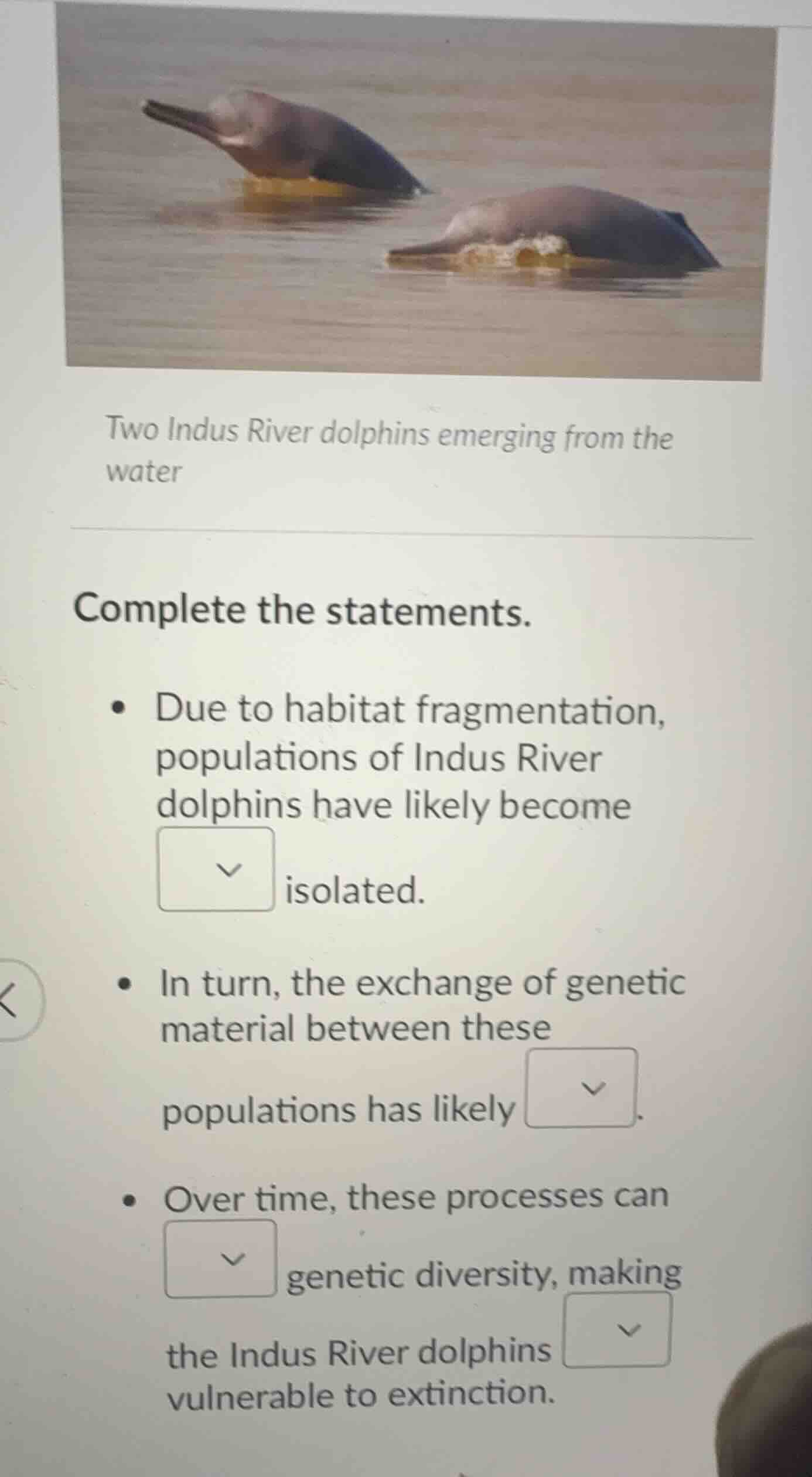
two indus river dolphins emerging from the water
complete the statements.
- due to habitat fragmentation, populations of indus river dolphins have likely become dropdown isolated.
- in turn, the exchange of genetic material between these populations has likely dropdown.
- over time, these processes can dropdown genetic diversity, making the indus river dolphins dropdown vulnerable to extinction.
Brief Explanations
- For the first blank: Habitat fragmentation splits habitats, so populations become "geographically" isolated (as the separation is due to physical space/habitat division).
- Second blank: If populations are geographically isolated, the exchange of genetic material (gene flow) between them will "decrease" because individuals can't move between populations to mate/exchange genes.
- Third blank: Less gene flow and isolated populations lead to "reduce" genetic diversity over time (since new genes aren't introduced, and genetic drift/founder effects in small populations can reduce variation).
- Fourth blank: Lower genetic diversity makes a population "more" vulnerable to extinction (because there's less variation to adapt to environmental changes, diseases, etc.).

Snap & solve any problem in the app
Get step-by-step solutions on Sovi AI
Photo-based solutions with guided steps
Explore more problems and detailed explanations
- Due to habitat fragmentation, populations of Indus River dolphins have likely become \boxed{geographically} isolated.
- In turn, the exchange of genetic material between these populations has likely \boxed{decreased}.
- Over time, these processes can \boxed{reduce} genetic diversity, making the Indus River dolphins \boxed{more} vulnerable to extinction.