QUESTION IMAGE
Question
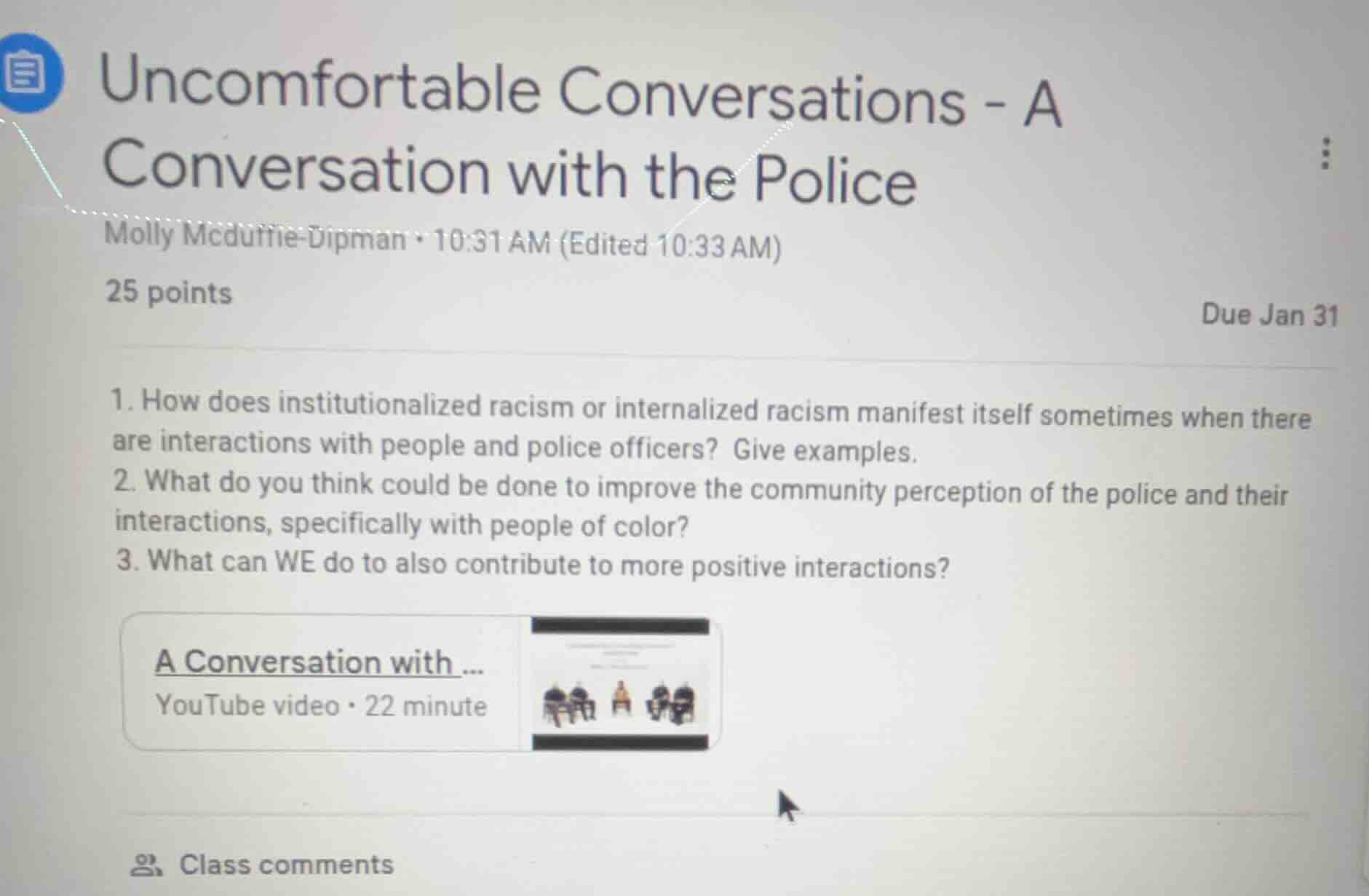
uncomfortable conversations - a conversation with the police
molly mcduffie - dipman · 10:31 am (edited 10:33 am)
25 points due jan 31
- how does institutionalized racism or internalized racism manifest itself sometimes when there are interactions with people and police officers? give examples.
- what do you think could be done to improve the community perception of the police and their interactions, specifically with people of color?
- what can we do to also contribute to more positive interactions?
a conversation with...
youtube video · 22 minute
Brief Explanations
- For institutionalized racism, this refers to systemic biases in policing policies or practices. Internalized racism is when marginalized groups absorb negative stereotypes about themselves.
- Improving community perception requires structural and relational changes to address bias and build trust.
- Individual and collective actions can foster mutual respect and accountability between the public and police.

Snap & solve any problem in the app
Get step-by-step solutions on Sovi AI
Photo-based solutions with guided steps
Explore more problems and detailed explanations
1.
- Institutionalized racism: It can manifest in racial profiling, where police officers stop, search, or question people of color at disproportionately higher rates than white people without reasonable suspicion. For example, data showing Black drivers are pulled over for "traffic violations" far more often than white drivers in the same area, even when controlling for driving behavior. It can also appear in sentencing disparities, where people of color receive harsher penalties for similar offenses handled by police and the criminal justice system.
- Internalized racism: In police interactions, a person of color may feel they have to overcomply with police orders (such as speaking in an overly deferential tone, avoiding any sudden movements even when not instructed) out of fear that any perceived misstep will be interpreted as aggression due to negative stereotypes they have internalized. They may also doubt their own right to question police actions, assuming the officer is in the right because of internalized beliefs about their own group's supposed "criminality".
2.
- Implement mandatory, ongoing anti-racism and cultural competency training for all police officers that includes scenario-based learning about interacting with diverse communities, and requires regular refreshers to maintain skills.
- Establish independent civilian oversight boards with the power to investigate complaints of police misconduct, with transparent processes and consequences for officers found to act with bias.
- Increase community policing initiatives, where officers are assigned to specific neighborhoods, attend local meetings, build personal relationships with residents, and work collaboratively on community safety projects rather than just responding to calls.
- Publish regular, disaggregated data on police stops, searches, use of force, and arrests by race to hold departments accountable for racial disparities.
3.
- Educate ourselves and others about systemic racism, policing history, and the experiences of people of color in interactions with law enforcement, through reading, listening to community members, and engaging with educational resources like the provided video.
- Participate in or organize community dialogues that include both police officers and residents of color to facilitate open, honest conversations about concerns and shared goals for safety.
- Advocate for policy changes at local, state, and federal levels that address racial bias in policing, such as defunding programs that over-militarize police and redirecting funds to community social services.
- When witnessing biased policing or unfair interactions, speak up safely (e.g., recording the incident if legal, reporting it to oversight bodies, or supporting the person affected) to hold officers accountable.
- Practice empathy and active listening when engaging with both police officers and people of color to understand different perspectives and build bridges between groups.