QUESTION IMAGE
Question
unit 3 evolution & classification ls. bio 9.1, 9.2, 9.3, 9.4, 10.1, 10.2
5
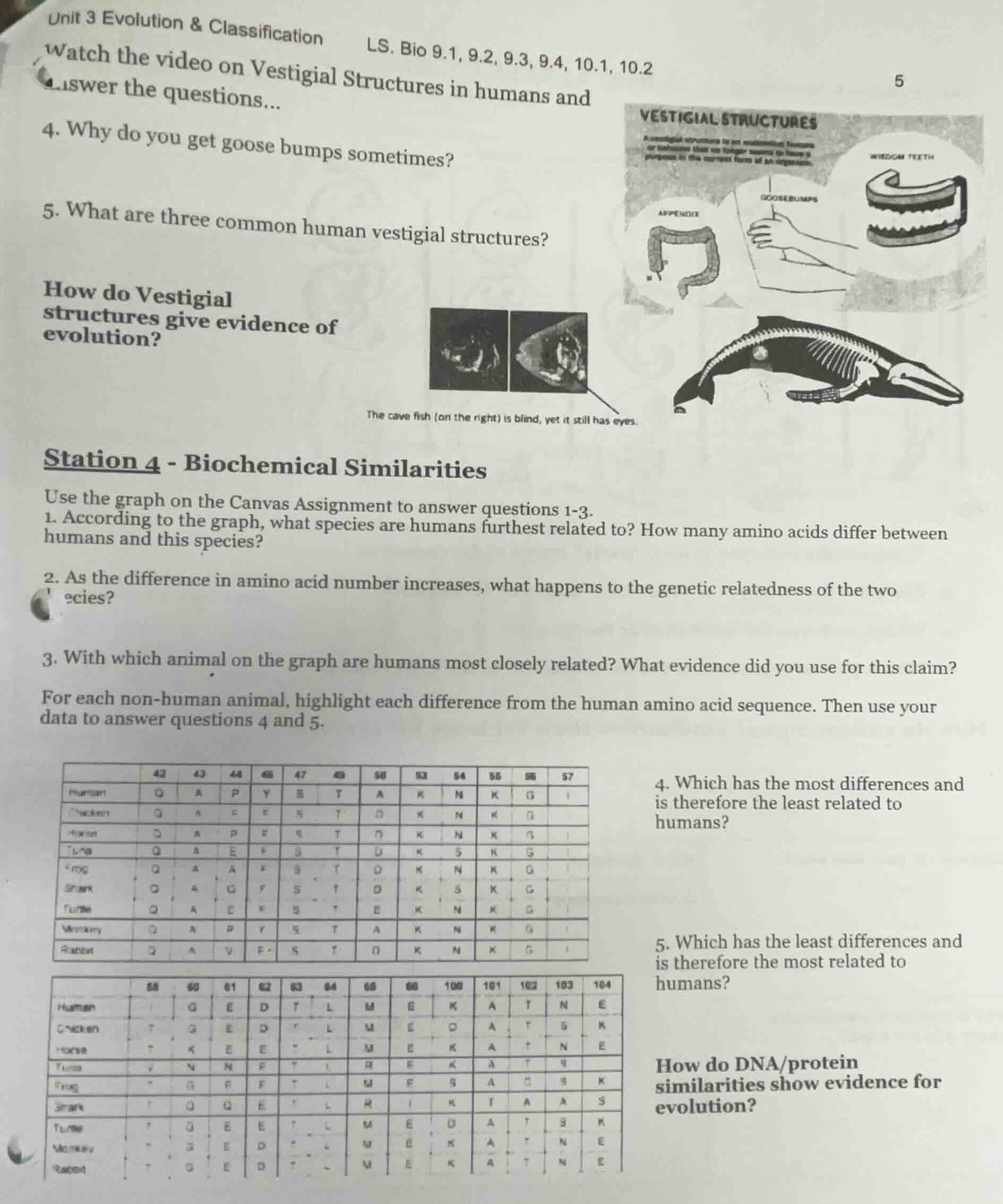
watch the video on vestigial structures in humans and
answer the questions...
- why do you get goose bumps sometimes?
- what are three common human vestigial structures?
how do vestigial
structures give evidence of
evolution?
the cave fish (on the right) is blind, yet it still has eyes.
vestigial structures
a vestigial structure is an anatomical feature
or behavior that no longer seems to have a
purpose in the current form of an organism.
appendix
goosebumps
wisdom teeth
station 4 - biochemical similarities
use the graph on the canvas assignment to answer questions 1-3.
- according to the graph, what species are humans furthest related to? how many amino acids differ between humans and this species?
- as the difference in amino acid number increases, what happens to the genetic relatedness of the two species?
- with which animal on the graph are humans most closely related? what evidence did you use for this claim?
for each non-human animal, highlight each difference from the human amino acid sequence. then use your data to answer questions 4 and 5.
- which has the most differences and is therefore the least related to humans?
- which has the least differences and is therefore the most related to humans?
how do dna/protein similarities show evidence for evolution?
Step1: Answer vestigial structure questions
Q4: Goose bumps trigger reason
Goose bumps are a leftover (vestigial) reflex from human ancestors who had thick fur. When cold or scared, the reflex would fluff up fur to trap heat or make the individual look larger to threats; in modern humans, it only creates bumps on the skin as we no longer have dense fur for this function.
Q5: Identify 3 vestigial structures
From the provided image, three common human vestigial structures are: the appendix, goose bumps (the associated reflex/structure), and wisdom teeth.
Evolution evidence from vestigial structures
Vestigial structures are remnants of traits that served a purpose in an organism's evolutionary ancestors but have lost most or all of their original function in the modern organism. Their presence shows that species have changed over time (evolved) from ancestors with different body plans and needs, as seen in blind cave fish retaining non-functional eyes (evidence they descended from sighted fish) and whales retaining small, non-functional hind limb bones (evidence they descended from land-dwelling mammals).
Step2: Answer biochemical similarity questions (using provided table)
Q1: Count amino acid differences (most distant)
Count differences between human and each species:
- Chicken: 8 differences
- Horse: 6 differences
- Tuna: 8 differences
- Frog: 7 differences
- Shark: 10 differences
- Turtle: 7 differences
- Monkey: 1 difference
- Rabbit: 6 differences
Shark has the most differences (10), so it is the furthest related to humans.
Q2: Relate differences to relatedness
As the number of differing amino acids increases, the genetic relatedness between the two species decreases. Amino acid sequences are coded by DNA; more differences mean more genetic mutations and divergence over time, so the species share a more distant common ancestor.
Q3: Identify closest related species
Monkey has only 1 amino acid difference from humans, so it is the most closely related. The evidence is the smallest number of amino acid differences in the compared sequence, indicating very similar genetic coding for this protein.
Q4: Least related species (most differences)
Shark has the most amino acid differences (10), so it is the least related to humans.
Q5: Most related species (least differences)
Monkey has the least amino acid differences (1), so it is the most related to humans.
Evolution evidence from DNA/protein similarities
DNA and protein (amino acid) similarities show that all species share a common ancestor. The fewer differences in amino acid/DNA sequences between two species, the more recently they diverged from a shared ancestor. This consistent pattern of similarity corresponds to evolutionary relationships, proving that species change and diversify over time from common origins.

Snap & solve any problem in the app
Get step-by-step solutions on Sovi AI
Photo-based solutions with guided steps
Explore more problems and detailed explanations
Vestigial Structures Section
- Goose bumps are a vestigial reflex from fur-covered human ancestors; they occur as a leftover response to cold or fear, even though humans no longer have dense fur to fluff for warmth or defense.
- Three common human vestigial structures are the appendix, wisdom teeth, and the reflex causing goose bumps.
How do vestigial structures give evidence of evolution?
Vestigial structures are remnants of traits that had a function in an organism's evolutionary ancestors but are non-functional or reduced in modern organisms. Their presence shows that species have evolved from ancestors with different traits and needs (e.g., blind cave fish have non-functional eyes, proving they descended from sighted fish; whales have tiny hind limb bones, proving they descended from land mammals).
Biochemical Similarities Section
- Humans are furthest related to sharks, with 10 differing amino acids.
- As the number of differing amino acids increases, genetic relatedness between the two species decreases.
- Humans are most closely related to monkeys; the evidence is that monkeys have only 1 amino acid difference from humans in the compared sequence.
- The shark has the most differences and is the least related to humans.
- The monkey has the least differences and is the most related to humans.
How do DNA/protein similarities show evidence for evolution?
Similarities in DNA and amino acid sequences indicate shared evolutionary ancestry. Fewer sequence differences mean two species diverged from a common ancestor more recently, while more differences mean a more distant common ancestor. This consistent pattern of similarity across species confirms that organisms evolve and diversify from shared origins over time.