QUESTION IMAGE
Question
(from unit 6, lesson 5.)
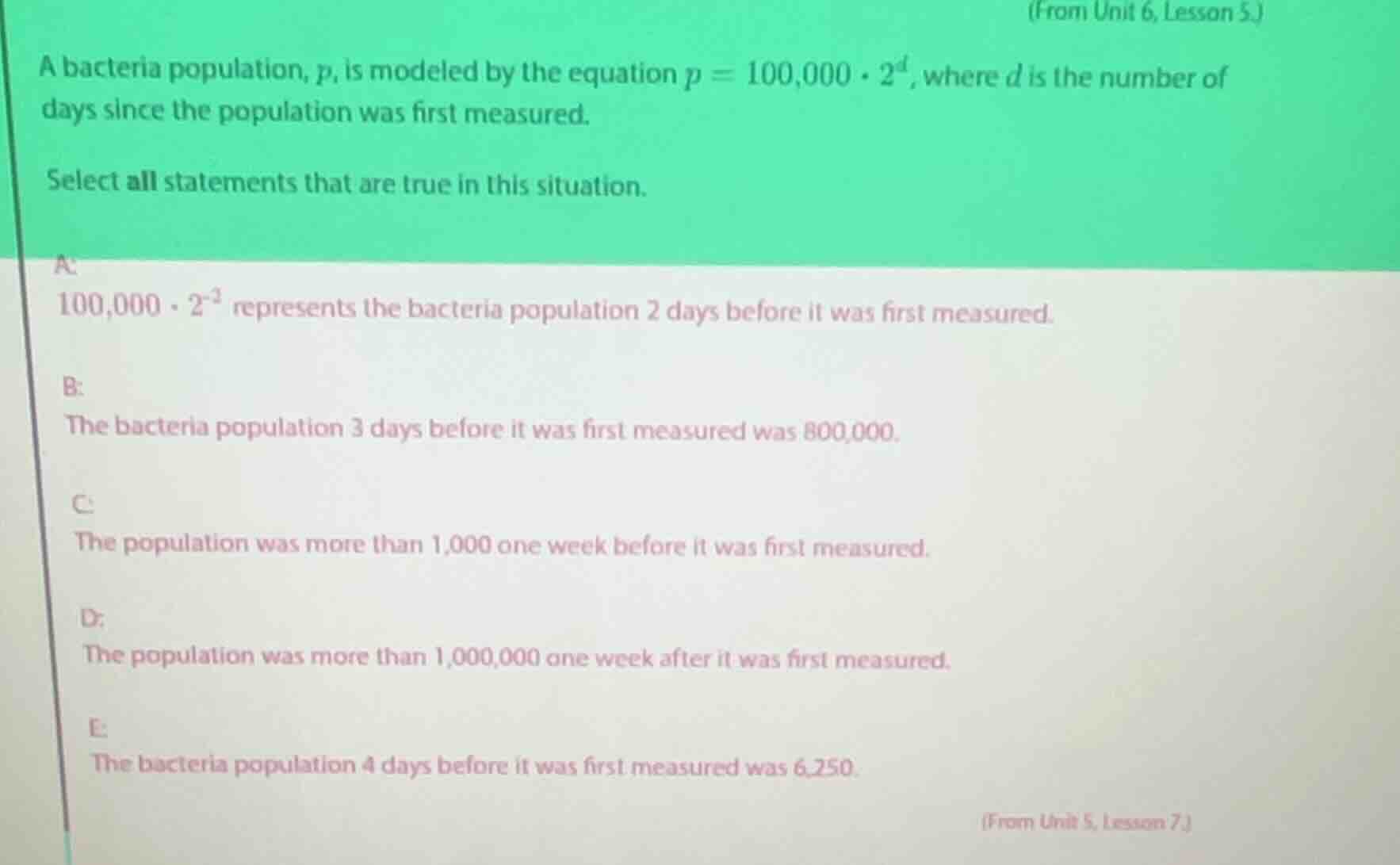
a bacteria population, p, is modeled by the equation $p = 100,000 \cdot 2^d$, where d is the number of days since the population was first measured.
select all statements that are true in this situation.
a:
$100,000 \cdot 2^{-2}$ represents the bacteria population 2 days before it was first measured.
b:
the bacteria population 3 days before it was first measured was 800,000.
c:
the population was more than 1,000 one week before it was first measured.
d:
the population was more than 1,000,000 one week after it was first measured.
e:
the bacteria population 4 days before it was first measured was 6,250.
(from unit 5, lesson 7.)
for each option:
Option A:
To check this, we know that "days before" means \( d=-2 \) (since \( d \) is days since first measured, so negative \( d \) is days before). Substitute \( d = - 2\) into the formula \( p=100000\cdot2^{d}\). We get \( p = 100000\cdot2^{-2}\). Using the rule \( a^{-n}=\frac{1}{a^{n}}\), \( 2^{-2}=\frac{1}{4}\), so \( p=100000\times\frac{1}{4} = 25000\). But the statement says it represents the population 2 days before. Wait, actually, when \( d=-2 \), it is 2 days before. Wait, maybe I miscalculated. Wait, \( 2^{-2}=\frac{1}{4}\), \( 100000\times\frac{1}{4}=25000 \). But the statement is just saying that \( 100000\cdot2^{-2} \) represents the population 2 days before. Since \( d = - 2\) corresponds to 2 days before, this expression is correct for 2 days before. So the statement about what the expression represents is true. Wait, but let's check the calculation again. Wait, the statement is " \( 100,000\cdot2^{-2} \) represents the bacteria population 2 days before it was first measured." Since \( d=-2 \) is 2 days before, substituting \( d = - 2\) gives the population 2 days before. So the representation is correct. So option A is true? Wait, maybe I made a mistake earlier. Let's re - evaluate.
Option B:
For 3 days before, \( d=-3 \). Substitute into \( p = 100000\cdot2^{d}\), we get \( p=100000\cdot2^{-3}\). \( 2^{-3}=\frac{1}{8}\), so \( p = 100000\times\frac{1}{8}=12500
eq800000\). So option B is false.
Option C:
One week before is \( d=-7 \) (since 1 week = 7 days). Substitute \( d=-7 \) into \( p = 100000\cdot2^{d}\), we get \( p=100000\cdot2^{-7}\). \( 2^{-7}=\frac{1}{128}\), so \( p=\frac{100000}{128}\approx781.25\), which is less than 1000. So option C is false.
Option D:
One week after is \( d = 7\). Substitute \( d = 7\) into \( p=100000\cdot2^{7}\). \( 2^{7}=128\), so \( p=100000\times128 = 12800000>1000000\). So option D is true.
Option E:
4 days before means \( d=-4 \). Substitute \( d=-4 \) into \( p = 100000\cdot2^{d}\), we get \( p=100000\cdot2^{-4}\). \( 2^{-4}=\frac{1}{16}\), so \( p=\frac{100000}{16}=6250\). So option E is true.
Wait, let's re - check Option A. The expression \( 100000\cdot2^{-2} \) when \( d=-2 \) (2 days before) gives \( p = 100000\times\frac{1}{4}=25000 \). The statement is just saying that the expression represents the population 2 days before. Since \( d=-2 \) is 2 days before, the expression is correctly representing the population 2 days before. So Option A is true? Wait, maybe I was confused earlier. Let's re - summarize:
- Option A: \( d=-2 \) (2 days before), so \( p = 100000\cdot2^{-2}\) represents the population 2 days before. True.
- Option B: 3 days before, \( d=-3 \), \( p=100000\cdot2^{-3}=12500
eq800000 \). False.
- Option C: 1 week before (\( d = - 7\)), \( p=100000\cdot2^{-7}\approx781.25<1000 \). False.
- Option D: 1 week after (\( d = 7\)), \( p=100000\cdot2^{7}=12800000>1000000 \). True.
- Option E: 4 days before (\( d=-4 \)), \( p=100000\cdot2^{-4}=6250 \). True.
Wait, but let's check Option A again. The statement is " \( 100,000\cdot2^{-3} \) represents the bacteria population 2 days before it was first measured." Wait, no, wait the option A is \( 100,000\cdot2^{-2} \) (I think I misread earlier). Wait, the original option A: " \( 100,000\cdot2^{-2} \) represents the bacteria population 2 days before it was first measured." Since \( d=-2 \) is 2 days before, substituting \( d=-2 \) into \( p = 100000\cdot2^{d}\) gives \( p = 100000\cdot2^{-2}\), so this expression does represent the population 2 days before. So Option A is tru…

Snap & solve any problem in the app
Get step-by-step solutions on Sovi AI
Photo-based solutions with guided steps
Explore more problems and detailed explanations
A. \( 100,000 \cdot 2^{-2} \) represents the bacteria population 2 days before it was first measured.
D. The population was more than 1,000,000 one week after it was first measured.
E. The bacteria population 4 days before it was first measured was 6,250.