QUESTION IMAGE
Question
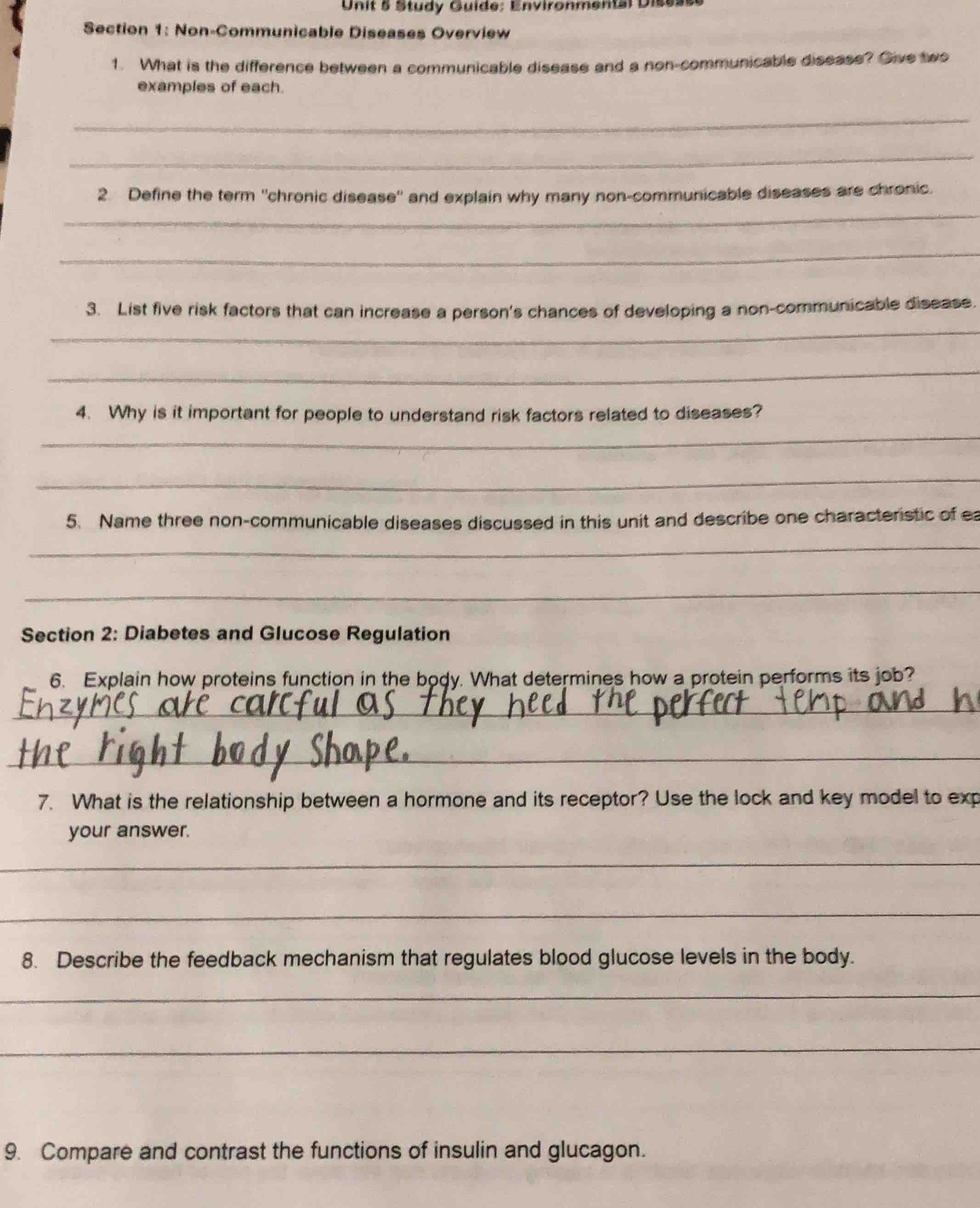
unit 5 study guide: environmental disease
section 1: non-communicable diseases overview
- what is the difference between a communicable disease and a non-communicable disease? give two examples of each.
- define the term \chronic disease\ and explain why many non-communicable diseases are chronic.
- list five risk factors that can increase a persons chances of developing a non-communicable disease.
- why is it important for people to understand risk factors related to diseases?
- name three non-communicable diseases discussed in this unit and describe one characteristic of ea
section 2: diabetes and glucose regulation
- explain how proteins function in the body. what determines how a protein performs its job?
enzymes are carcful as they need the perfect temp and h
the right body shape.
- what is the relationship between a hormone and its receptor? use the lock and key model to exp your answer.
- describe the feedback mechanism that regulates blood glucose levels in the body.
- compare and contrast the functions of insulin and glucagon.
Brief Explanations
- Question 1: Communicable diseases spread between people via pathogens; non-communicable diseases do not spread. Examples are provided for each.
- Question 2: Chronic diseases are long-lasting, often progressive. Most non-communicable diseases develop slowly and have no cure, so they persist.
- Question 3: Common modifiable and non-modifiable risk factors for non-communicable diseases are listed.
- Question 4: Understanding risk factors lets people take preventive actions to lower disease risk.
- Question 5: Three common non-communicable diseases and a key trait of each are noted.
- Question 6: Proteins have diverse bodily roles; their 3D structure determines function.
- Question 7: The lock-and-key model explains hormone-receptor specificity.
- Question 8: Blood glucose is regulated by a negative feedback loop using insulin and glucagon.
- Question 9: Insulin lowers blood glucose, while glucagon raises it; they work in opposition to maintain balance.

Snap & solve any problem in the app
Get step-by-step solutions on Sovi AI
Photo-based solutions with guided steps
Explore more problems and detailed explanations
- Difference & Examples:
- Communicable diseases: Caused by pathogens (germs) and spread between people. Examples: Influenza (flu), COVID-19.
- Non-communicable diseases: Not caused by transmissible pathogens, do not spread between people. Examples: Type 2 diabetes, coronary heart disease.
- Chronic Disease Definition & Rationale:
- A chronic disease is a long-lasting condition (typically lasting 1+ years) that often requires ongoing medical management.
- Many non-communicable diseases are chronic because they develop gradually from long-term exposure to risk factors (like poor diet or inactivity), have no cure, and cause permanent changes to body systems that require lifelong management.
- Risk Factors for Non-Communicable Diseases:
- Unhealthy diet (high in sugar, salt, saturated fat)
- Physical inactivity
- Tobacco use
- Harmful alcohol consumption
- High blood pressure
- Importance of Understanding Risk Factors:
- It allows individuals to make intentional lifestyle changes (e.g., quitting smoking, improving diet) to reduce their risk of developing non-communicable diseases. It also helps public health officials create targeted prevention programs.
- Non-Communicable Diseases & Characteristics:
- Type 2 diabetes: Characterized by insulin resistance, leading to elevated blood glucose levels.
- Lung cancer: Often linked to long-term tobacco use, causes uncontrolled growth of abnormal lung cells.
- Hypertension (high blood pressure): Typically has no obvious symptoms, but damages blood vessels over time, increasing heart disease risk.
- Protein Function & Determinant:
- Proteins perform many roles: acting as enzymes (speed up chemical reactions), structural components (e.g., collagen in skin), transport molecules (e.g., hemoglobin carrying oxygen), and hormones (e.g., insulin).
- A protein's specific 3-dimensional shape (primary, secondary, tertiary, quaternary structure) determines its function; the shape allows it to bind to specific molecules to carry out its role.
- Hormone-Receptor Relationship (Lock-and-Key Model):
- A hormone acts as the "key," and its receptor acts as the "lock." The hormone has a unique 3D shape that fits perfectly into the shape of its specific receptor, like a key fits a lock. Only the correct hormone (key) can bind to its matching receptor (lock) to trigger a cellular response; other hormones cannot bind to the receptor, ensuring targeted signaling.
- Blood Glucose Feedback Mechanism:
- This is a negative feedback loop:
- When blood glucose rises (e.g., after eating), the pancreas releases insulin. Insulin signals cells (muscle, liver, fat cells) to absorb glucose, lowering blood glucose levels.
- When blood glucose drops (e.g., after fasting), the pancreas releases glucagon. Glucagon signals the liver to break down stored glycogen into glucose, releasing it into the bloodstream to raise blood glucose levels.
- Once blood glucose returns to normal levels, the pancreas stops releasing the respective hormone, maintaining homeostasis.
- Insulin vs. Glucagon:
- Similarity: Both are hormones produced by the pancreas that regulate blood glucose levels.
- Differences:
- Insulin: Released when blood glucose is high; lowers blood glucose by promoting glucose uptake and storage (as glycogen in the liver/muscles).
- Glucagon: Released when blood glucose is low; raises blood glucose by triggering glycogen breakdown in the liver and glucose release into the blood.