QUESTION IMAGE
Question
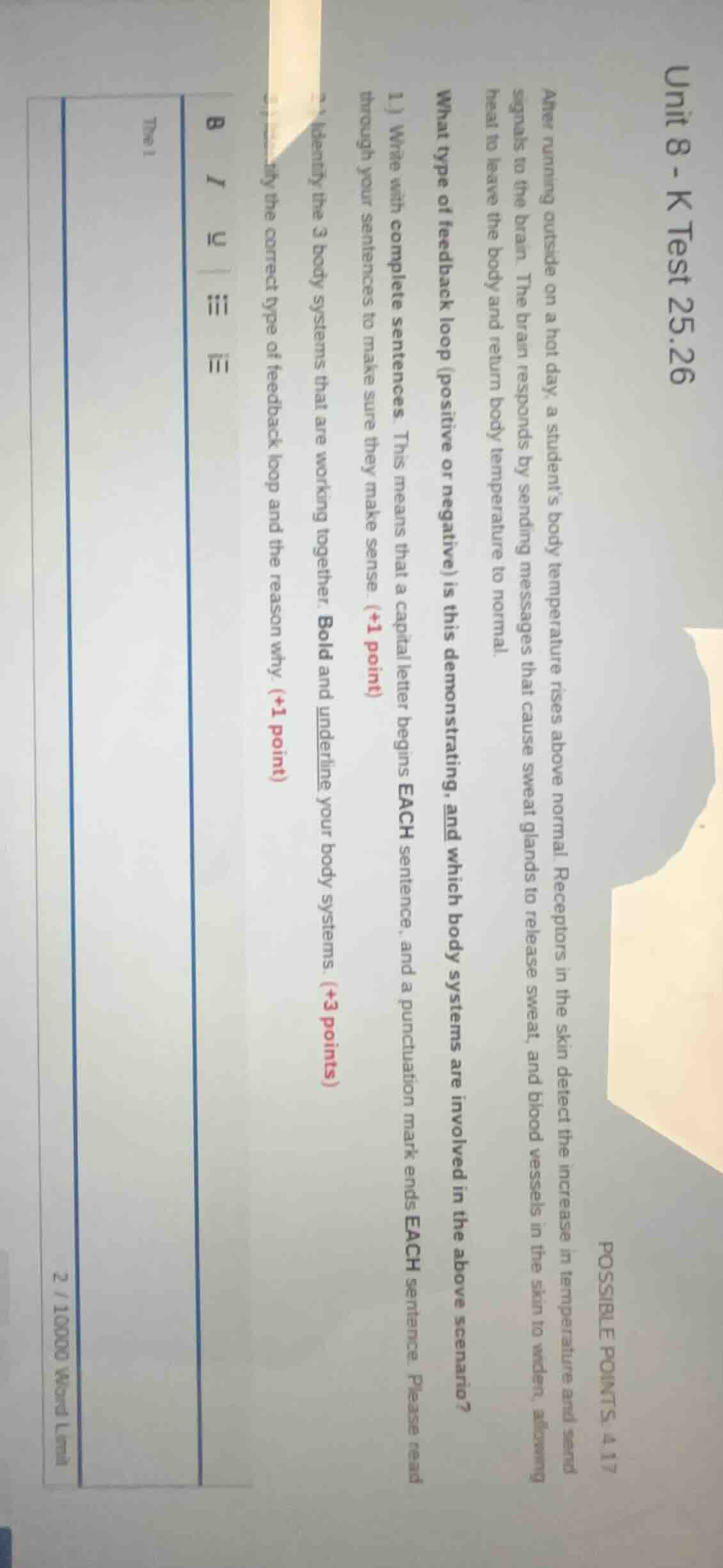
unit 8 - k test 25.26
possible points. 4.17
after running outside on a hot day, a students body temperature rises above normal. receptors in the skin detect the increase in temperature and send signals to the brain. the brain responds by sending messages that cause sweat glands to release sweat, and blood vessels in the skin to widen, allowing heat to leave the body and return body temperature to normal.
what type of feedback loop is this demonstrating, and which body systems are involved in the above scenario?
1.) write with complete sentences. this means that a capital letter begins each sentence, and a punctuation mark ends each sentence. please read through your sentences to make sure they make sense. +1 point
2.) identify the 3 body systems that are working together. bold and underline your body systems. +3 points
3.) identify the correct type of feedback loop and the reason why. +1 point
- This scenario shows a negative feedback loop because the body acts to reverse the initial change (elevated temperature) and return to a normal set point. The involved body systems are: the nervous system (detects signals, coordinates response), the integumentary system (skin receptors, sweat glands, blood vessels), and the circulatory system (blood vessels that widen to release heat).
- The feedback loop is negative because it counteracts the deviation from normal body temperature, maintaining homeostasis.

Snap & solve any problem in the app
Get step-by-step solutions on Sovi AI
Photo-based solutions with guided steps
Explore more problems and detailed explanations
- This is a negative feedback loop. The three body systems working together are:
- Nervous System: Receives temperature signals and sends response commands.
- Integumentary System: Contains skin receptors, sweat glands, and blood vessels that release heat.
- Circulatory System: Uses widened blood vessels to carry heat to the skin for release.
- This is a negative feedback loop. It works to reverse the elevated body temperature and return the body to its normal, stable temperature set point, which is the defining feature of negative feedback for homeostasis.