QUESTION IMAGE
Question
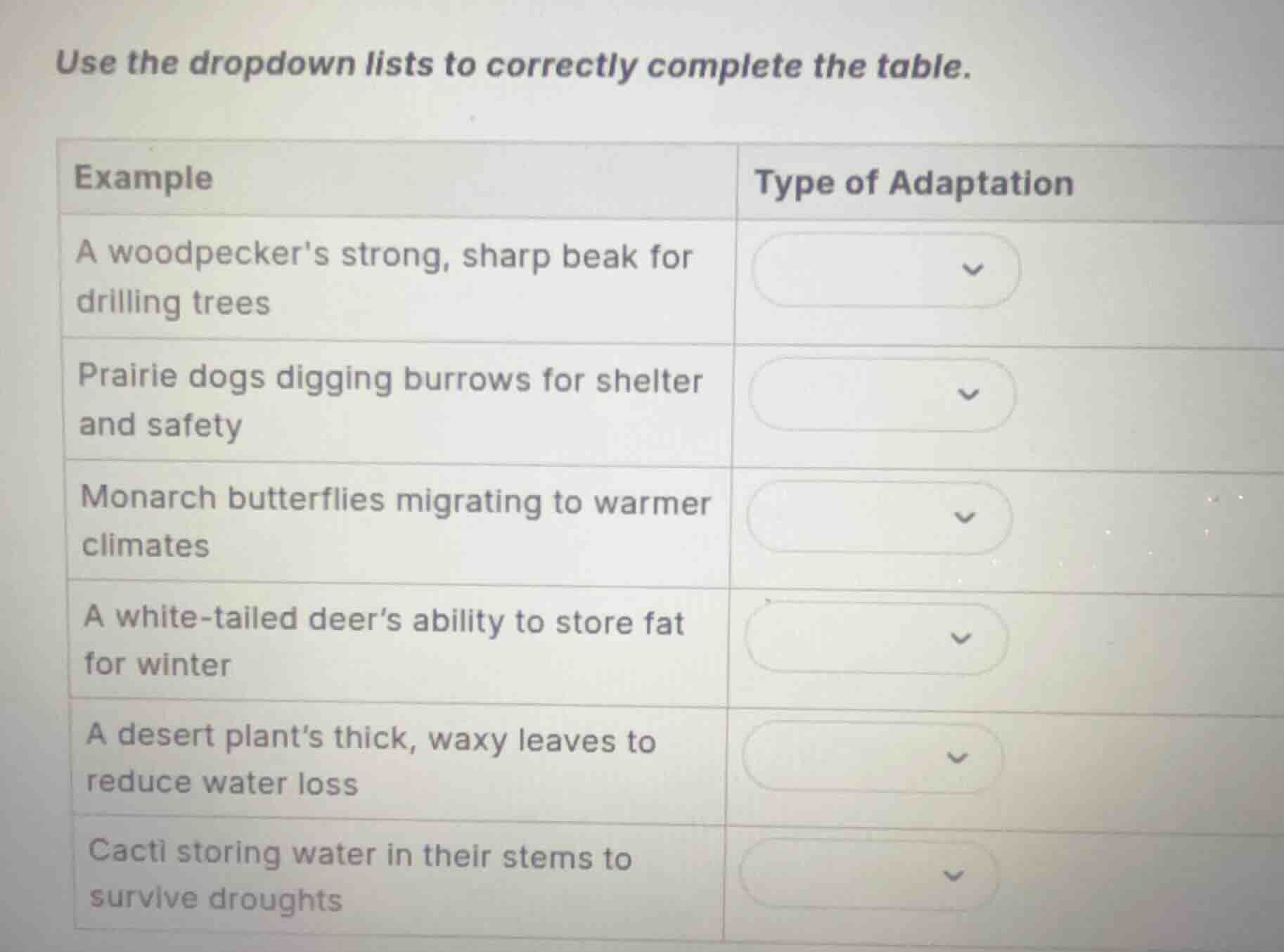
use the dropdown lists to correctly complete the table.
example | type of adaptation
a woodpeckers strong, sharp beak for drilling trees |
prairie dogs digging burrows for shelter and safety |
monarch butterflies migrating to warmer climates |
a white - tailed deer’s ability to store fat for winter |
a desert plant’s thick, waxy leaves to reduce water loss |
cacti storing water in their stems to survive droughts |
To solve this, we identify the type of adaptation (structural, behavioral, or physiological) for each example:
1. Woodpecker’s beak
A beak is a physical feature. Type: Structural Adaptation (body part for function).
2. Prairie dogs digging burrows
Digging is an action (behavior). Type: Behavioral Adaptation (action for survival).
3. Monarch butterflies migrating
Migrating is an action (behavior). Type: Behavioral Adaptation (seasonal movement).
4. Deer storing fat
Storing fat is a bodily process (physiology). Type: Physiological Adaptation (internal function for survival).
5. Desert plant’s waxy leaves
Leaves are a physical feature. Type: Structural Adaptation (body part to reduce water loss).
6. Cacti storing water
Storing water is a bodily process (physiology). Type: Physiological Adaptation (internal function to retain water).
| Example | Type of Adaptation |
|---|---|
| Prairie dogs digging burrows for shelter and safety | Behavioral Adaptation |
| Monarch butterflies migrating to warmer climates | Behavioral Adaptation |
| A white - tailed deer’s ability to store fat for winter | Physiological Adaptation |
| A desert plant’s thick, waxy leaves to reduce water loss | Structural Adaptation |
| Cacti storing water in their stems to survive droughts | Physiological Adaptation |

Snap & solve any problem in the app
Get step-by-step solutions on Sovi AI
Photo-based solutions with guided steps
Explore more problems and detailed explanations
To solve this, we identify the type of adaptation (structural, behavioral, or physiological) for each example:
1. Woodpecker’s beak
A beak is a physical feature. Type: Structural Adaptation (body part for function).
2. Prairie dogs digging burrows
Digging is an action (behavior). Type: Behavioral Adaptation (action for survival).
3. Monarch butterflies migrating
Migrating is an action (behavior). Type: Behavioral Adaptation (seasonal movement).
4. Deer storing fat
Storing fat is a bodily process (physiology). Type: Physiological Adaptation (internal function for survival).
5. Desert plant’s waxy leaves
Leaves are a physical feature. Type: Structural Adaptation (body part to reduce water loss).
6. Cacti storing water
Storing water is a bodily process (physiology). Type: Physiological Adaptation (internal function to retain water).
| Example | Type of Adaptation |
|---|---|
| Prairie dogs digging burrows for shelter and safety | Behavioral Adaptation |
| Monarch butterflies migrating to warmer climates | Behavioral Adaptation |
| A white - tailed deer’s ability to store fat for winter | Physiological Adaptation |
| A desert plant’s thick, waxy leaves to reduce water loss | Structural Adaptation |
| Cacti storing water in their stems to survive droughts | Physiological Adaptation |