QUESTION IMAGE
Question
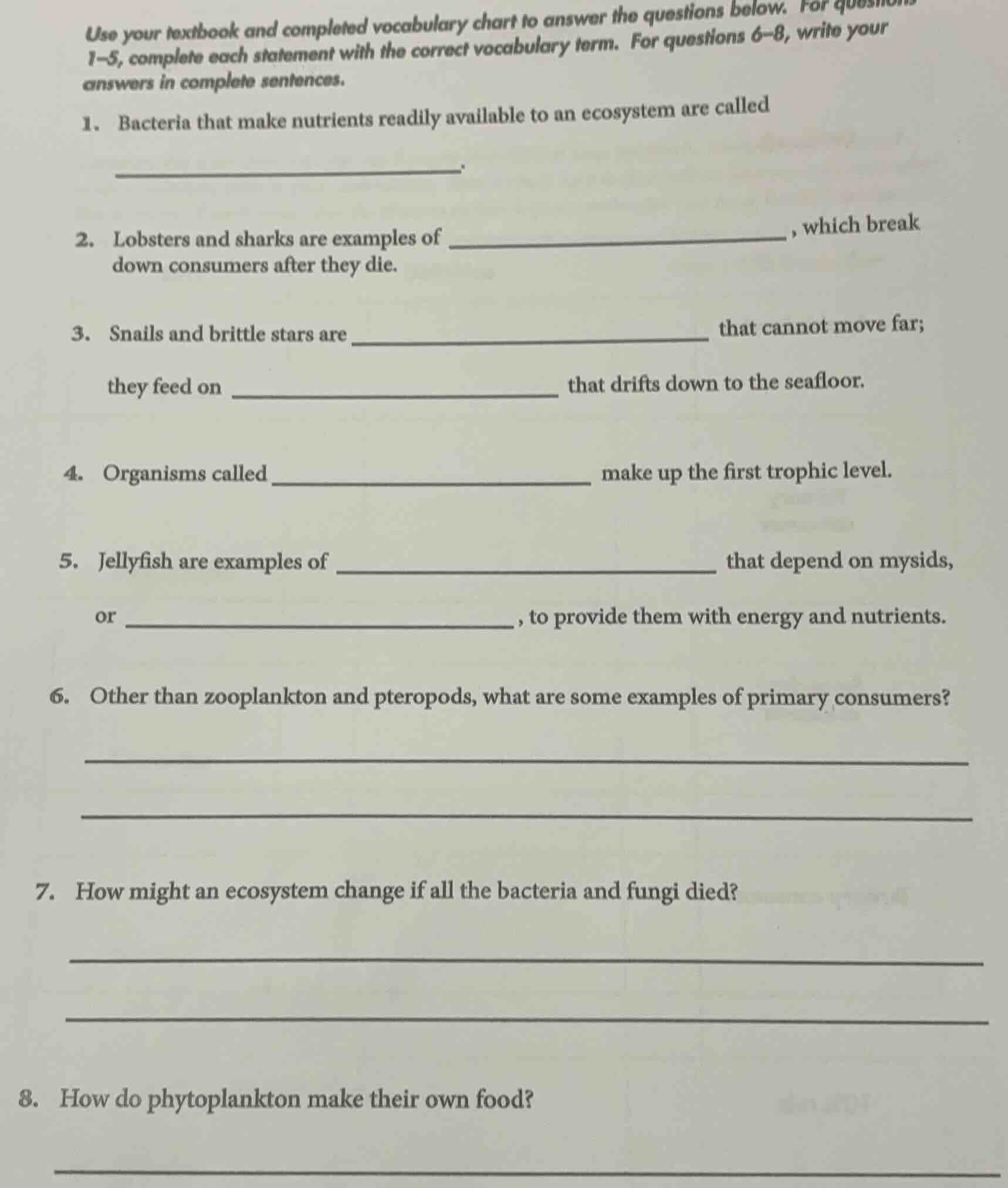
use your textbook and completed vocabulary chart to answer the questions below. for questions 1-5, complete each statement with the correct vocabulary term. for questions 6-8, write your answers in complete sentences.
- bacteria that make nutrients readily available to an ecosystem are called _______________.
- lobsters and sharks are examples of _______________, which break down consumers after they die.
- snails and brittle stars are _____________ that cannot move far; they feed on _____________ that drifts down to the seafloor.
- organisms called _______________ make up the first trophic level.
- jellyfish are examples of _____________ that depend on mysids, or _____________, to provide them with energy and nutrients.
- other than zooplankton and pteropods, what are some examples of primary consumers?
- how might an ecosystem change if all the bacteria and fungi died?
- how do phytoplankton make their own food?
Brief Explanations
- Identified key ecological roles for fill-in-the-blank terms based on marine ecosystem definitions.
- Provided accurate examples of primary consumers in marine environments.
- Explained the critical nutrient cycling role of decomposers (bacteria/fungi) and ecosystem impacts of their loss.
- Described the core food-making process of phytoplankton.

Snap & solve any problem in the app
Get step-by-step solutions on Sovi AI
Photo-based solutions with guided steps
Explore more problems and detailed explanations
- decomposers
- scavengers
- deposit feeders; marine snow
- producers (or primary producers)
- secondary consumers; primary consumers
- Some other examples of primary consumers include sea urchins, zooplankton (other types), and small herbivorous fish like damselfish that feed directly on algae or phytoplankton.
- If all bacteria and fungi died, dead organic matter and waste would not be broken down, so essential nutrients like nitrogen and phosphorus would remain trapped in dead organisms instead of being recycled back into the ecosystem. This would lead to a shortage of nutrients for producers, causing their populations to decline, which would then reduce food availability for all higher trophic levels, ultimately collapsing the ecosystem's food web.
- Phytoplankton make their own food through the process of photosynthesis. They use chlorophyll and other light-harvesting pigments to capture energy from sunlight, then convert carbon dioxide and water into glucose (chemical energy) and oxygen, using nutrients like nitrogen and phosphorus from the water to support this process.