QUESTION IMAGE
Question
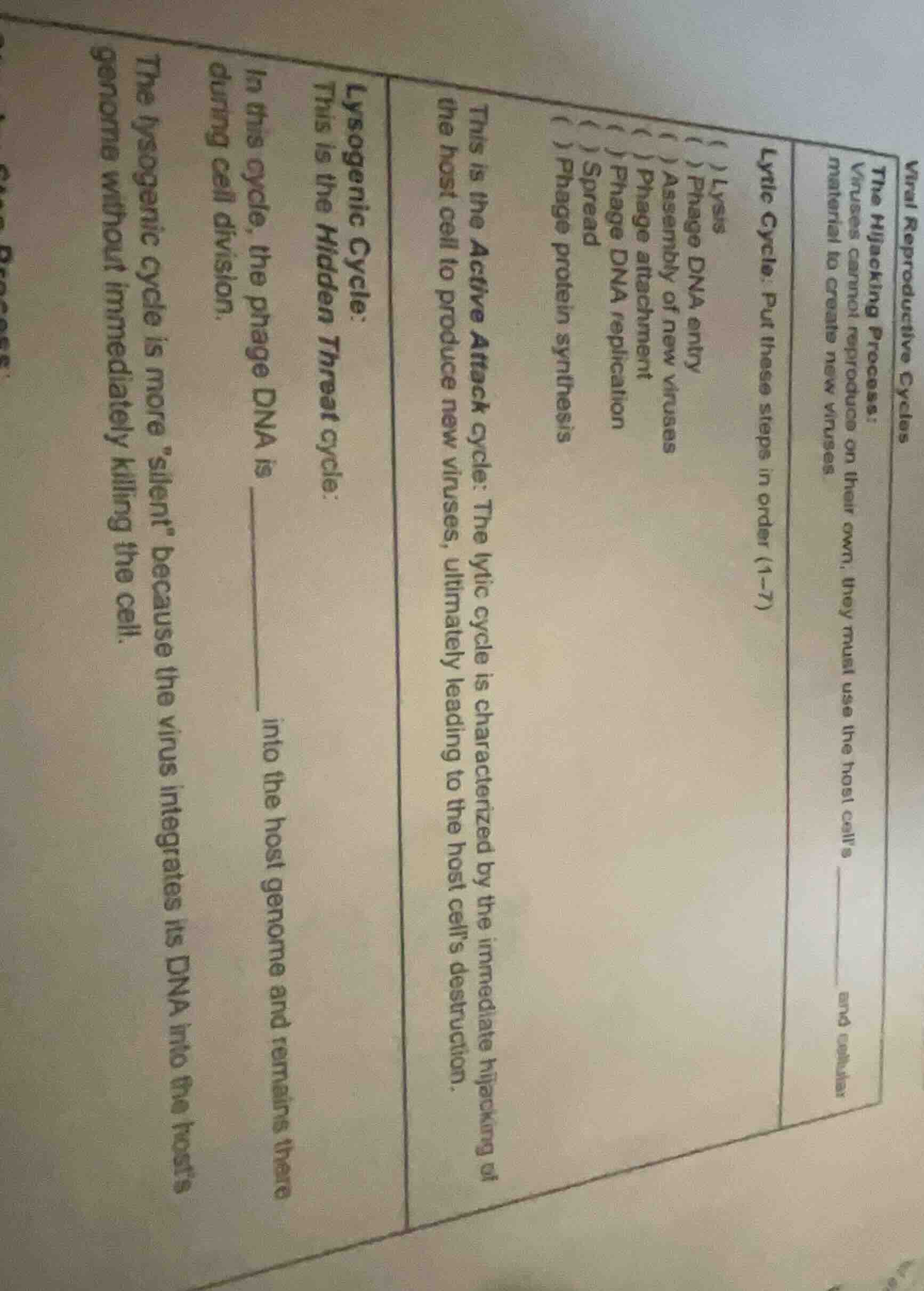
viral reproductive cycles
the hijacking process:
viruses cannot reproduce on their own; they must use the host cells ______ and cellular material to create new viruses.
lytic cycle: put these steps in order (1-7)
( ) lysis
( ) phage dna entry
( ) assembly of new viruses
( ) phage attachment
( ) phage dna replication
( ) spread
( ) phage protein synthesis
this is the active attack cycle: the lytic cycle is characterized by the immediate hijacking of the host cell to produce new viruses, ultimately leading to the host cells destruction.
lysogenic cycle:
this is the hidden threat cycle:
in this cycle, the phage dna is ______ into the host genome and remains there during cell division.
the lysogenic cycle is more \silent\ because the virus integrates its dna into the hosts genome without immediately killing the cell.
- For the hijacking process: Viruses rely on the host cell's genetic material (nucleic acids) to replicate.
- For the lytic cycle order: The cycle starts with the phage attaching to the host, inserting its DNA, replicating its DNA, making viral proteins, assembling new viruses, breaking open the host cell (lysis), and then spreading the new phages.
- For the lysogenic cycle: Phage DNA integrates into the host genome and is passed on during cell division.

Snap & solve any problem in the app
Get step-by-step solutions on Sovi AI
Photo-based solutions with guided steps
Explore more problems and detailed explanations
The Hijacking Process:
Viruses cannot reproduce on their own; they must use the host cell's genetic (nucleic acid) and cellular material to create new viruses.
Lytic Cycle (Ordered 1-7):
- (1) Phage attachment
- (2) Phage DNA entry
- (3) Phage DNA replication
- (4) Phage protein synthesis
- (5) Assembly of new viruses
- (6) Lysis
- (7) Spread
Lysogenic Cycle:
In this cycle, the phage DNA is integrated into the host genome and remains there during cell division.