QUESTION IMAGE
Question
vocabulary in context
read the passage
sacagawea’s great adventure
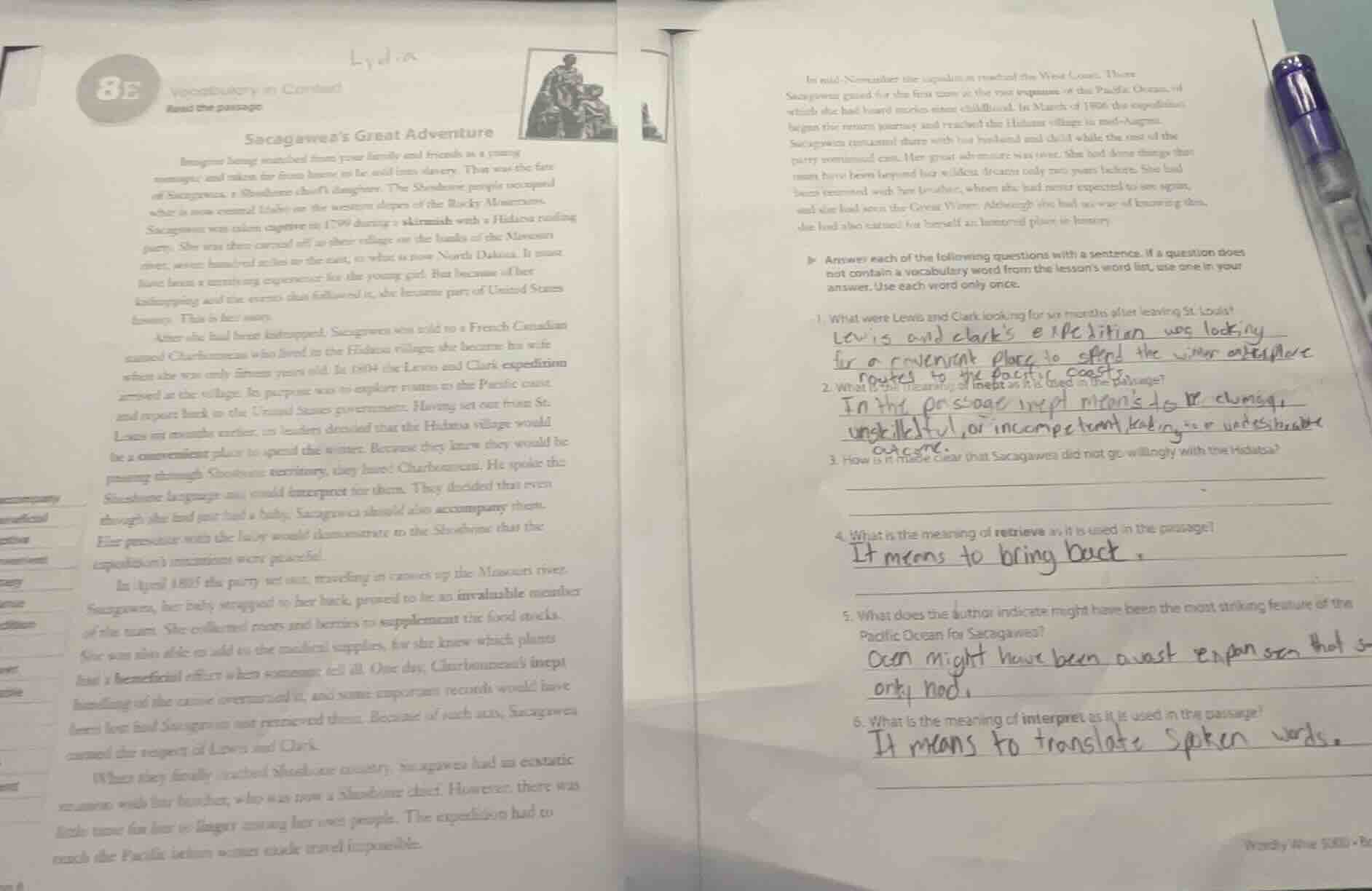
imagine being snatched from your family and friends as a young teenager, and taken far from home to be sold into slavery. that was the fate of sacagawea, a shoshone chief’s daughter. the shoshone people occupied what is now central idaho on the western slopes of the rocky mountains. sacagawea was taken captive in 1790 during a skirmish with a hidatsa raiding party. she was then carried off to their village on the banks of the missouri river, seven hundred miles to the east, to what is now north dakota. it must have been a terrifying experience for the young girl. but because of her kidnapping and the events that followed it, she became part of united states history. this is her story.
after she had been kidnapped, sacagawea was sold to a french canadian named charbonneau who lived in the hidatsa village; she became his wife when she was only fifteen years old. in 1804 the lewis and clark expedition arrived at the village. its purpose was to explore routes to the pacific coast and report back to the united states government. having set out from st. louis six months earlier, its leaders decided that the hidatsa village would be a convenient place to spend the winter. because they knew they would be passing through shoshone territory, they hired charbonneau. he spoke the shoshone language and could interpret for them. they decided that even though she had just had a baby, sacagawea should also accompany them. her presence with the baby would demonstrate to the shoshone that the expedition’s intentions were peaceful.
in april 1805 the party set out, traveling in canoes up the missouri river. sacagawea, her baby strapped to her back, proved to be an invaluable member of the team. she collected roots and berries to supplement the food stocks. she was also able to add to the medical supplies, for she knew which plants had a beneficial effect when someone fell ill. one day, charbonneau’s inept handling of the canoe overturned it, and some important records would have been lost had sacagawea not retrieved them. because of such acts, sacagawea earned the respect of lewis and clark.
when they finally reached shoshone country, sacagawea had an ecstatic reunion with her brother, who was now a shoshone chief. however, there was little time for her to linger among her own people. the expedition had to reach the pacific before winter made travel impossible.
in mid - november the expedition reached the west coast. there sacagawea gazed at the sea for the first time in the vast expanse of the pacific ocean, of which she had heard stories since childhood. in march of 1806 the expedition began its return journey and reached the hidatsa village in mid - august. sacagawea remained there with her husband and child while the rest of the party continued east. her great adventure was over. she had done things that men had been beyond her wildest dreams only two years before. she had been reunited with her brother, whom she had never expected to see again, and she had seen the great water. although she had no way of knowing this, she had also earned for herself an honored place in history.
answer each of the following questions with a sentence. if a question does not contain a vocabulary word from the lesson’s word list, use one in your answer. use each word only once.
- what were lewis and clark looking for six months after leaving st. louis?
- what is the meaning of inept as it is used in the passage?
- how is it made clear that sacagawea did not go willingly with the hidatsa?
- what is the meaning of retrieve as it is used in the passage?
- what does the author indicate might have been the most striking feature of the pacific ocean for sacagawea?
- what is the meaning of interpret as it is used in the passage?
- The passage states the Lewis and Clark expedition's purpose was to explore routes to the Pacific coast and report back.
- The passage notes Charbonneau's "inept handling" of a canoe caused it to overturn, so the word means unskilled/incompetent here.
- The text says Sacagawea was taken captive in a 1799 skirmish with the Hidatsa, showing she did not go willingly.
- The passage says Sacagawea "retrieved" important records from an overturned canoe, so the word means to get back/bring back.
- The passage mentions Sacagawea had heard stories of the Pacific Ocean since childhood, so its vastness was likely the most striking feature.
- The passage states Charbonneau spoke Shoshone and could "interpret" for the expedition, so the word means translate/explain speech between languages.

Snap & solve any problem in the app
Get step-by-step solutions on Sovi AI
Photo-based solutions with guided steps
Explore more problems and detailed explanations
- Lewis and Clark were looking for routes to the Pacific coast to report back to the U.S. government.
- In the passage, inept means lacking skill or being incompetent.
- It is made clear that Sacagawea did not go willingly with the Hidatsa because she was taken captive in a 1799 skirmish.
- In the passage, retrieve means to recover or bring back something lost or misplaced.
- The author indicates the vastness of the Pacific Ocean (a feature she had only heard about in childhood) was likely its most striking feature for Sacagawea.
- In the passage, interpret means to translate and relay meaning between spoken languages.