QUESTION IMAGE
Question
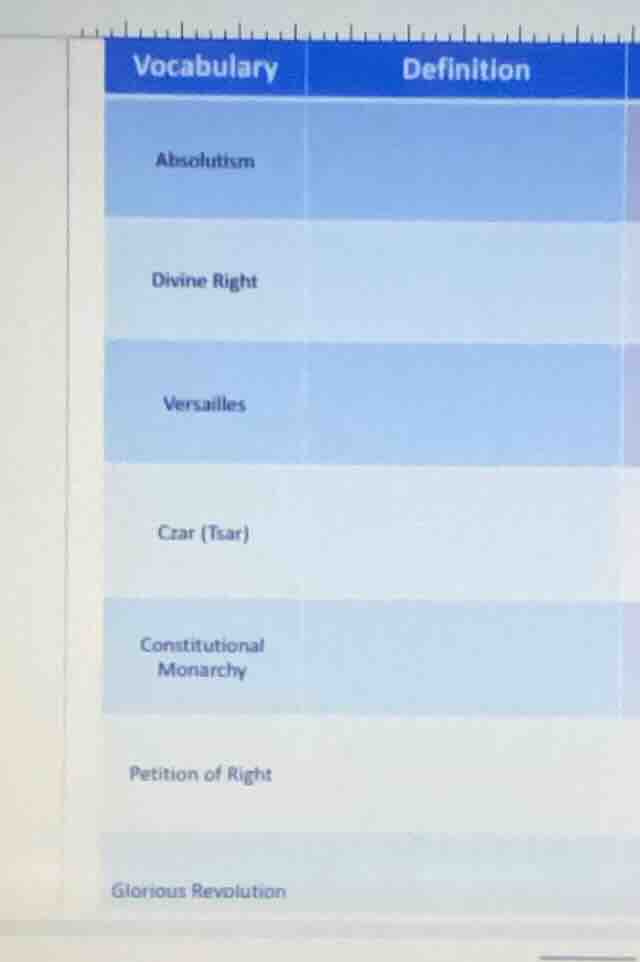
vocabulary | definition
absolutism |
divine right |
versailles |
czar (tsar) |
constitutional monarchy |
petition of right |
glorious revolution |
Brief Explanations
- Absolutism: A system where a ruler has unlimited, centralized authority, with no checks from other institutions.
- Divine Right: The belief that a monarch's right to rule comes directly from God, not the people, making their authority unchallengeable.
- Versailles: A lavish royal palace in France, built by Louis XIV, used to centralize power and control the French nobility.
- Czar (Tsar): The title for the absolute monarch of Russia, derived from the Latin "Caesar," signifying imperial authority.
- Constitutional Monarchy: A system where a monarch's power is limited by a written or unwritten constitution, with governance often led by an elected legislature.
- Petition of Right (1628): A British document that restricted King Charles I's power, forbidding arbitrary imprisonment, forced loans, and martial law in peacetime.
- Glorious Revolution (1688): A bloodless British revolution that replaced James II with William and Mary, establishing parliamentary supremacy and confirming constitutional monarchy.

Snap & solve any problem in the app
Get step-by-step solutions on Sovi AI
Photo-based solutions with guided steps
Explore more problems and detailed explanations
| Vocabulary | Definition |
|---|---|
| Divine Right | The idea that monarchs derive their right to rule directly from God, making their authority absolute and unaccountable to the public. |
| Versailles | A grand French royal palace built by Louis XIV; used to centralize power and assert the king's dominance over the nobility. |
| Czar (Tsar) | The title for the absolute monarch of Russia, modeled after the Roman "Caesar," representing supreme imperial power. |
| Constitutional Monarchy | A system where a monarch's power is constrained by a constitution, with most governing authority held by an elected legislative body. |
| Petition of Right | A 1628 British legal document limiting King Charles I's power, banning arbitrary imprisonment, forced taxes, and peacetime martial law. |
| Glorious Revolution | A 1688 bloodless British revolution that overthrew James II, installed William and Mary, and established parliamentary supremacy, solidifying constitutional monarchy in Britain. |