QUESTION IMAGE
Question
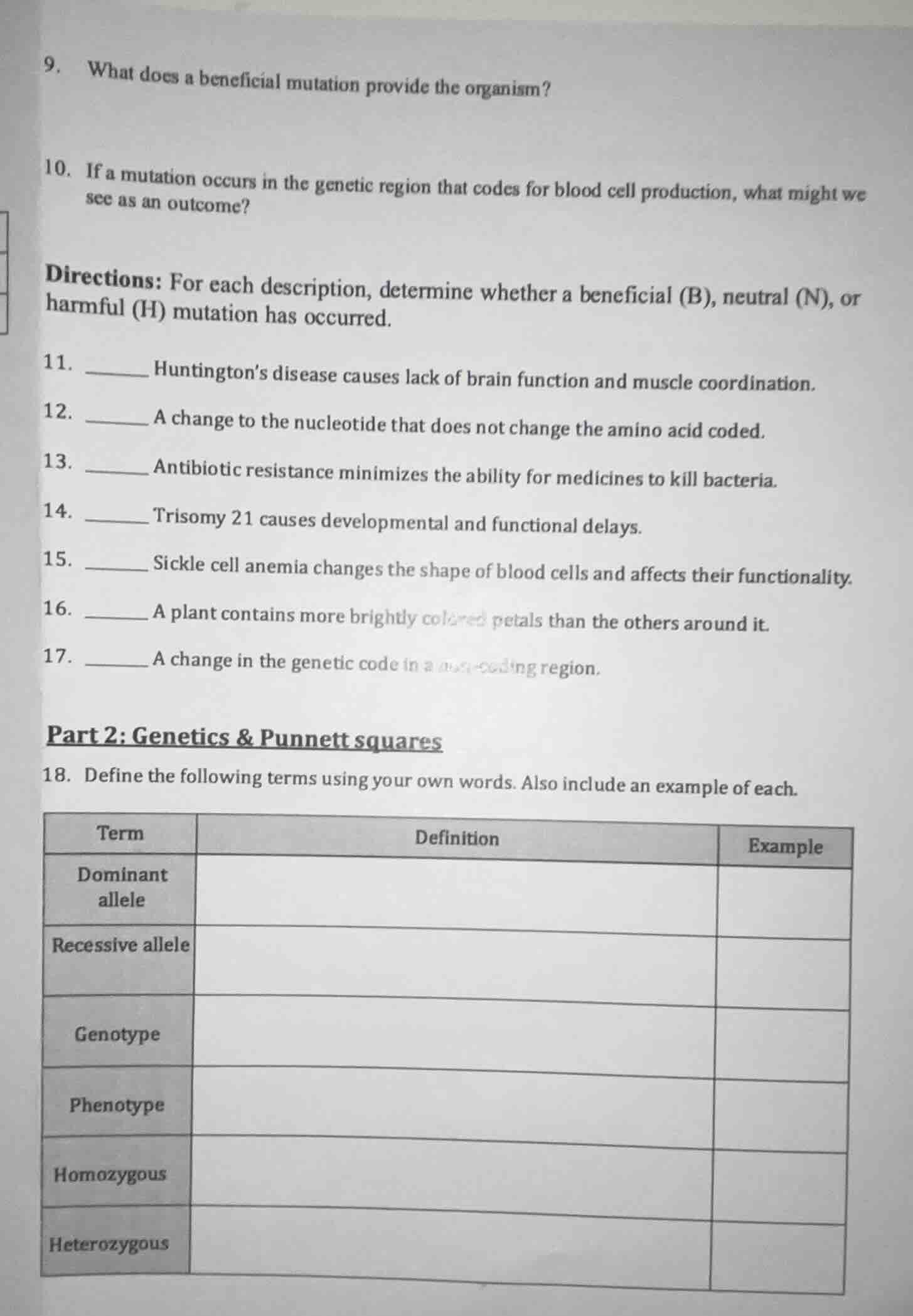
- what does a beneficial mutation provide the organism?
- if a mutation occurs in the genetic region that codes for blood cell production, what might we see as an outcome?
directions: for each description, determine whether a beneficial (b), neutral (n), or harmful (h) mutation has occurred.
- ______ huntington’s disease causes lack of brain function and muscle coordination.
- ______ a change to the nucleotide that does not change the amino acid coded.
- ______ antibiotic resistance minimizes the ability for medicines to kill bacteria.
- ______ trisomy 21 causes developmental and functional delays.
- ______ sickle cell anemia changes the shape of blood cells and affects their functionality.
- ______ a plant contains more brightly colored petals than the others around it.
- ______ a change in the genetic code in a non - coding region.
part 2: genetics & punnett squares
- define the following terms using your own words. also include an example of each.
| term | definition | example |
|---|---|---|
| recessive allele | ||
| genotype | ||
| phenotype | ||
| homozygous | ||
| heterozygous |
Brief Explanations
Questions 9-10
- Beneficial mutations improve an organism's survival/reproduction.
- Mutations in blood cell genes disrupt cell production/function.
Questions 11-17
- Huntington's disease causes severe health decline.
- Silent mutations don't alter protein function.
- Antibiotic resistance helps bacteria survive treatment.
- Trisomy 21 causes lifelong developmental impairments.
- Sickle cell anemia impairs oxygen transport.
- Brighter petals boost pollination for plants.
- Non-coding region changes don't affect proteins.
Question 18
Definitions use plain language, examples are common genetic traits.

Snap & solve any problem in the app
Get step-by-step solutions on Sovi AI
Photo-based solutions with guided steps
Explore more problems and detailed explanations
- A beneficial mutation provides the organism with an advantage that improves its ability to survive, reproduce, or thrive in its environment (e.g., better access to food, resistance to disease, or improved mating success).
- Possible outcomes include disorders affecting blood cell formation or function, such as anemia (low red blood cells), increased risk of infections (low white blood cells), or bleeding disorders (abnormal platelets); in some cases, it could also lead to blood cancers like leukemia.
- H
- N
- B
- H
- H
- B
- N
18.
| Term | Definition | Example |
|---|---|---|
| Recessive allele | A gene variant whose trait is only expressed when two copies are present (no dominant allele). | The allele for blue eyes (b); only people with bb genotype have blue eyes. |
| Genotype | The specific set of gene variants (alleles) an organism carries. | A person's eye color genotype: BB, Bb, or bb. |
| Phenotype | The observable physical/functional trait resulting from genotype and environment. | Having brown eyes, or having attached earlobes. |
| Homozygous | Having two identical copies of an allele for a gene. | Genotype BB (homozygous dominant) or bb (homozygous recessive) for eye color. |
| Heterozygous | Having two different copies of an allele for a gene. | Genotype Bb for eye color (one dominant, one recessive allele). |