QUESTION IMAGE
Question
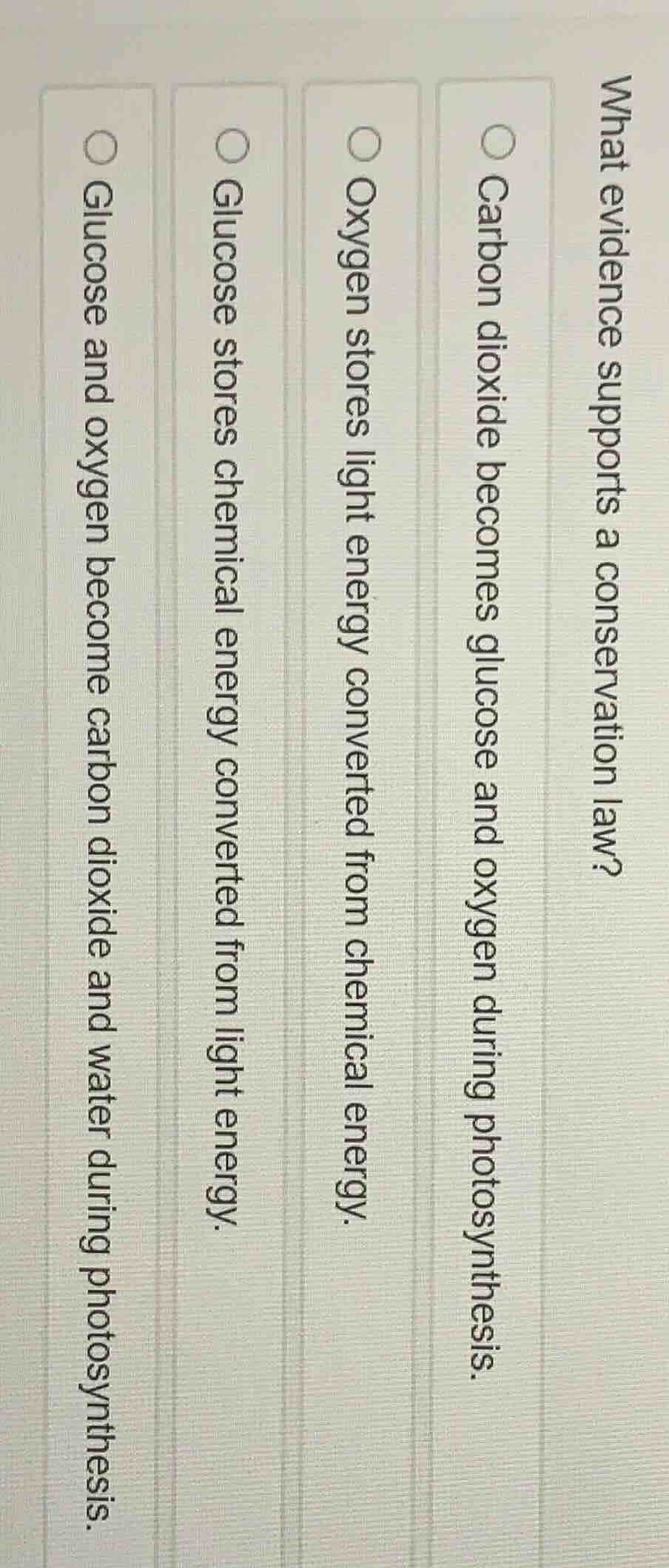
what evidence supports a conservation law?
○ carbon dioxide becomes glucose and oxygen during photosynthesis.
○ oxygen stores light energy converted from chemical energy.
○ glucose stores chemical energy converted from light energy.
○ glucose and oxygen become carbon dioxide and water during photosynthesis.
To determine the correct answer, we analyze each option in the context of the law of conservation of mass (or energy, but here mass in chemical reactions). Photosynthesis has the equation \(6CO_2 + 6H_2O \xrightarrow[\text{Chlorophyll}]{\text{Light}} C_6H_{12}O_6 + 6O_2\).
- Option 1: "Carbon dioxide becomes glucose and oxygen during photosynthesis" aligns with the reactants (CO₂, H₂O) forming products (glucose, O₂), showing atoms are rearranged, not created/destroyed (conservation of mass).
- Option 2: Oxygen doesn't store light energy converted from chemical energy (photosynthesis converts light to chemical in glucose, not oxygen storing).
- Option 3: Glucose stores chemical energy from light, but this is about energy storage, not conservation law evidence.
- Option 4: Glucose and oxygen becoming CO₂ and water is cellular respiration, not photosynthesis.

Snap & solve any problem in the app
Get step-by-step solutions on Sovi AI
Photo-based solutions with guided steps
Explore more problems and detailed explanations
Carbon dioxide becomes glucose and oxygen during photosynthesis.