QUESTION IMAGE
Question
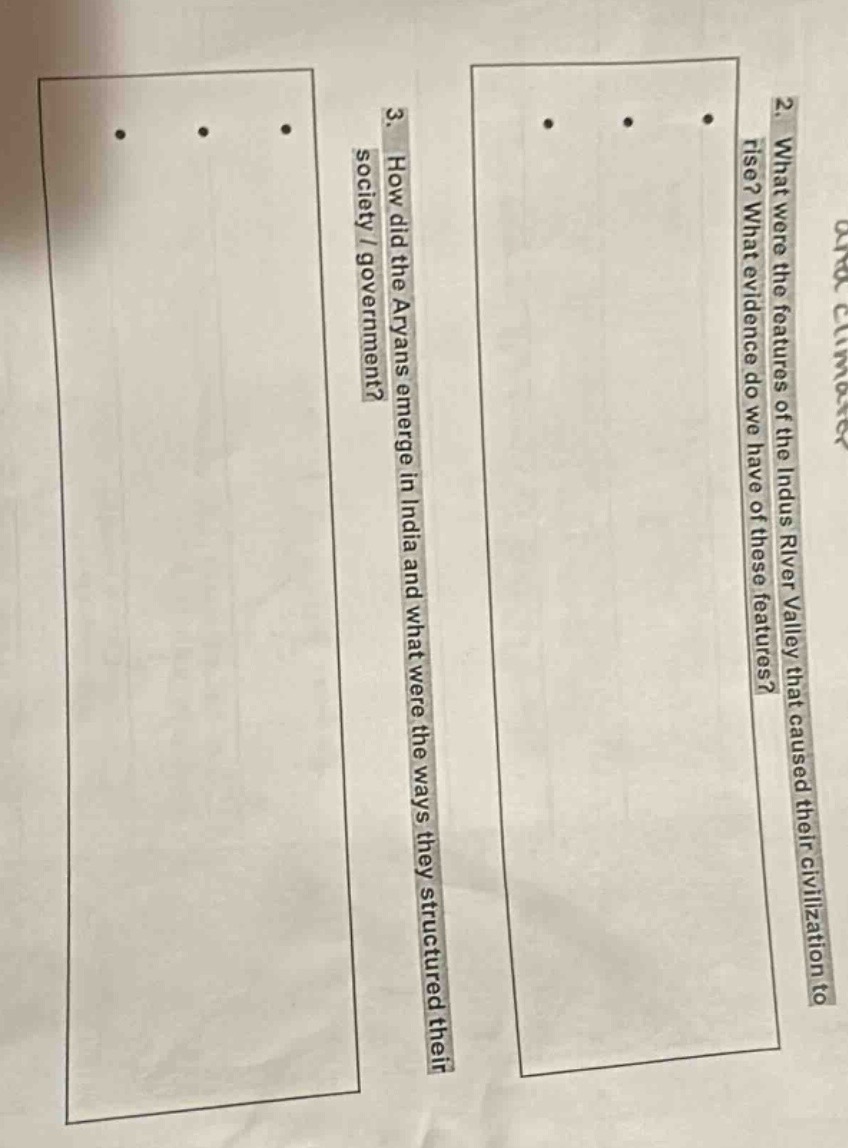
- what were the features of the indus river valley that caused their civilization to rise? what evidence do we have of these features?
- how did the aryans emerge in india and what were the ways they structured their society / government?
Brief Explanations
For Question 2:
- Features causing decline:
- Environmental changes: Shifts in the Indus River's course, droughts, or flooding patterns reduced agricultural productivity.
- Ecological degradation: Overuse of natural resources (like deforestation for fuel/construction) weakened the ecosystem's ability to support the population.
- Possible invasion or conflict: Some theories suggest incursions by outside groups disrupted the civilization.
- Evidence:
- Archaeological data: Abandoned cities (like Mohenjo-daro and Harappa) show signs of gradual decay rather than sudden destruction; soil samples indicate long-term drought conditions.
- Geological records: Sediment layers reveal changes in river flow and increased aridity in the region around the time of the civilization's decline.
- Lack of defensive structures (in most sites) casts doubt on violent invasion as the sole cause, pointing more to environmental factors.
For Question 3:
- Aryan emergence in India:
- The Aryans migrated into the Indian subcontinent from Central Asia around 1500 BCE, likely through the mountain passes of the Hindu Kush. They displaced or merged with the remaining Indus Valley populations.
- Society structure:
- They established the caste system (varna system), dividing society into four main groups: Brahmins (priests/scholars), Kshatriyas (warriors/rulers), Vaishyas (merchants/farmers), and Shudras (laborers). This system was enforced through religious texts like the Vedas.
- Government structure:
- Early Aryan society was organized into small kingdoms (janapadas) ruled by rajas (kings). Rajas advised by councils of elders (sabha) and assemblies of free men (samiti). Power was tied to military strength and religious authority, with Brahmins playing a key role in legitimizing royal rule.

Snap & solve any problem in the app
Get step-by-step solutions on Sovi AI
Photo-based solutions with guided steps
Explore more problems and detailed explanations
Question 2:
- Decline-causing features:
- Indus River course shifts, droughts/flooding
- Ecological degradation (deforestation, resource overuse)
- Potential external conflict (debated)
- Evidence:
- Abandoned, gradually decaying Indus city sites
- Geological/soil records showing aridity and river changes
- Minimal defensive structures, favoring environmental over violent collapse theories
Question 3:
- Emergence: Migrated from Central Asia to India c.1500 BCE via Hindu Kush passes, merging with local populations
- Society structure: Enforced the varna (caste) system: Brahmins, Kshatriyas, Vaishyas, Shudras, codified in Vedic texts
- Government structure: Ruled by rajas (kings) in small janapadas, advised by sabha (elder councils) and samiti (free men's assemblies), with Brahmins legitimizing royal power