QUESTION IMAGE
Question
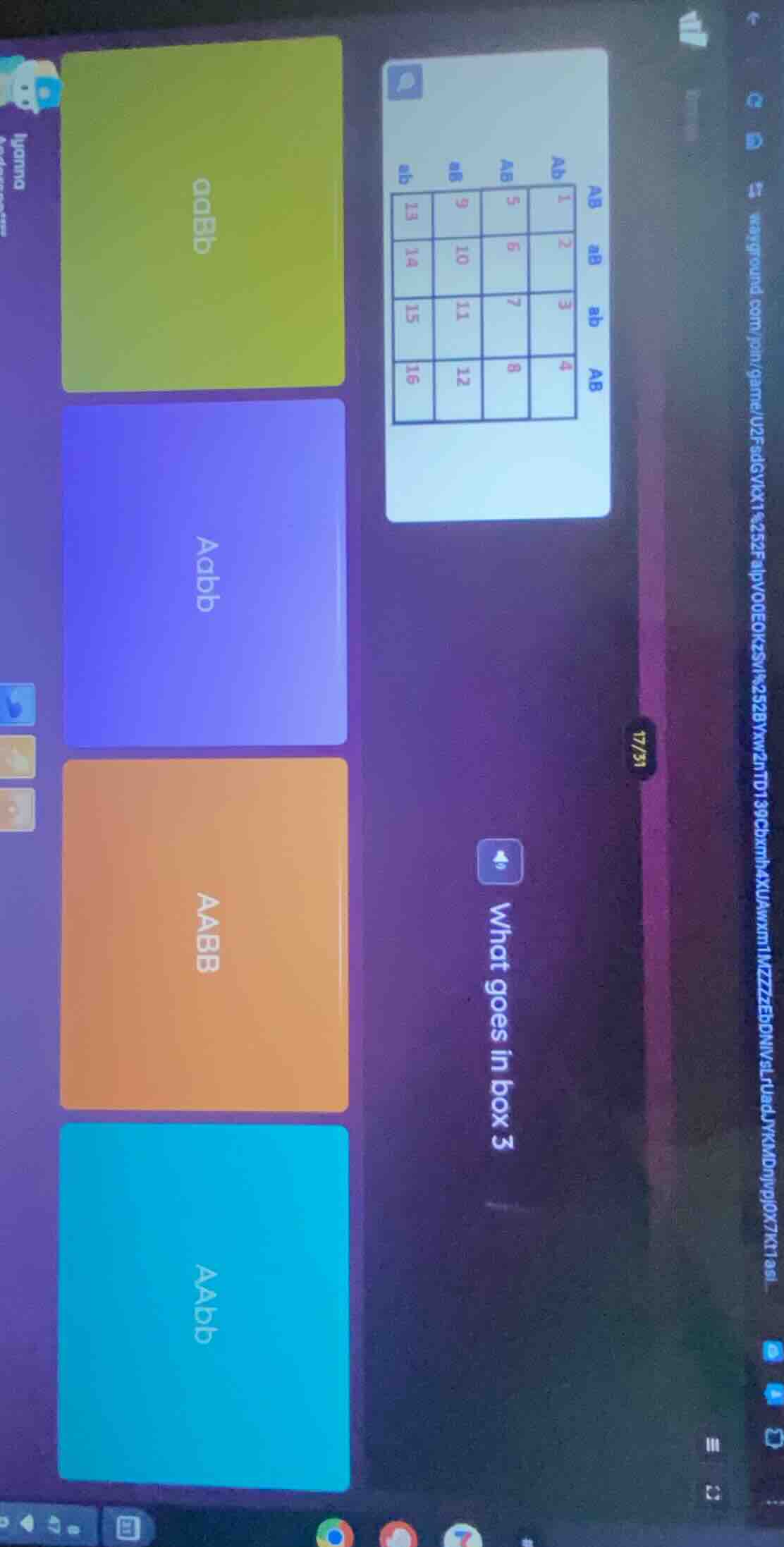
what goes in box 3
options: aabb, aabb, aabb, aabb
Step1: Analyze the Punnett Square Rows and Columns
The row for box 3 is "ab" and the column is "Ab". To find the genotype, we combine the alleles from the row and column. The row allele is "ab" (so alleles \(a\) and \(b\)) and the column allele is "Ab" (alleles \(A\) and \(b\)). Combining them, we get the genotype by taking one allele from each gene: for the first gene, \(A\) (from column) and \(a\) (from row); for the second gene, \(b\) (from column) and \(b\) (from row)? Wait, no, let's correct. Wait, the row is the gamete from one parent, column from another. Wait, the row label is "ab" (so gamete with alleles \(a\) and \(b\)) and column label is "Ab" (gamete with alleles \(A\) and \(b\)). So when we cross \(Ab\) (column) and \(ab\) (row), the possible genotypes are formed by combining each allele: \(A\) (from column) with \(a\) (from row) for the first gene, and \(b\) (from column) with \(b\) (from row) for the second gene? Wait, no, each gamete has two alleles (assuming dihybrid cross). Wait, the options are \(aaBb\), \(Aabb\), \(AABB\), \(AABb\). Wait, let's re - evaluate. Wait, the row is "ab" (so the two alleles in the gamete are \(a\) and \(b\)) and the column is "Ab" (alleles \(A\) and \(b\)). So the cross is \(Ab\times ab\). Let's do the allele combination: for the first gene (A - a), we have \(A\) (from column) and \(a\) (from row), so \(Aa\)? Wait, no, maybe the row and column are the two gametes, so the genotype in the box is the combination of the two gametes. Wait, the gamete from column is \(Ab\) (so alleles \(A\) and \(b\)) and from row is \(ab\) (alleles \(a\) and \(b\)). So combining them: \(A\) (from column) with \(a\) (from row) for the first gene, \(b\) (from column) with \(b\) (from row) for the second gene? No, that would be \(Aabb\)? Wait, let's check the options. The options are \(aaBb\), \(Aabb\), \(AABB\), \(AABb\). Wait, maybe I mixed up row and column. Wait, the row is "ab" (so the parent's gamete is \(ab\)) and column is "Ab" (parent's gamete is \(Ab\)). So the cross is \(Ab\times ab\). Let's do the Punnett square for two genes:
First gene (A - a): \(A\) (from \(Ab\)) and \(a\) (from \(ab\)) → \(Aa\)? No, wait, no, each gamete has one allele for each gene. Wait, maybe it's a dihybrid cross where the gametes are \(Ab\) (so for gene 1: \(A\), gene 2: \(b\)) and \(ab\) (gene 1: \(a\), gene 2: \(b\)). So when we combine them, gene 1: \(A\) (from \(Ab\)) and \(a\) (from \(ab\)) → \(Aa\)? No, that's not matching the options. Wait, maybe the row is the other way. Wait, the options include \(Aabb\). Let's see: if the row is \(ab\) (gamete: \(a\) and \(b\)) and column is \(Ab\) (gamete: \(A\) and \(b\)), then the genotype is \(A\) (from column) and \(a\) (from row) for the first gene, \(b\) (from column) and \(b\) (from row) for the second gene? No, that would be \(Aabb\) (since \(A\) and \(a\) for first gene, \(b\) and \(b\) for second? Wait, no, \(A\) (from column) and \(a\) (from row) is \(Aa\), \(b\) (from column) and \(b\) (from row) is \(bb\)? No, that's \(Aabb\)? Wait, \(A\) (from column) and \(a\) (from row) → \(Aa\), \(b\) (from column) and \(b\) (from row) → \(bb\)? No, \(Aabb\) is \(Aa\) and \(bb\)? Wait, no, \(Aabb\) is \(A\) and \(a\) for the first gene, \(b\) and \(b\) for the second? Wait, no, \(Aabb\) is \(A\) (first allele), \(a\) (second allele) for the first gene, \(b\) (first allele), \(b\) (second allele) for the second gene. So when we cross \(Ab\) (gamete: \(A\) and \(b\)) and \(ab\) (gamete: \(a\) and \(b\)), the combination is \(A\) (from \(Ab\)) with \(a\) (from \(ab\)) → \(Aa\) fo…

Snap & solve any problem in the app
Get step-by-step solutions on Sovi AI
Photo-based solutions with guided steps
Explore more problems and detailed explanations
Aabb (the option with the purple box, labeled "Aabb")