QUESTION IMAGE
Question
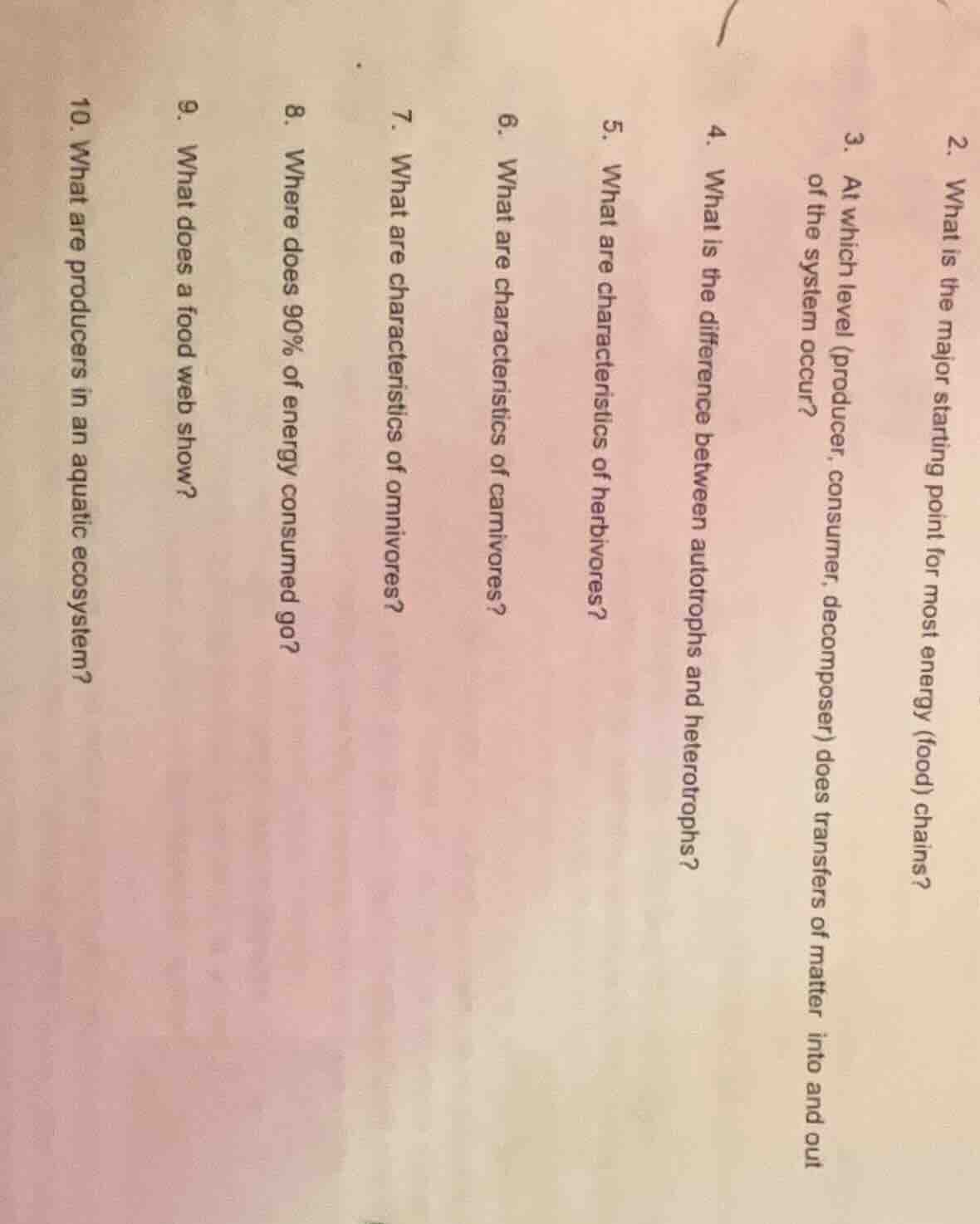
- what is the major starting point for most energy (food) chains?
- at which level (producer, consumer, decomposer) does transfers of matter into and out of the system occur?
- what is the difference between autotrophs and heterotrophs?
- what are characteristics of herbivores?
- what are characteristics of carnivores?
- what are characteristics of omnivores?
- where does 90% of energy consumed go?
- what does a food web show?
- what are producers in an aquatic ecosystem?
Brief Explanations
- Most energy chains start with producers, as they capture sunlight to make food via photosynthesis, forming the base energy source.
- Matter transfers into and out of the ecosystem at all levels: producers take in nutrients/water, consumers move matter between trophic levels, decomposers release matter back to the environment, and external sources add matter while some leaves the system.
- Autotrophs produce their own food via photosynthesis/chemosynthesis; heterotrophs must consume other organisms for energy.
- Herbivores are primary consumers that only eat producers (plants/algae) and have adaptations like flat teeth for grinding plant material.
- Carnivores are consumers that only eat other animals, have sharp teeth/claws for hunting, and are secondary/tertiary consumers in food chains.
- Omnivores eat both plant and animal matter, allowing them to occupy multiple trophic levels and have flexible diets.
- 90% of consumed energy is lost as heat via cellular respiration, used for the organism's metabolic processes (movement, growth, maintenance), or remains in undigested waste.
- A food web shows all interconnected food chains in an ecosystem, illustrating complex feeding relationships between multiple species.
- Producers in aquatic ecosystems are mostly photosynthetic organisms like phytoplankton, algae, and aquatic plants (e.g., seagrass, water lilies) that make their own food.

Snap & solve any problem in the app
Get step-by-step solutions on Sovi AI
Photo-based solutions with guided steps
Explore more problems and detailed explanations
- Producers (photosynthetic organisms like plants/algae)
- All trophic levels (producer, consumer, decomposer)
- Autotrophs produce their own food; heterotrophs consume other organisms for energy.
- They are primary consumers that only eat producers (plant/algae-based diet) and have adaptations for processing plant matter.
- They are consumers that only eat other animals, are predatory, and occupy higher trophic levels.
- They eat both plant and animal material, can occupy multiple trophic levels, and have flexible feeding habits.
- It is lost as heat (via cellular respiration), used for the organism's metabolic functions, or excreted as undigested waste.
- It shows all the interconnected feeding relationships and food chains within an ecosystem.
- Phytoplankton, aquatic algae, and aquatic plants (e.g., seagrass, water lilies)