QUESTION IMAGE
Question
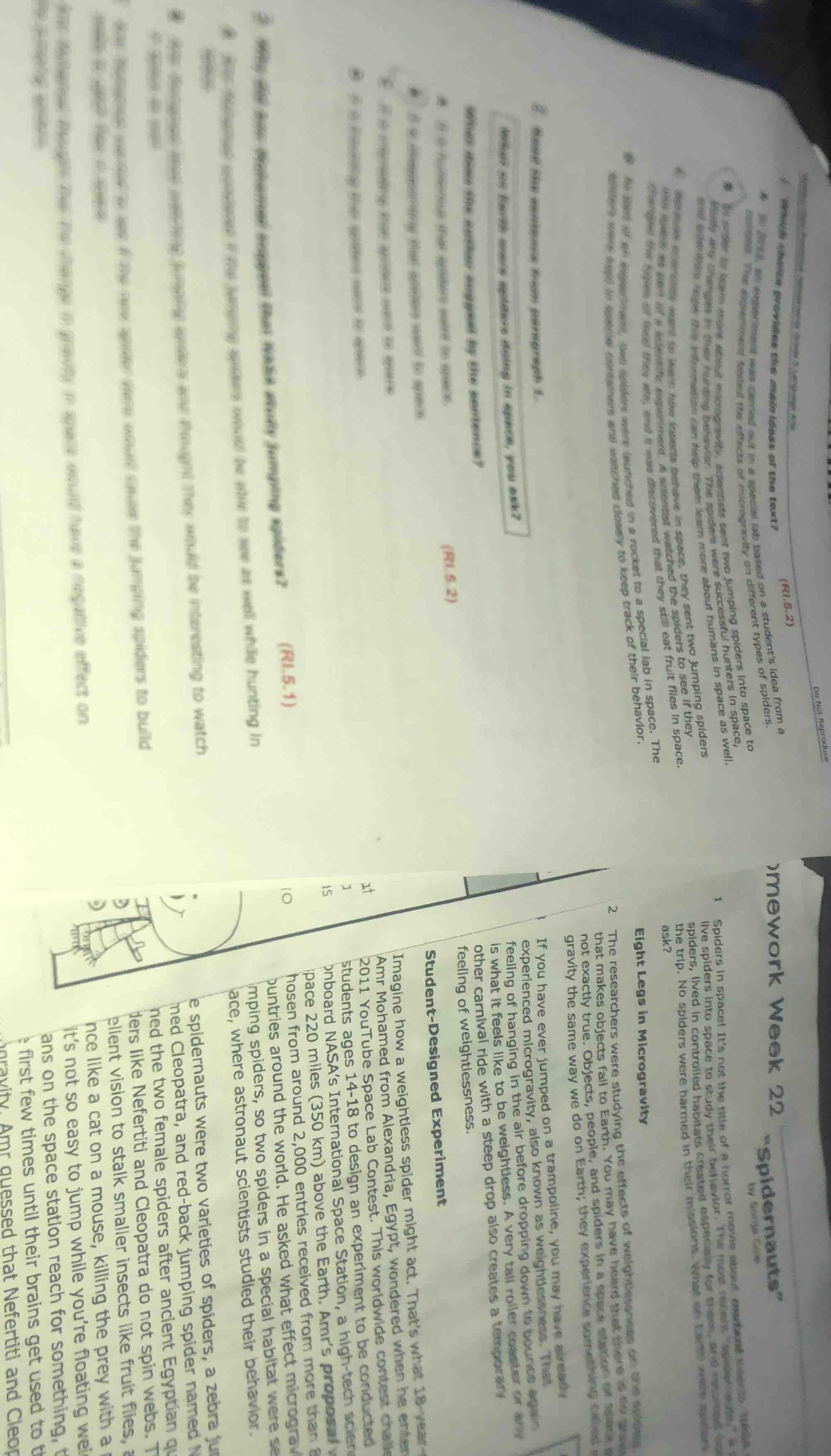
- what opinion does the text provide the main idea or the text? (ri.5.2) in 2008, the experiment was carried out in a special lab based on a student’s idea from a contest. the experiment sent two different types of spiders to study how they behave in microgravity, scientists sent two jumping spiders into space to study the changes in their hunting behavior. their golden were two successful hunters in space, well. now these two types of jumping spiders were chosen to participate in the experiment. a student watched the spiders in space, they sent two jumping spiders from earth to see if they could adapt to space. after they were launched in a rocket to a special lab in space. the scientists were surprised, and students were (selected) to keep track of their behavior. 2. based on the text, what is the author’s purpose for writing this passage? (ri.5.6) a. to inform readers about a student’s experiment in space. b. to persuade readers that spiders are good pets. c. to entertain readers with a funny story about spiders. d. to explain why spiders are afraid of space. 3. what is the meaning of the word “microgravity” as used in the passage? (ri.5.4) a. the study of how spiders behave in space. b. the condition of having no gravity. c. the feeling of being weightless. d. the effect of gravity on objects in space. 4. how does the author organize the information in the passage? (ri.5.5) a. by comparing the behavior of jumping spiders in space and on earth. b. by describing the steps of the experiment in order. c. by explaining the cause and effect of sending spiders to space. d. by telling a story about a student and his experiment. 5. what is the author’s point of view about the experiment? (ri.5.6) a. the experiment was a waste of time and money. b. the experiment was interesting and successful. c. the experiment was too dangerous for the spiders. d. the experiment was not important for science. 6. what is the main idea of the section “student-designed experiment”? (ri.5.2) a. amr mohamed designed an experiment to study spiders in space. b. nasa’s international space station is a good place for experiments. c. spiders from different countries behave differently in space. d. microgravity has a negative effect on spiders’ behavior. 7. how does the author support the idea that the experiment was successful? (ri.5.1) a. by explaining that the spiders were able to jump in space. b. by describing the spiders’ behavior in space and on earth. c. by providing data about the spiders’ weight in space. d. by quoting the scientists who conducted the experiment. 8. what is the author’s purpose for including the section “eight legs in microgravity”? (ri.5.5) a. to introduce the concept of microgravity. b. to explain why spiders were chosen for the experiment. c. to describe the results of the experiment. d. to compare the behavior of spiders and humans in space. 9. what is the meaning of the word “weightlessness” as used in the passage? (ri.5.4) a. the condition of having no weight. b. the feeling of being very light. c. the effect of gravity on objects. d. the ability to float in space. 10. how does the author organize the information in the section “student-designed experiment”? (ri.5.5) a. by telling a story about amr mohamed and his experiment. b. by explaining the steps of the experiment in order. c. by comparing the behavior of different types of spiders. d. by describing the effects of microgravity on spiders. 11. what is the main idea of the passage? (ri.5.2) a. spiders are interesting creatures that can adapt to different environments. b. a student’s experiment sent spiders to space to study their behavior in microgravity. c. microgravity has a significant effect on the behavior of all animals. d. nasa’s international space station is a great place for scientific experiments. 12. how does the author support the idea that the spiders were able to adapt to space? (ri.5.1) a. by describing how the spiders built webs and caught prey in space. b. by providing statistics about the spiders’ survival rate in space. c. by quoting the scientists who observed the spiders. d. by comparing the spiders’ behavior in space and on earth. 13. what is the author’s point of view about the spiders’ ability to adapt to space? (ri.5.6) a. the author is impressed by the spiders’ ability to adapt. b. the author is concerned about the spiders’ safety in space. c. the author thinks the spiders should not have been sent to space. d. the author is bored by the spiders’ behavior in space. 14. what is the meaning of the word “adapt” as used in the passage? (ri.5.4) a. to change in order to survive in a new environment. b. to become used to a new situation over time. c. to resist change in a new environment. d. to feel comfortable in a new situation. 15. how does the author organize the information in the passage? (ri.5.5) a. by explaining the cause and effect of sending spiders to space. b. by describing the experiment and its results. c. by comparing the behavior of spiders and other animals in space. d. by telling a story about the scientists who conducted the experiment.
Brief Explanations
- For question 1 (main idea): The text centers on an experiment sending jumping spiders to space to study microgravity's effects on their behavior, which ties to learning about human adaptation too.
- For question 2 (maintenance question): The text notes the spiders were monitored closely in their space habitat, so the relevant question is about their care.
- For question 3 (reason for experiment): The experiment's goal was to study microgravity's impact on the spiders' hunting behavior, to inform human space adaptation.

Snap & solve any problem in the app
Get step-by-step solutions on Sovi AI
Photo-based solutions with guided steps
Explore more problems and detailed explanations
- The main idea of the text is that scientists launched two jumping spiders into space as part of a student-designed experiment to study how microgravity affects their hunting behavior, with findings that could also help understand human adaptation to space.
- B. Is it interesting that spiders went to space? (This is the only option that aligns with the text's focus on monitoring the spiders' habitat/well-being in space)
- Scientists suggested testing jumping spiders because they wanted to see how microgravity affects the behavior of a predator that hunts by jumping, and the results could help understand how humans might adapt to space conditions.