QUESTION IMAGE
Question
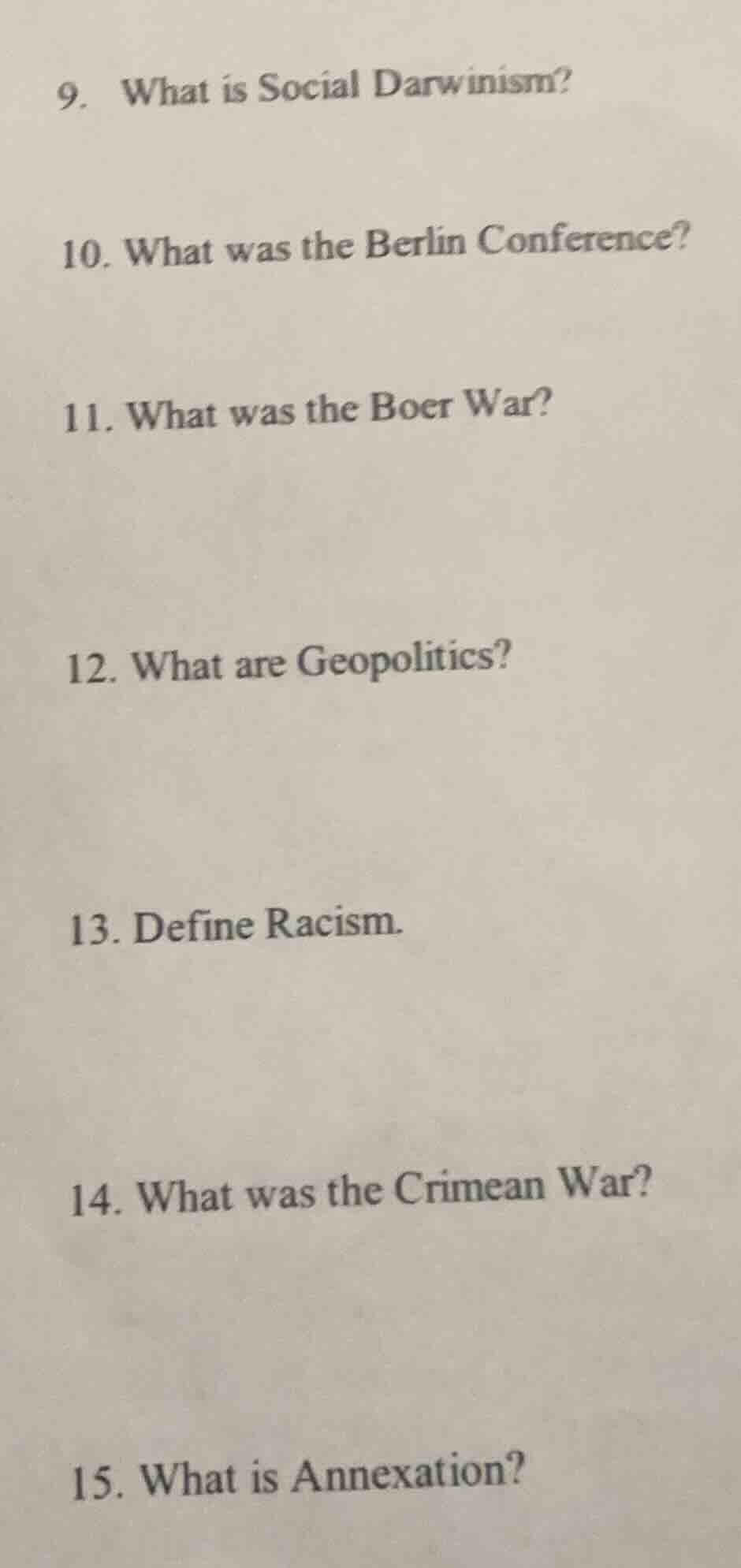
- what is social darwinism?
- what was the berlin conference?
- what was the boer war?
- what are geopolitics?
- define racism.
- what was the crimean war?
- what is annexation?
Brief Explanations
- Social Darwinism: Applies Darwin's "survival of the fittest" to human societies, justifying inequality, imperialism, and hierarchy as natural outcomes.
- Berlin Conference (1884-1885): A meeting of European powers to divide Africa's territories, establishing rules for colonial expansion without African representation.
- Boer War (1899-1902): A conflict between the British Empire and Dutch-speaking Boer states (Transvaal, Orange Free State) in South Africa, ending with British control and the formation of the Union of South Africa.
- Geopolitics: The study of how geography, resources, and political power interact, focusing on how territorial factors shape international relations and state strategies.
- Racism: The belief that inherent genetic traits of a racial group make it superior/inferior to others, paired with systemic or individual discrimination based on race.
- Crimean War (1853-1856): A conflict primarily between Russia and an alliance of France, Britain, the Ottoman Empire, and Sardinia, fought over control of Ottoman territories and religious sites in the Balkans.
- Annexation: The formal act of a state incorporating another territory or political entity into its own, often via force, diplomacy, or occupation.

Snap & solve any problem in the app
Get step-by-step solutions on Sovi AI
Photo-based solutions with guided steps
Explore more problems and detailed explanations
- Social Darwinism is the application of Charles Darwin's evolutionary concept of "survival of the fittest" to human social, political, and economic systems, used to justify social inequality, imperialism, and the dominance of powerful groups over weaker ones as a "natural" process.
- The Berlin Conference was an 1884-1885 meeting of major European powers (and the U.S.) that established rules for the colonization and division of African territories, allowing European nations to claim African lands without input from African peoples, accelerating the Scramble for Africa.
- The Boer War (1899-1902) was a conflict between the British Empire and the Boer states (the South African Republic and Orange Free State) in southern Africa, fought over British attempts to consolidate control over the region's gold and diamond resources; the British won, leading to the creation of the Union of South Africa in 1910.
- Geopolitics is an academic field and policy framework that analyzes how geographic factors (such as landmasses, natural resources, and strategic locations) interact with political power, shaping state behavior, international relations, and global security strategies.
- Racism is a system of beliefs, attitudes, and practices that asserts the inherent superiority or inferiority of a racial group, and uses this to justify and enforce discrimination, oppression, or unequal treatment of individuals based on their perceived racial identity.
- The Crimean War (1853-1856) was a major European conflict fought primarily on the Crimean Peninsula, pitting Russia against an alliance of the Ottoman Empire, France, Britain, and Sardinia. It stemmed from disputes over Ottoman territory and religious access in the Holy Land, and ended with a Russian defeat that limited its expansion in the Black Sea region.
- Annexation is the formal process by which a sovereign state incorporates another territory, region, or independent political entity into its own territory and legal system, often through military conquest, diplomatic pressure, or a unilateral declaration, though such acts are not always recognized internationally.