QUESTION IMAGE
Question
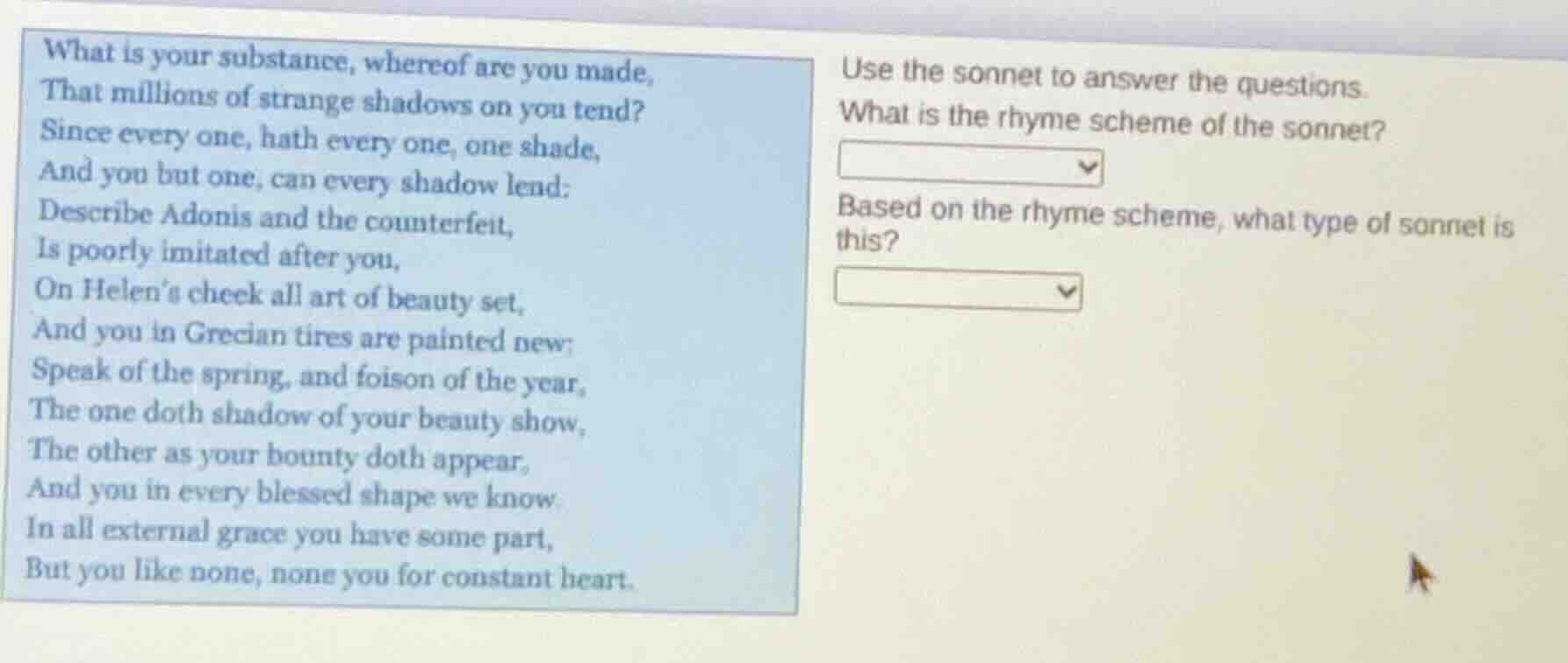
what is your substance, whereof are you made, that millions of strange shadows on you tend? since every one, hath every one, one shade, and you but one, can every shadow lend: describe adonis and the counterfeit, is poorly imitated after you, on helen’s cheek all art of beauty set, and you in grecian tires are painted new; speak of the spring, and foison of the year, the one doth shadow of your beauty show, the other as your bounty doth appear, and you in every blessed shape we know. in all external grace you have some part, but you like none, none you for constant heart. use the sonnet to answer the questions. what is the rhyme scheme of the sonnet? based on the rhyme scheme, what type of sonnet is this?
First Question: Rhyme Scheme of the Sonnet
To determine the rhyme scheme, we analyze the end - words of each line:
- Line 1: "made"
- Line 2: "tend" → Does not rhyme with "made". Let's mark line 1 as "A".
- Line 3: "shade" → Rhymes with "made" (A).
- Line 4: "lend" → Rhymes with "tend" (B).
- Line 5: "counterfeit"
- Line 6: "you" → Does not rhyme with "counterfeit". Mark line 5 as "C".
- Line 7: "set" → Rhymes with "lend"? No. Wait, line 7: "set", line 4: "lend" – no. Wait line 7: "set", line 6: "you" – no. Wait line 5: "counterfeit", line 7: "set" – no. Wait, let's re - evaluate:
Line 1: made (A)
Line 2: tend (B)
Line 3: shade (A) (rhymes with made)
Line 4: lend (B) (rhymes with tend)
Line 5: counterfeit (C)
Line 6: you (D)
Line 7: set (E)? No, wait line 7: "set", line 4: "lend" – no. Wait, line 7: "set", line 6: "you" – no. Wait, line 5: "counterfeit", line 7: "set" – no. Wait, maybe I made a mistake. Let's check again:
Line 1: made (A)
Line 2: tend (B)
Line 3: shade (A) (A)
Line 4: lend (B) (B)
Line 5: counterfeit (C)
Line 6: you (D)
Line 7: set (E)? No, line 7: "set", line 10: "show" – no. Wait line 7: "set", line 8: "new" – no. Wait line 8: "new", line 4: "lend" – no. Line 8: "new", line 6: "you" – rhymes! Oh, line 6: "you", line 8: "new" – rhyme? "you" and "new" – yes, they rhyme (D). So line 6: D, line 8: D.
Line 5: counterfeit (C), line 7: "set" – does "counterfeit" and "set" rhyme? No. Line 5: counterfeit (C), line 9: "year" – no. Line 9: "year" (E), line 11: "appear" (E) (rhymes with year). Line 10: "show" (F), line 12: "shape" – no. Wait, let's do it properly:
Line 1: made (A)
Line 2: tend (B)
Line 3: shade (A) (A)
Line 4: lend (B) (B)
Line 5: counterfeit (C)
Line 6: you (D)
Line 7: set (E)
Line 8: new (D) (rhymes with you)
Line 9: year (F)
Line 10: show (G)
Line 11: appear (F) (rhymes with year)
Line 12: shape (G) (rhymes with show)
Line 13: part (H)
Line 14: heart (H) (rhymes with part)
Wait, no, this is getting too complicated. Wait, the sonnet is a Shakespearean sonnet? Wait, the rhyme scheme of a Shakespearean sonnet is ABAB CDCD EFEF GG. Let's check:
Line 1: made (A)
Line 2: tend (B)
Line 3: shade (A) (A)
Line 4: lend (B) (B) → ABAB
Line 5: counterfeit (C)
Line 6: you (D)
Line 7: set (C)? No, line 7: "set", line 5: "counterfeit" – no. Wait line 5: "counterfeit", line 7: "set" – no. Wait line 5: "counterfeit", line 9: "year" – no. Wait, maybe it's ABAB CDCD EFEF GG. Let's check again:
Line 1: made (A)
Line 2: tend (B)
Line 3: shade (A) (A)
Line 4: lend (B) (B) → ABAB
Line 5: counterfeit (C)
Line 6: you (D)
Line 7: set (C)? No, line 7: "set", line 5: "counterfeit" – no. Wait line 7: "set", line 10: "show" – no. Wait line 7: "set", line 8: "new" – no. Line 8: "new", line 6: "you" – rhyme (D), so line 6: D, line 8: D → CDCD
Line 9: year (E)
Line 10: show (F)
Line 11: appear (E) (rhymes with year)
Line 12: shape (F) (rhymes with show) → EFEF
Line 13: part (G)
Line 14: heart (G) (rhymes with part) → GG
Yes! So the rhyme scheme is ABAB CDCD EFEF GG.
A Shakespearean (English) sonnet has a rhyme scheme of ABAB CDCD EFEF GG and is divided into three quatrains and a couplet. Since the rhyme scheme we identified (ABAB CDCD EFEF GG) matches the Shakespearean sonnet's rhyme scheme, this is a Shakespearean (English) sonnet.

Snap & solve any problem in the app
Get step-by-step solutions on Sovi AI
Photo-based solutions with guided steps
Explore more problems and detailed explanations
(for first question): ABAB CDCD EFEF GG