QUESTION IMAGE
Question
- what surrounds a cell and separates it from its environment?
- what is the difference between unicellular and multicellular organisms?
- give an example of a multicellular organism and an example of a unicellular organism.
- multicellular organisms can be organized into what other levels?
- circle which of the following would be made of cells. place a box around the ones which only show cell walls.
cork sponge wood plastic tree
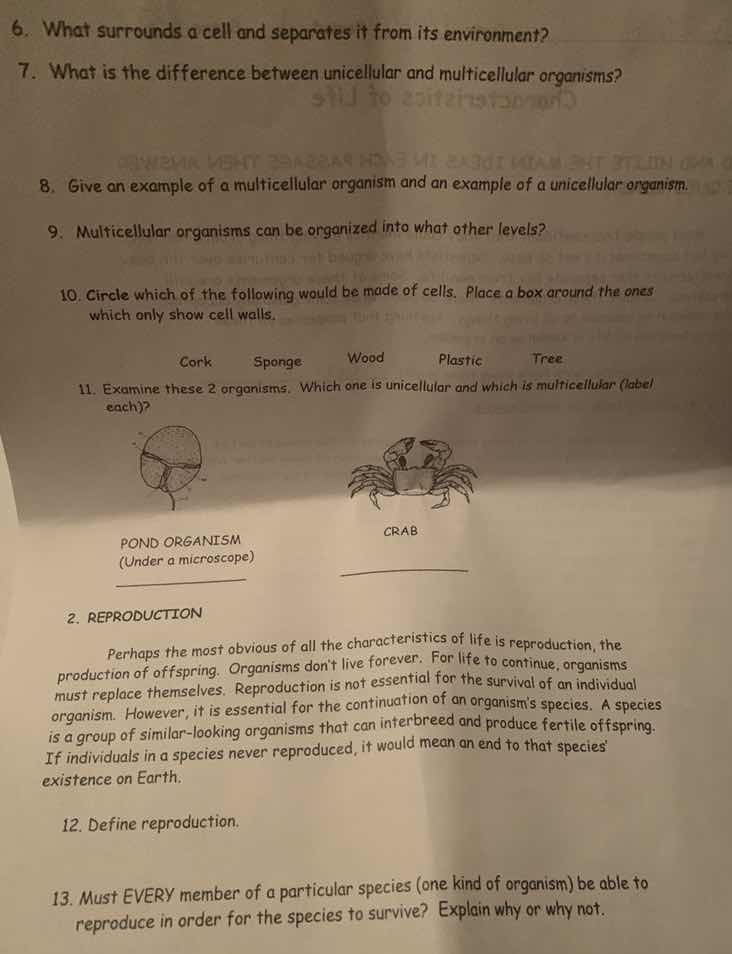
- examine these 2 organisms. which one is unicellular and which is multicellular (label each)?
pond organism (under a microscope) image crab image
- reproduction
perhaps the most obvious of all the characteristics of life is reproduction, the production of offspring. organisms dont live forever. for life to continue, organisms must replace themselves. reproduction is not essential for the survival of an individual organism. however, it is essential for the continuation of an organisms species. a species is a group of similar - looking organisms that can interbreed and produce fertile offspring. if individuals in a species never reproduced, it would mean an end to that species existence on earth.
- define reproduction.
- must every member of a particular species (one kind of organism) be able to reproduce in order for the species to survive? explain why or why not.
Question 6:
Identifies the structure forming a cell's outer barrier.
Question 7:
Differentiates organisms by cell count.
Question 8:
Provides common examples of each organism type.
Question 9:
Lists biological organization levels beyond single cells.
Question 10:
Classifies items by cellular presence and cell walls. Cork, wood, and tree have cell walls; plastic is non-cellular.
Question 11:
Matches organism size/visibility to cell count. Microscopic = unicellular, visible = multicellular.
Question 12:
Defines the core biological process for species continuation.
Question 13:
Evaluates species survival vs. individual reproduction ability.

Snap & solve any problem in the app
Get step-by-step solutions on Sovi AI
Photo-based solutions with guided steps
Explore more problems and detailed explanations
- The cell membrane (or plasma membrane) surrounds a cell and separates it from its environment.
- Unicellular organisms are made up of only one single cell that carries out all life functions, while multicellular organisms are made up of multiple specialized cells that work together to perform different life functions.
- Example of a multicellular organism: Human (or tree, dog, crab); Example of a unicellular organism: Bacteria (or amoeba, paramecium, the pond organism shown).
- Multicellular organisms can be organized into: tissues, organs, organ systems, and the whole organism (in order: cells → tissues → organs → organ systems → organism).
10.
Circle: Cork, Sponge, Wood, Tree
Box: Cork, Wood, Tree
11.
POND ORGANISM (Under a microscope): Unicellular
CRAB: Multicellular
- Reproduction is the biological process by which organisms produce new individuals (offspring) of their own kind, ensuring the continuation of their species.
- No, every member of a species does not need to be able to reproduce for the species to survive. As long as a sufficient number of individuals within the species can reproduce to produce new offspring, the species can continue to exist. For example, some individuals may be infertile, too young, or too old to reproduce, but as long as there are reproductively active individuals, the species will persist.