QUESTION IMAGE
Question
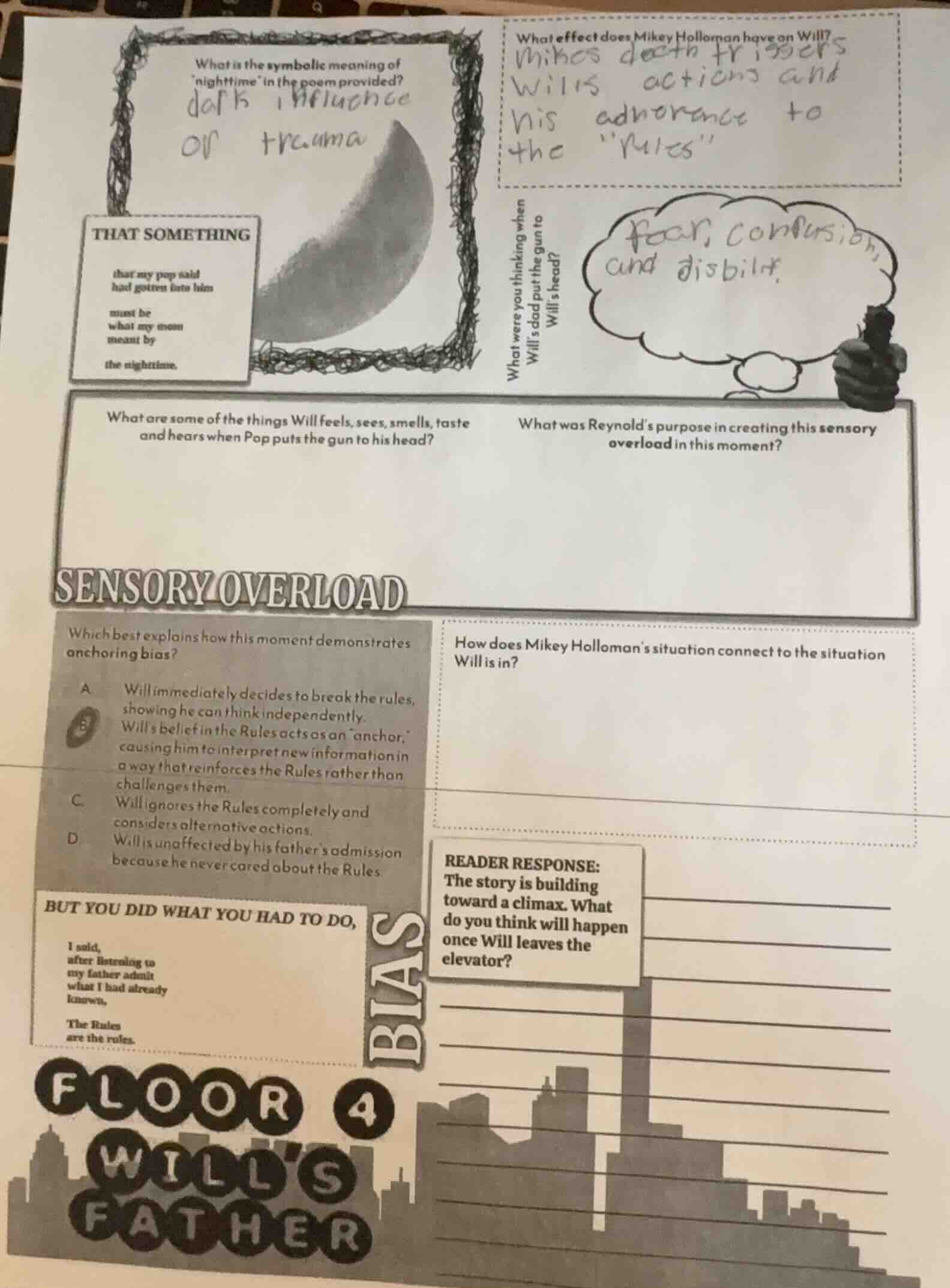
what is the symbolic meaning of nighttime in the poem provided?
that something
that my pop said
had gotten into him
must be
what my mom
meant by
the nighttime.
what effect does mikey holloman have on will?
what were you thinking when wills dad put the gun to wills head?
what are some of the things will feels, sees, smells, taste and hears when pop puts the gun to his head?
what was reynolds purpose in creating this sensory overload in this moment?
sensory overload
which best explains how this moment demonstrates anchoring bias?
a will immediately decides to break the rules, showing he can think independently.
b wills belief in the rules acts as an anchor, causing him to interpret new information in a way that reinforces the rules rather than challenges them.
c will ignores the rules completely and considers alternative actions.
d will is unaffected by his fathers admission because he never cared about the rules.
how does mikey holloman’s situation connect to the situation will is in?
but you did what you had to do,
i said,
after listening to
my father admit
what i had already
known,
the rules
are the rules.
reader response:
the story is building toward a climax. what do you think will happen once will leaves the elevator?
floor 4 wills father
- What are some of the things Will feels, sees, smells, taste and hears when Pop puts the gun to his head?
This refers to sensory details from the text Long Way Down. Will would feel the cold metal of the gun against his skin, see his father's intense, conflicted face, smell the gunpowder and his father's sweat, taste the metallic tang of fear in his mouth, and hear the heavy, shaky breathing of both himself and his father, plus the quiet hum of the elevator.
- What was Reynold's purpose in creating this sensory overload in this moment?
Reynolds uses sensory overload to immerse readers in Will's overwhelming panic and confusion, making his emotional turmoil tangible. It also highlights the intensity of the moment where Will's core beliefs (the Rules) are challenged by his father's vulnerability.
- Which best explains how this moment demonstrates anchoring bias?
Anchoring bias means relying on an initial belief to interpret new information. Will's long-held faith in the "Rules" acts as this anchor, so he frames his father's admission through that lens instead of questioning the Rules.
- How does Mikey Holloman's situation connect to the situation Will is in?
Mikey Holloman was killed in a cycle of retaliation, which is exactly the cycle Will is about to enter by following the Rules to avenge his brother. Will's father's story shows that the cycle of violence trapped Mikey, and it is also trapping Will and his family.
- READER RESPONSE: The story is building toward a climax. What do you think will happen once Will leaves the elevator?
It is likely Will will confront the person he believes killed his brother, but his father's story will make him hesitate. He may choose to break the cycle of violence instead of acting on revenge, or he may be forced to confront the reality that his target is not the true culprit, leading to a moment of crisis for his adherence to the Rules.

Snap & solve any problem in the app
Get step-by-step solutions on Sovi AI
Photo-based solutions with guided steps
Explore more problems and detailed explanations
- Will feels cold metal on his skin, sees his father's conflicted face, smells gunpowder/sweat, tastes metallic fear, hears heavy breathing/elevator hum.
- To immerse readers in Will's panic and highlight his conflicting beliefs.
- B. Will's belief in the Rules acts as an "anchor," causing him to interpret new information in a way that reinforces the Rules rather than challenges them.
- Mikey was killed in the same cycle of retaliation Will is about to enter; both are trapped by the cycle of violence the Rules enforce.
- Will will likely hesitate before acting on revenge, possibly choosing to break the cycle of violence instead of following the Rules, after confronting the weight of his father's story and the cycle that claimed Mikey Holloman.