QUESTION IMAGE
Question
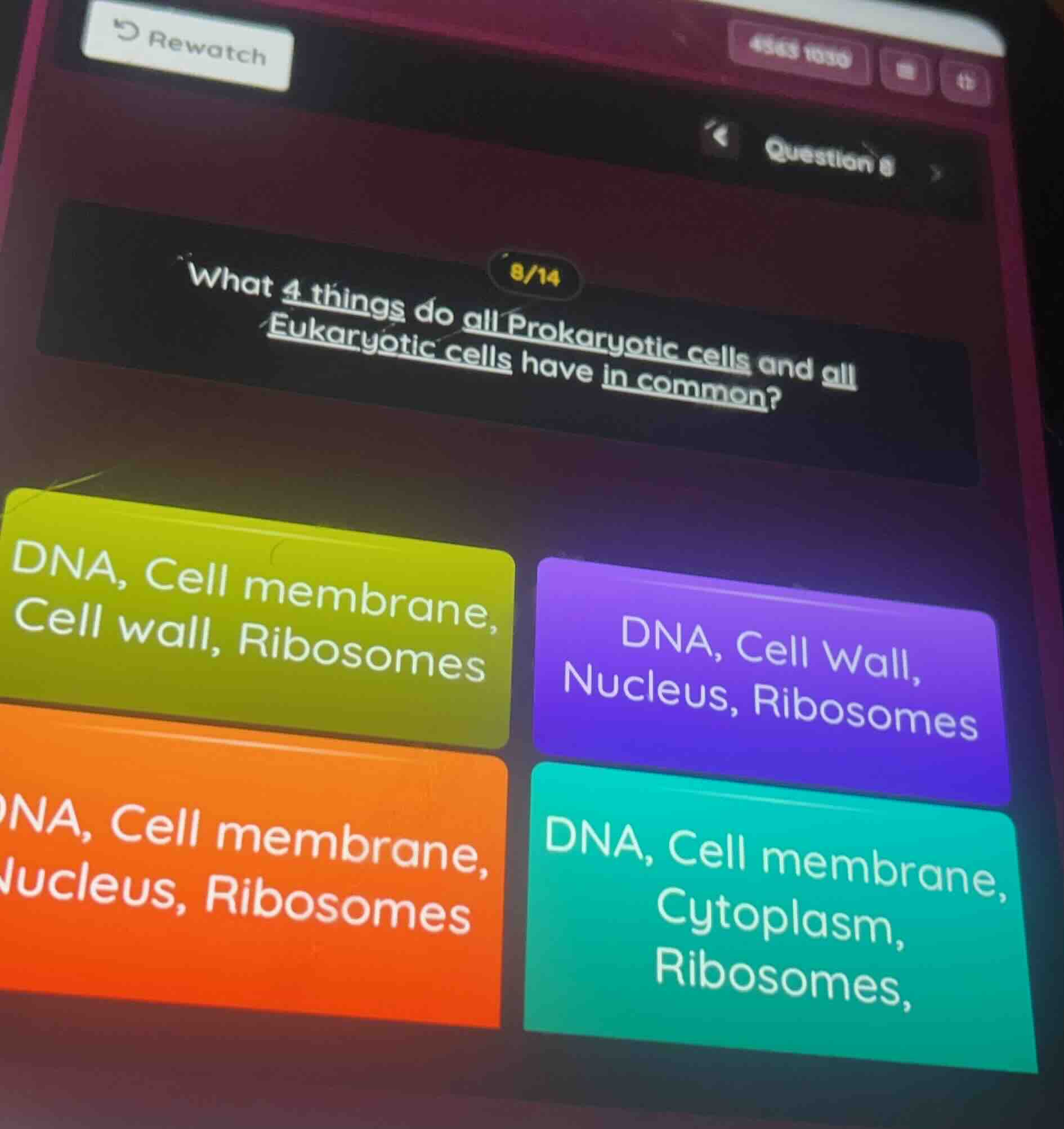
what 4 things do all prokaryotic cells and all eukaryotic cells have in common?
dna, cell membrane, cell wall, ribosomes
dna, cell wall, nucleus, ribosomes
dna, cell membrane, nucleus, ribosomes
dna, cell membrane, cytoplasm, ribosomes,
To solve this, we recall the common features of prokaryotic and eukaryotic cells:
- DNA: Both have genetic material (DNA) to store information.
- Cell Membrane: A semi - permeable membrane that encloses the cell, present in both.
- Cytoplasm: The gel - like substance within the cell where many cellular processes occur, common to both.
- Ribosomes: Involved in protein synthesis, present in both prokaryotic (smaller ribosomes) and eukaryotic cells.
Now let's analyze the options:
- Option 1 (DNA, Cell membrane, Cell wall, Ribosomes): Not all eukaryotic cells have a cell wall (e.g., animal cells), so this is incorrect.
- Option 2 (DNA, Cell Wall, Nucleus, Ribosomes): Prokaryotic cells do not have a nucleus, and not all eukaryotic cells have a cell wall, so this is incorrect.
- Option 3 (DNA, Cell membrane, Nucleus, Ribosomes): Prokaryotic cells do not have a nucleus, so this is incorrect.
- Option 4 (DNA, Cell membrane, Cytoplasm, Ribosomes): All these components are common to both prokaryotic and eukaryotic cells.

Snap & solve any problem in the app
Get step-by-step solutions on Sovi AI
Photo-based solutions with guided steps
Explore more problems and detailed explanations
The correct option is the one with "DNA, Cell membrane, Cytoplasm, Ribosomes" (the teal - colored option in the image). If we assume the options are labeled as follows (from the image layout: top - left yellow, top - right purple, bottom - left orange, bottom - right teal):
D. DNA, Cell membrane, Cytoplasm, Ribosomes