QUESTION IMAGE
Question
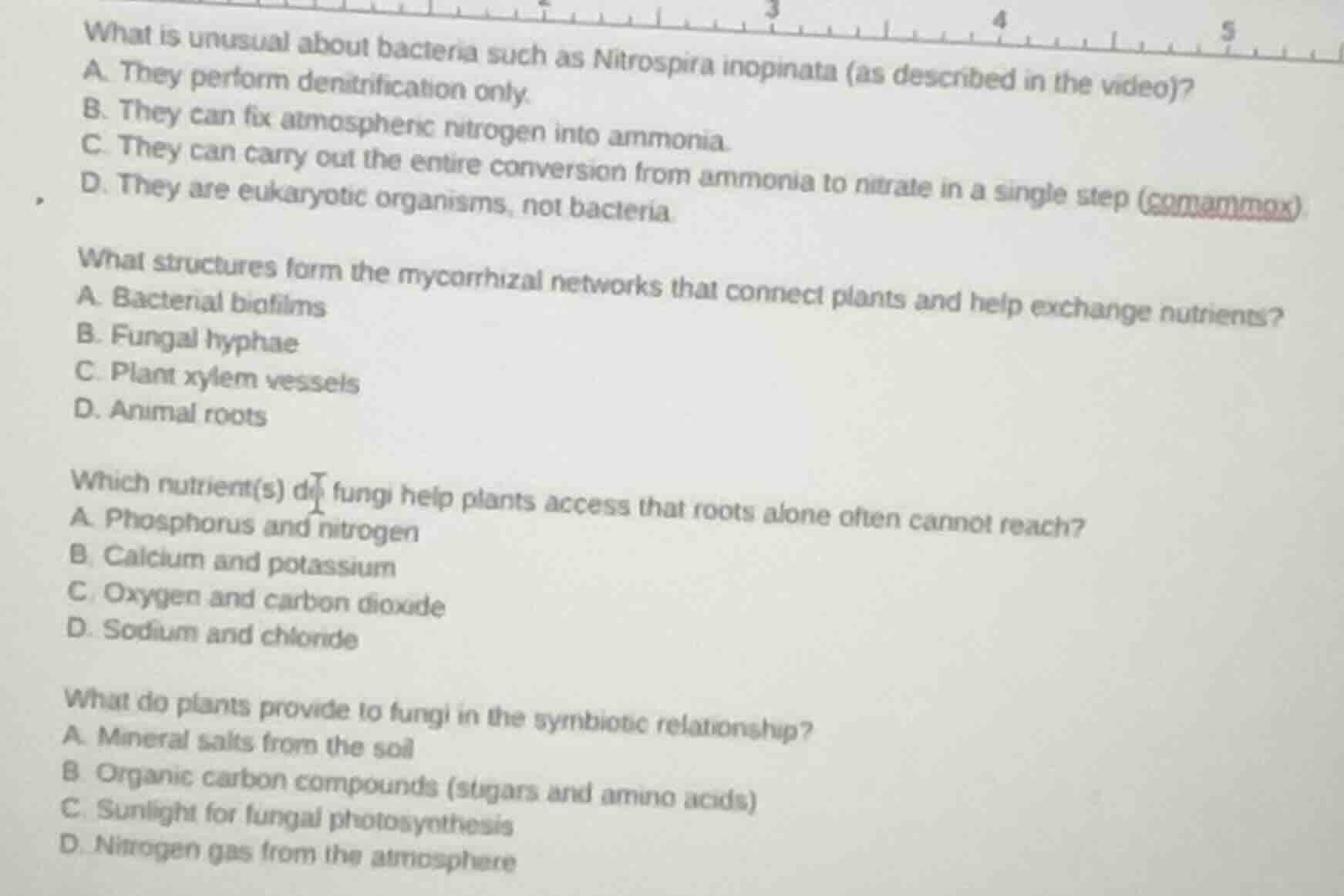
what is unusual about bacteria such as nitrospira inopinata (as described in the video)?
a. they perform denitrification only.
b. they can fix atmospheric nitrogen into ammonia.
c. they can carry out the entire conversion from ammonia to nitrate in a single step (comammox)
d. they are eukaryotic organisms, not bacteria.
what structures form the mycorrhizal networks that connect plants and help exchange nutrients?
a. bacterial biofilms
b. fungal hyphae
c. plant xylem vessels
d. animal roots
which nutrient(s) do fungi help plants access that roots alone often cannot reach?
a. phosphorus and nitrogen
b. calcium and potassium
c. oxygen and carbon dioxide
d. sodium and chloride
what do plants provide to fungi in the symbiotic relationship?
a. mineral salts from the soil
b. organic carbon compounds (sugars and amino acids)
c. sunlight for fungal photosynthesis
d. nitrogen gas from the atmosphere
- Nitrospira inopinata is a comammox bacterium, meaning it completes the full nitrification process (ammonia to nitrate) alone, unlike typical nitrifying bacteria that split this into two separate steps.
- Mycorrhizal networks are formed by thread-like fungal hyphae, which extend to connect plant roots and facilitate nutrient exchange.
- Fungal hyphae have a large surface area that allows them to access and absorb phosphorus and nitrogen from soil areas that plant roots cannot reach, transferring these nutrients to the plant.
- In the mycorrhizal symbiosis, plants produce organic carbon compounds (via photosynthesis) and provide these to fungi, while fungi supply the plant with soil nutrients.

Snap & solve any problem in the app
Get step-by-step solutions on Sovi AI
Photo-based solutions with guided steps
Explore more problems and detailed explanations
- C. They can carry out the entire conversion from ammonia to nitrate in a single step (comammox)
- B. Fungal hyphae
- A. Phosphorus and nitrogen
- B. Organic carbon compounds (sugars and amino acids)