QUESTION IMAGE
Question
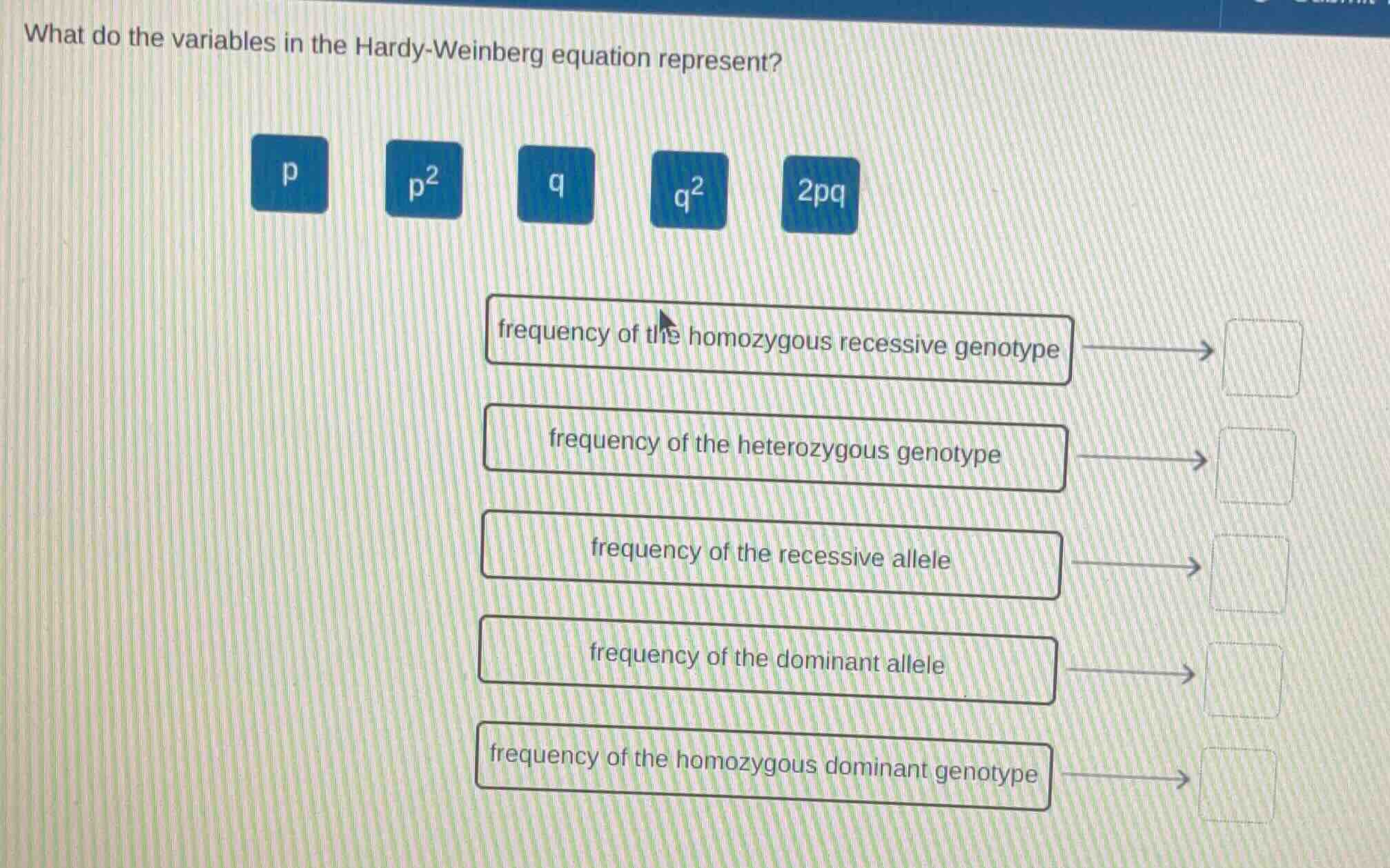
what do the variables in the hardy-weinberg equation represent?
p
p²
q
q²
2pq
frequency of the homozygous recessive genotype
frequency of the heterozygous genotype
frequency of the recessive allele
frequency of the dominant allele
frequency of the homozygous dominant genotype
Brief Explanations
The Hardy - Weinberg equation is \(p^{2}+2pq + q^{2}=1\) (and \(p + q=1\)) in the context of allele and genotype frequencies in a population.
- \(p\): Represents the frequency of the dominant allele.
- \(p^{2}\): Represents the frequency of the homozygous dominant genotype (since if the frequency of the dominant allele is \(p\), the probability of getting two dominant alleles is \(p\times p=p^{2}\)).
- \(q\): Represents the frequency of the recessive allele.
- \(q^{2}\): Represents the frequency of the homozygous recessive genotype (similarly, probability of two recessive alleles is \(q\times q = q^{2}\)).
- \(2pq\): Represents the frequency of the heterozygous genotype (the probability of getting one dominant and one recessive allele, and since there are two ways to get a heterozygous genotype (dominant from first parent and recessive from second, or vice - versa), it is \(2\times p\times q=2pq\)).

Snap & solve any problem in the app
Get step-by-step solutions on Sovi AI
Photo-based solutions with guided steps
Explore more problems and detailed explanations
- \(p\): frequency of the dominant allele
- \(p^{2}\): frequency of the homozygous dominant genotype
- \(q\): frequency of the recessive allele
- \(q^{2}\): frequency of the homozygous recessive genotype
- \(2pq\): frequency of the heterozygous genotype