QUESTION IMAGE
Question
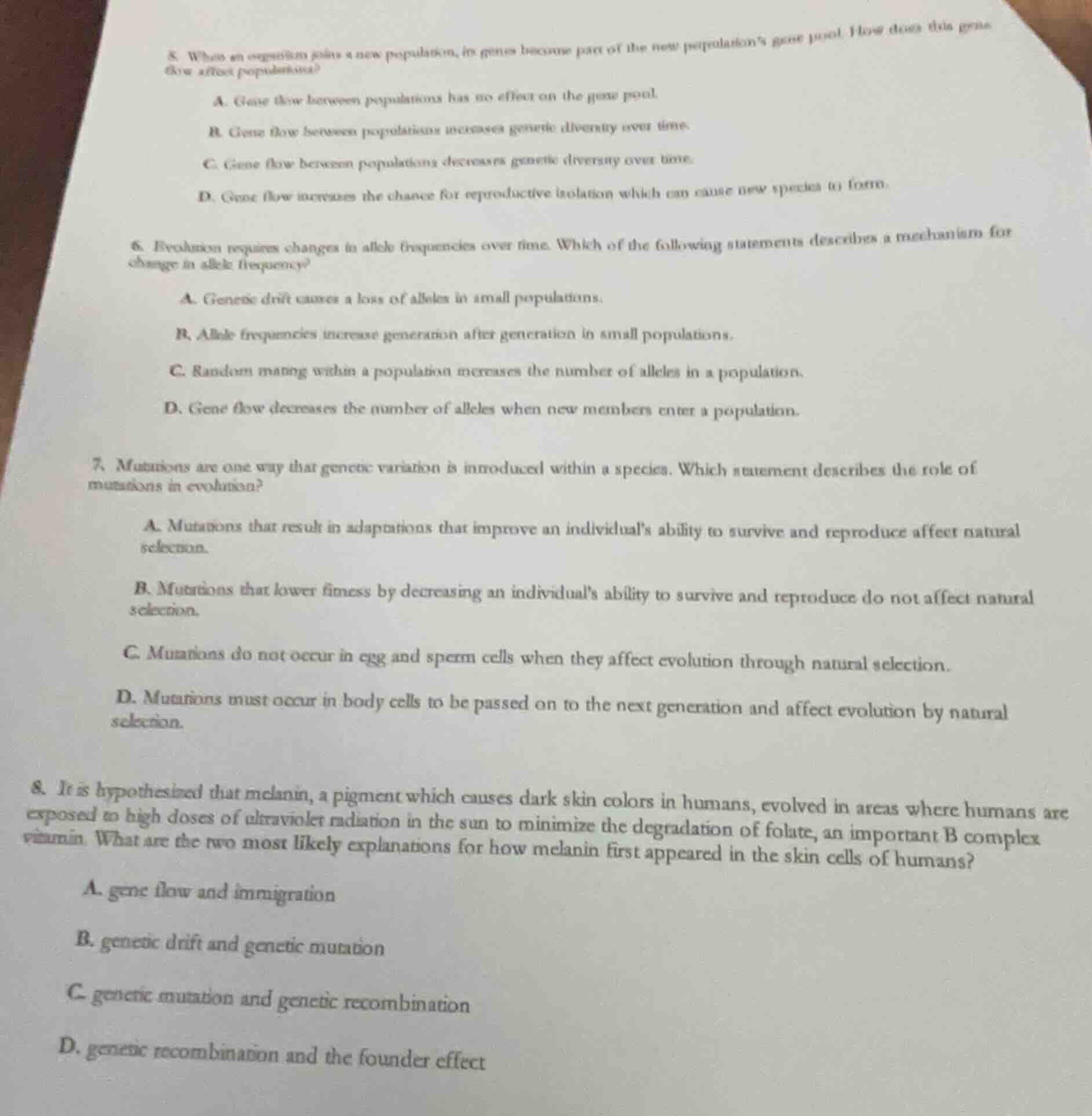
- when an organism joins a new population, its genes become part of the new population’s gene pool. how does this gene flow affect populations?
a. gene flow between populations has no effect on the gene pool.
b. gene flow between populations increases genetic diversity over time.
c. gene flow between populations decreases genetic diversity over time.
d. gene flow increases the chance for reproductive isolation which can cause new species to form.
- evolution requires changes in allele frequencies over time. which of the following statements describes a mechanism for change in allele frequency?
a. genetic drift causes a loss of alleles in small populations.
b. allele frequencies increase generation after generation in small populations.
c. random mating within a population increases the number of alleles in a population.
d. gene flow decreases the number of alleles when new members enter a population.
- mutations are one way that genetic variation is introduced within a species. which statement describes the role of mutations in evolution?
a. mutations that result in adaptations that improve an individual’s ability to survive and reproduce affect natural selection.
b. mutations that lower fitness by decreasing an individual’s ability to survive and reproduce do not affect natural selection.
c. mutations do not occur in egg and sperm cells when they affect evolution through natural selection.
d. mutations must occur in body cells to be passed on to the next generation and affect evolution by natural selection.
- it is hypothesized that melanin, a pigment which causes dark skin colors in humans, evolved in areas where humans are exposed to high doses of ultraviolet radiation in the sun to minimize the degradation of folate, an important b complex vitamin. what are the two most likely explanations for how melanin first appeared in the skin cells of humans?
a. gene flow and immigration
b. genetic drift and genetic mutation
c. genetic mutation and genetic recombination
d. genetic recombination and the founder effect
Question 5:
Gene flow occurs when individuals move between populations, introducing new alleles to the recipient population. This adds genetic variation, increasing overall genetic diversity over time. Option A is incorrect because gene flow does affect the gene pool. Option C is wrong as it increases, not decreases, diversity. Option D is incorrect because gene flow reduces reproductive isolation, not increases it.
Question 6:
Genetic drift is a mechanism of evolution that causes random changes in allele frequencies, and in small populations, it can lead to the loss of rare alleles. Option B is incorrect because allele frequencies do not consistently increase in small populations. Option C is wrong because random mating does not change the number of alleles in a population. Option D is incorrect because gene flow increases, not decreases, the number of alleles when new members enter.
Question 7:
Mutations that create adaptive traits (improving survival and reproduction) are acted upon by natural selection, driving evolution. Option B is incorrect because harmful mutations are selected against, so they do affect natural selection. Option C is wrong because mutations in gametes (egg and sperm) are heritable and affect evolution. Option D is incorrect because body cell mutations are not passed to offspring, so they do not affect evolution via natural selection.
Question 8:
A new trait like melanin first arises from a genetic mutation that creates the allele for dark skin. Genetic recombination can shuffle and spread this new allele in the population. Gene flow/immigration (A) would introduce existing alleles, not create a new trait. Genetic drift (B) is random change, not the origin of the trait. The founder effect (D) is a type of genetic drift, not the source of the new trait.

Snap & solve any problem in the app
Get step-by-step solutions on Sovi AI
Photo-based solutions with guided steps
Explore more problems and detailed explanations
- B. Gene flow between populations increases genetic diversity over time.
- A. Genetic drift causes a loss of alleles in small populations.
- A. Mutations that result in adaptations that improve an individual's ability to survive and reproduce affect natural selection.
- C. genetic mutation and genetic recombination