QUESTION IMAGE
Question
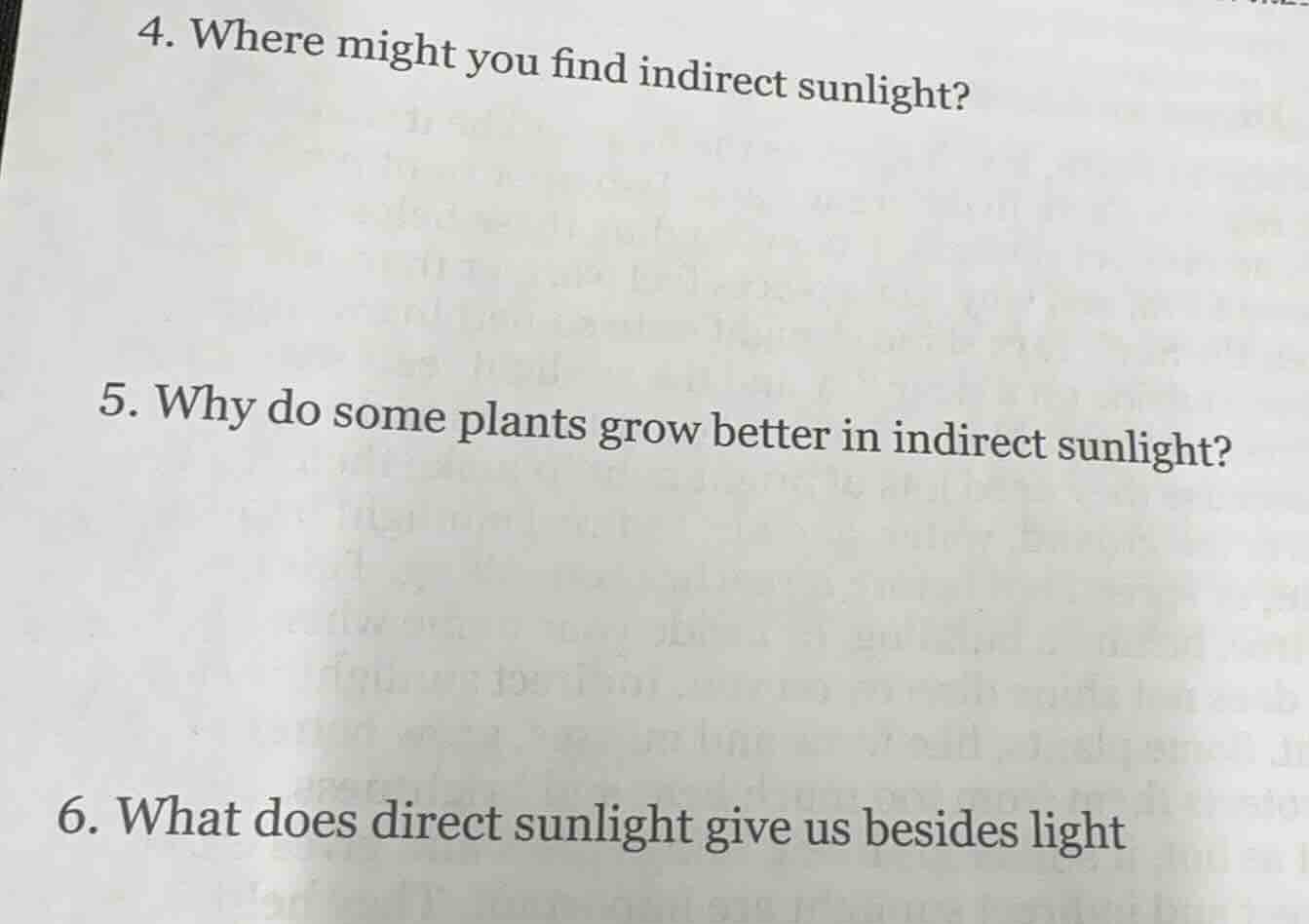
- where might you find indirect sunlight?
- why do some plants grow better in indirect sunlight?
- what does direct sunlight give us besides light
Question 4
Indirect sunlight occurs when the sun's rays are diffused or reflected before reaching an area. Common places include under a tree (where leaves block and scatter direct rays), inside a room with a window (glass can diffuse or reflect some light), or in a shaded patio (structures like umbrellas or awnings block direct rays).
Some plants (like ferns, peace lilies) are adapted to lower light intensities. Direct sunlight can cause excessive evaporation (water loss) and damage chloroplasts (from too much UV/heat), hindering photosynthesis. Indirect light provides enough energy for photosynthesis without these harms, so they grow better.
Direct sunlight provides heat (warming the Earth, aiding temperature regulation for life), ultraviolet (UV) radiation (needed for vitamin D synthesis in humans, though excess is harmful), and energy for photosynthesis in plants (which forms the base of food chains).

Snap & solve any problem in the app
Get step-by-step solutions on Sovi AI
Photo-based solutions with guided steps
Explore more problems and detailed explanations
Under a tree, inside a windowed room, or in a shaded patio (examples of areas with indirect sunlight).