QUESTION IMAGE
Question
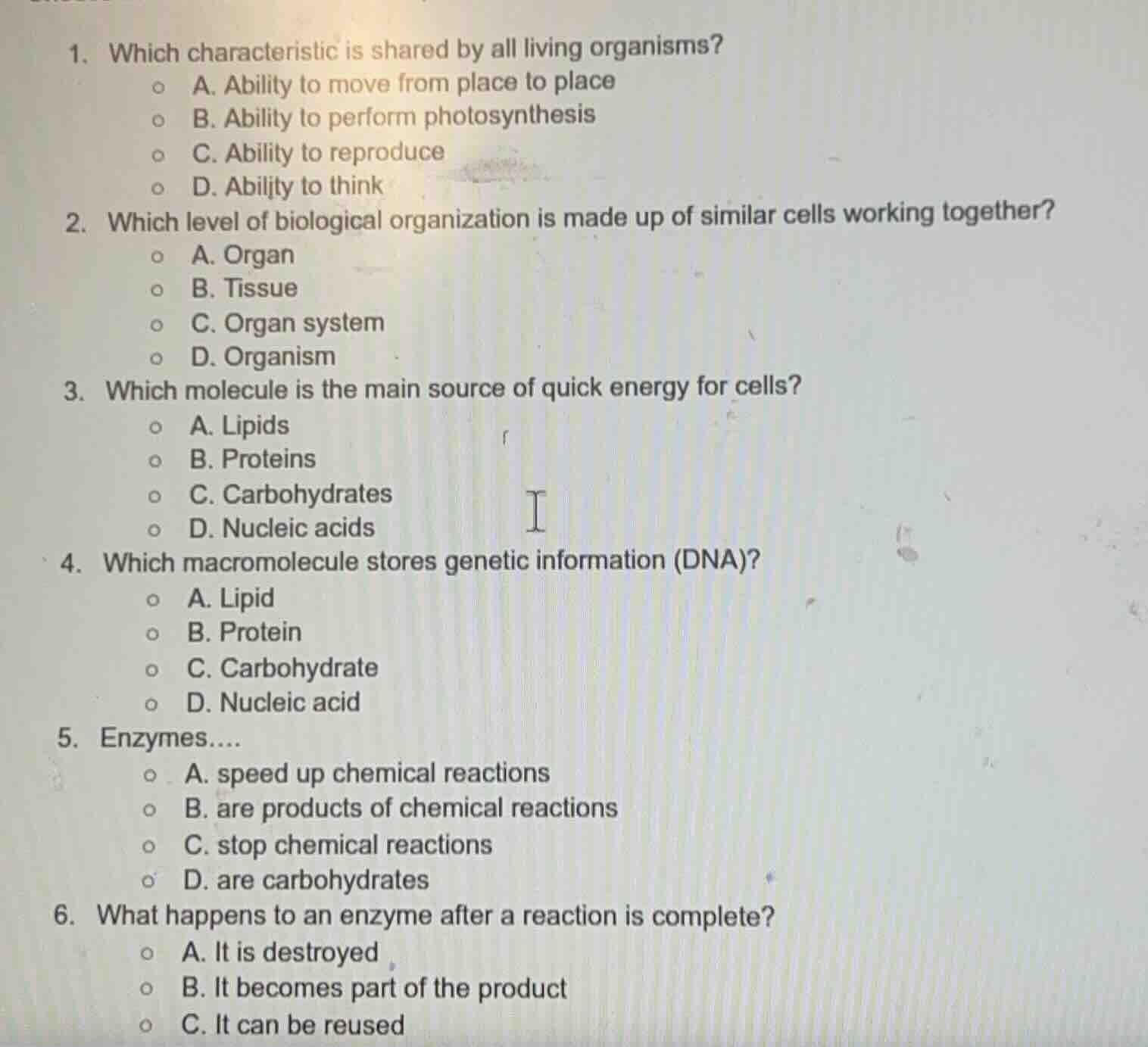
- which characteristic is shared by all living organisms?
a. ability to move from place to place
b. ability to perform photosynthesis
c. ability to reproduce
d. ability to think
- which level of biological organization is made up of similar cells working together?
a. organ
b. tissue
c. organ system
d. organism
- which molecule is the main source of quick energy for cells?
a. lipids
b. proteins
c. carbohydrates
d. nucleic acids
- which macromolecule stores genetic information (dna)?
a. lipid
b. protein
c. carbohydrate
d. nucleic acid
- enzymes....
a. speed up chemical reactions
b. are products of chemical reactions
c. stop chemical reactions
d. are carbohydrates
- what happens to an enzyme after a reaction is complete?
a. it is destroyed
b. it becomes part of the product
c. it can be reused
Response
Question 1
Brief Explanations
- Option A: Not all living organisms can move from place to place (e.g., plants are stationary).
- Option B: Only autotrophs (like plants) perform photosynthesis; heterotrophs do not.
- Option C: Reproduction (either sexually or asexually) is a fundamental characteristic of all living organisms to ensure the continuation of their species.
- Option D: Only organisms with complex nervous systems (like humans) can "think"; many organisms (e.g., bacteria) do not have this ability.
Brief Explanations
- Option A: An organ is made of different tissues working together.
- Option B: Tissue is defined as a group of similar cells that work together to perform a specific function.
- Option C: An organ system is a group of organs working together.
- Option D: An organism is a complete living entity made of organ systems (or simpler structures in single - celled organisms).
Brief Explanations
- Option A: Lipids are long - term energy storage molecules and are not the main source of quick energy.
- Option B: Proteins are mainly for structural support, enzyme activity, etc., and not the main quick energy source.
- Option C: Carbohydrates, especially glucose, are broken down quickly in cells to release energy (via cellular respiration), making them the main source of quick energy.
- Option D: Nucleic acids store genetic information and are not an energy source.

Snap & solve any problem in the app
Get step-by-step solutions on Sovi AI
Photo-based solutions with guided steps
Explore more problems and detailed explanations
C. Ability to reproduce