QUESTION IMAGE
Question
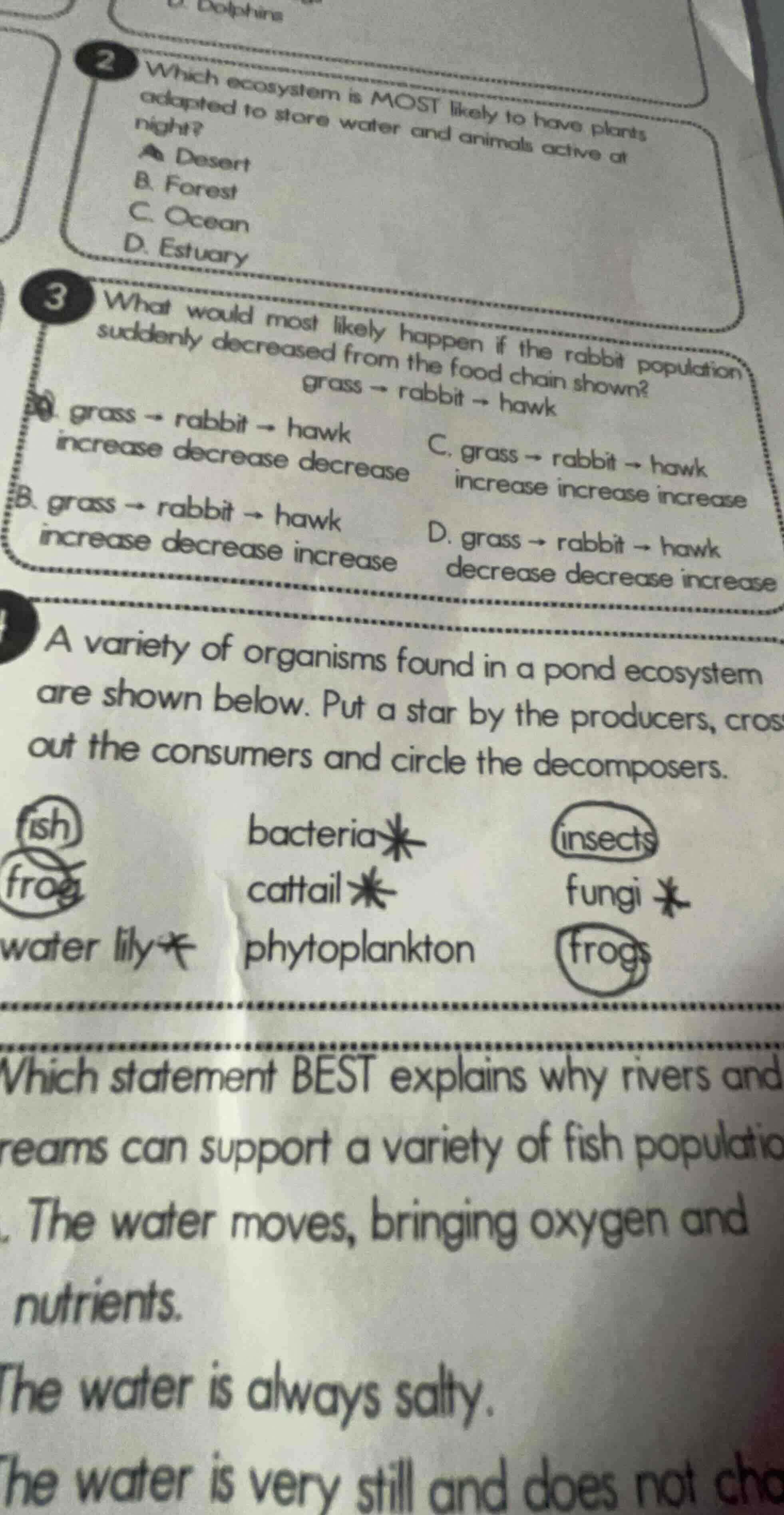
2 which ecosystem is most likely to have plants adapted to store water and animals active at night? a desert b. forest c. ocean d. estuary 3 what would most likely happen if the rabbit population suddenly decreased from the food chain shown? grass → rabbit → hawk a grass → rabbit → hawk increase decrease decrease b. grass → rabbit → hawk increase decrease increase c. grass → rabbit → hawk increase increase increase d. grass → rabbit → hawk decrease decrease increase a variety of organisms found in a pond ecosystem are shown below. put a star by the producers, cross out the consumers and circle the decomposers. fish bacteria insects frog cattail fungi water lily phytoplankton frogs which statement best explains why rivers and reams can support a variety of fish populatio. the water moves, bringing oxygen and nutrients. the water is always salty. the water is very still and does not cha
Question 2
Desert ecosystems have extreme heat during the day, so plants (like cacti) store water, and animals are active at night to avoid heat. Forests, oceans, and estuaries don't have this adaptation.
In the food chain grass → rabbit → hawk, if rabbits (prey) decrease, grass (producer) increases (less consumption), and hawks (predator) decrease (less food). So grass increases, rabbit decreases, hawk decreases.
- Producers: Make food via photosynthesis (water lily, cattail, phytoplankton).
- Consumers: Eat others (fish, insects, frogs).
- Decomposers: Break down matter (bacteria, fungi).
So:
- Producers (star): water lily, cattail, phytoplankton
- Consumers (cross out): fish, insects, frogs
- Decomposers (circle): bacteria, fungi
(Note: Original marks had errors—bacteria/fungi are decomposers, not producers; phytoplankton is a producer.)
Question (Rivers/Streams & Fish)
(Assuming options: A. Water moves, brings O₂/nutrients; B. Water is salty; C. Water is still...)

Snap & solve any problem in the app
Get step-by-step solutions on Sovi AI
Photo-based solutions with guided steps
Explore more problems and detailed explanations
A. Desert