QUESTION IMAGE
Question
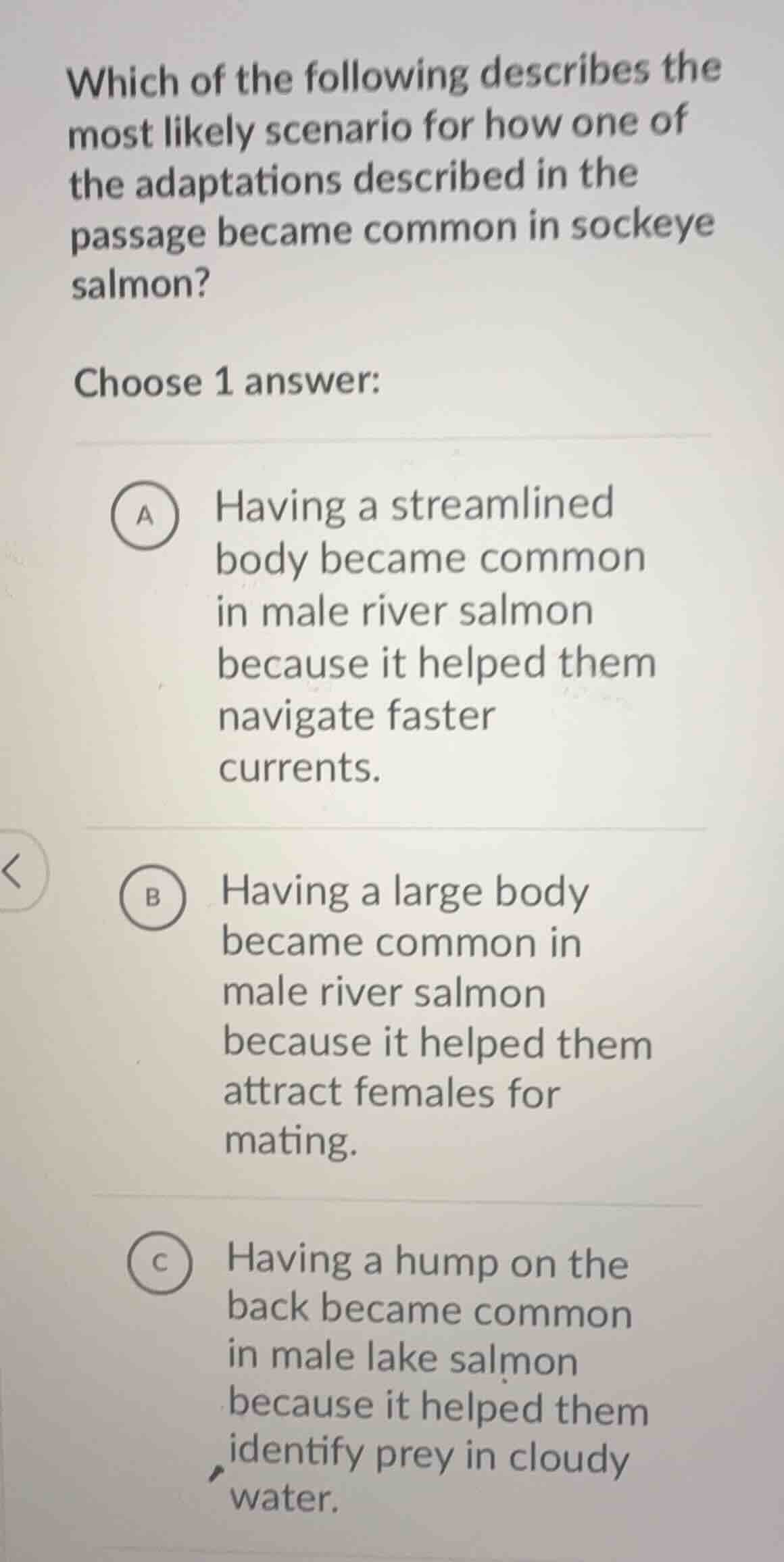
which of the following describes the most likely scenario for how one of the adaptations described in the passage became common in sockeye salmon? choose 1 answer: a having a streamlined body became common in male river salmon because it helped them navigate faster currents. b having a large body became common in male river salmon because it helped them attract females for mating. c having a hump on the back became common in male lake salmon because it helped them identify prey in cloudy water.
To determine the correct answer, we analyze each option based on evolutionary adaptations and the context of sockeye salmon (though the passage isn't fully provided, we use general knowledge about salmon adaptations):
- Option A: Streamlined bodies in river salmon (for faster current navigation) is plausible, but sockeye salmon males in rivers often have humps and more robust bodies, not just streamlined. Streamlined bodies are more associated with open - water/lake - to - ocean phases. So this is less likely.
- Option B: In sockeye salmon, male river - dwelling (spawning phase) salmon often develop larger bodies and humps. A larger body in male river salmon can be an adaptation for attracting females during mating (sexual selection). This aligns with the typical reproductive adaptations of male sockeye salmon in rivers.
- Option C: A hump on the back in male lake salmon for identifying prey in cloudy water is illogical. A hump is a reproductive/competitive adaptation (for fighting other males or attracting females), not for prey identification. Also, lake - dwelling sockeye (before spawning) have different body forms, and humps are more common in river - spawning males.

Snap & solve any problem in the app
Get step-by-step solutions on Sovi AI
Photo-based solutions with guided steps
Explore more problems and detailed explanations
B. Having a large body became common in male river salmon because it helped them attract females for mating.