QUESTION IMAGE
Question
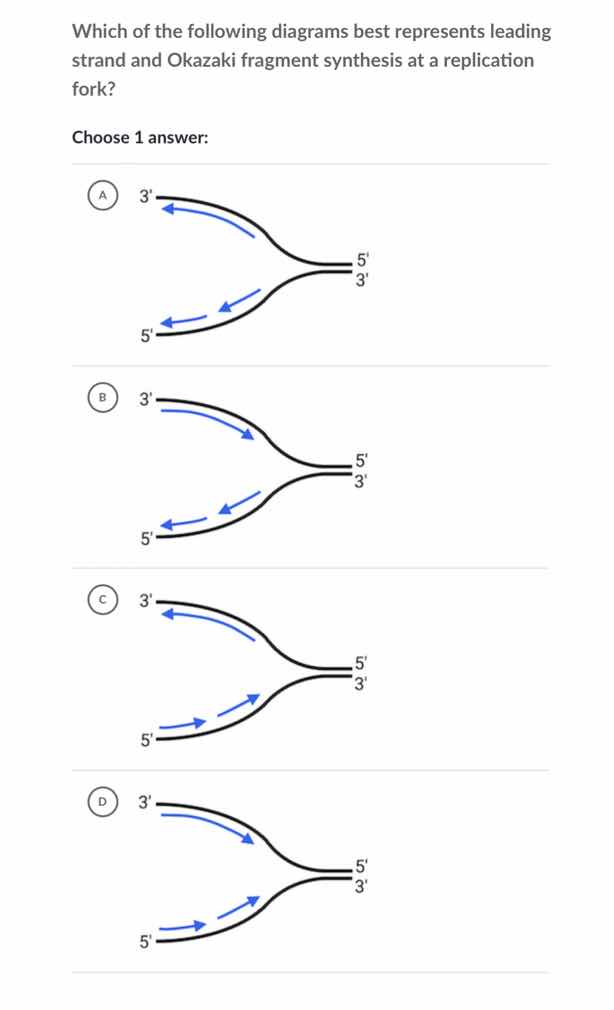
which of the following diagrams best represents leading strand and okazaki fragment synthesis at a replication fork? choose 1 answer: a
3’
←
5’
3’
5’
← ←
b
3’
→
5’
3’
5’
← ←
c
3’
←
5’
3’
5’
→ →
d
3’
→
5’
3’
5’
→ →
Brief Explanations
- DNA Replication Basics: DNA polymerase synthesizes new DNA in the \( 5' \to 3' \) direction. The leading strand is synthesized continuously (follows the replication fork), and the lagging strand (with Okazaki fragments) is synthesized discontinuously (opposite to the replication fork movement), with each Okazaki fragment also synthesized \( 5' \to 3' \).
- Analyzing the Diagrams:
- The replication fork has a \( 5' \to 3' \) template (top) and a \( 3' \to 5' \) template (bottom).
- The leading strand (on the \( 3' \to 5' \) template) should be synthesized continuously in the direction of the fork ( \( 5' \to 3' \), so the arrow points toward the fork).
- The lagging strand (on the \( 5' \to 3' \) template) has Okazaki fragments synthesized \( 5' \to 3' \), so the arrows for Okazaki fragments point away from the fork (since the template is \( 5' \to 3' \), the new strand must grow in the opposite direction of the fork’s movement).
- In option C: The leading strand (top) arrow points toward the fork (correct \( 5' \to 3' \) direction, following the fork), and the lagging strand (bottom) has Okazaki fragment arrows pointing away from the fork (each fragment is \( 5' \to 3' \), consistent with discontinuous synthesis). Other options fail:
- A: Leading strand arrow points away from the fork (incorrect direction).
- B: Lagging strand arrows point toward the fork (incorrect, as Okazaki fragments should grow opposite to fork movement).
- D: Leading strand arrow points toward the fork, but lagging strand arrows point toward the fork (incorrect for Okazaki fragments).

Snap & solve any problem in the app
Get step-by-step solutions on Sovi AI
Photo-based solutions with guided steps
Explore more problems and detailed explanations
C