QUESTION IMAGE
Question
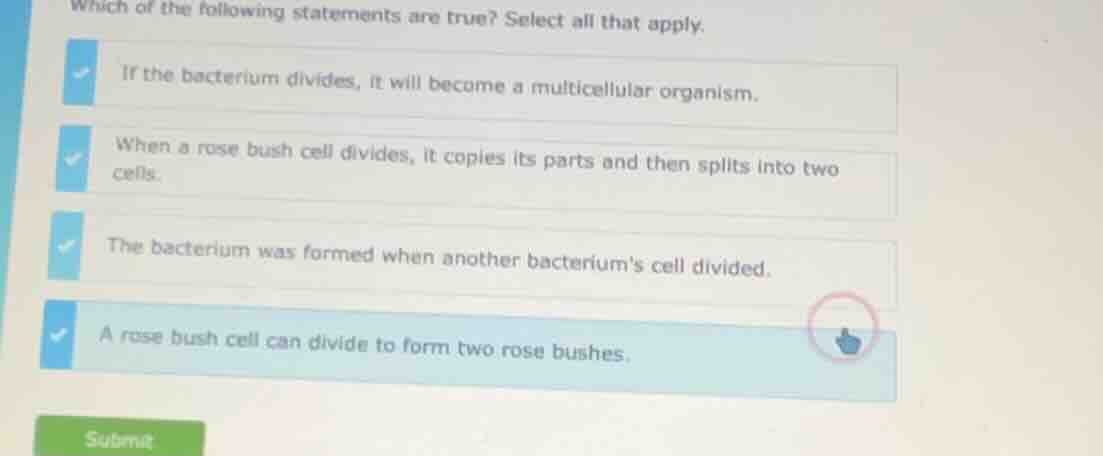
which of the following statements are true? select all that apply. if the bacterium divides, it will become a multicellular organism. when a rose bush cell divides, it copies its parts and then splits into two cells. the bacterium was formed when another bacteriums cell divided. a rose bush cell can divide to form two rose bushes.
Brief Explanations
- "If the bacterium divides, it will become a multicellular organism": Bacteria are unicellular, and cell division in bacteria (binary fission) results in two separate unicellular bacteria, not a multicellular organism. So this is false.
- "When a rose bush cell divides, it copies its parts and then splits into two cells": In cell division (mitosis/meiosis for plant cells), the cell replicates its components (like DNA, organelles) and then divides into two daughter cells. This is true for plant cell division.
- "The bacterium was formed when another bacterium's cell divided": Bacteria reproduce asexually by binary fission, where one bacterium divides into two. So a bacterium comes from the division of another bacterium. This is true.
- "A rose bush cell can divide to form two rose bushes": A single rose bush cell dividing (like in mitosis) will form new cells for the same rose bush (growth, repair) or gametes (for reproduction). It can't form two entire rose bushes. A rose bush reproduces via seeds (sexual) or vegetative propagation (like cuttings, which involve multiple cells/tissues), not a single cell dividing into two whole plants. So this is false.

Snap & solve any problem in the app
Get step-by-step solutions on Sovi AI
Photo-based solutions with guided steps
Explore more problems and detailed explanations
- When a rose bush cell divides, it copies its parts and then splits into two cells.
- The bacterium was formed when another bacterium's cell divided.