QUESTION IMAGE
Question
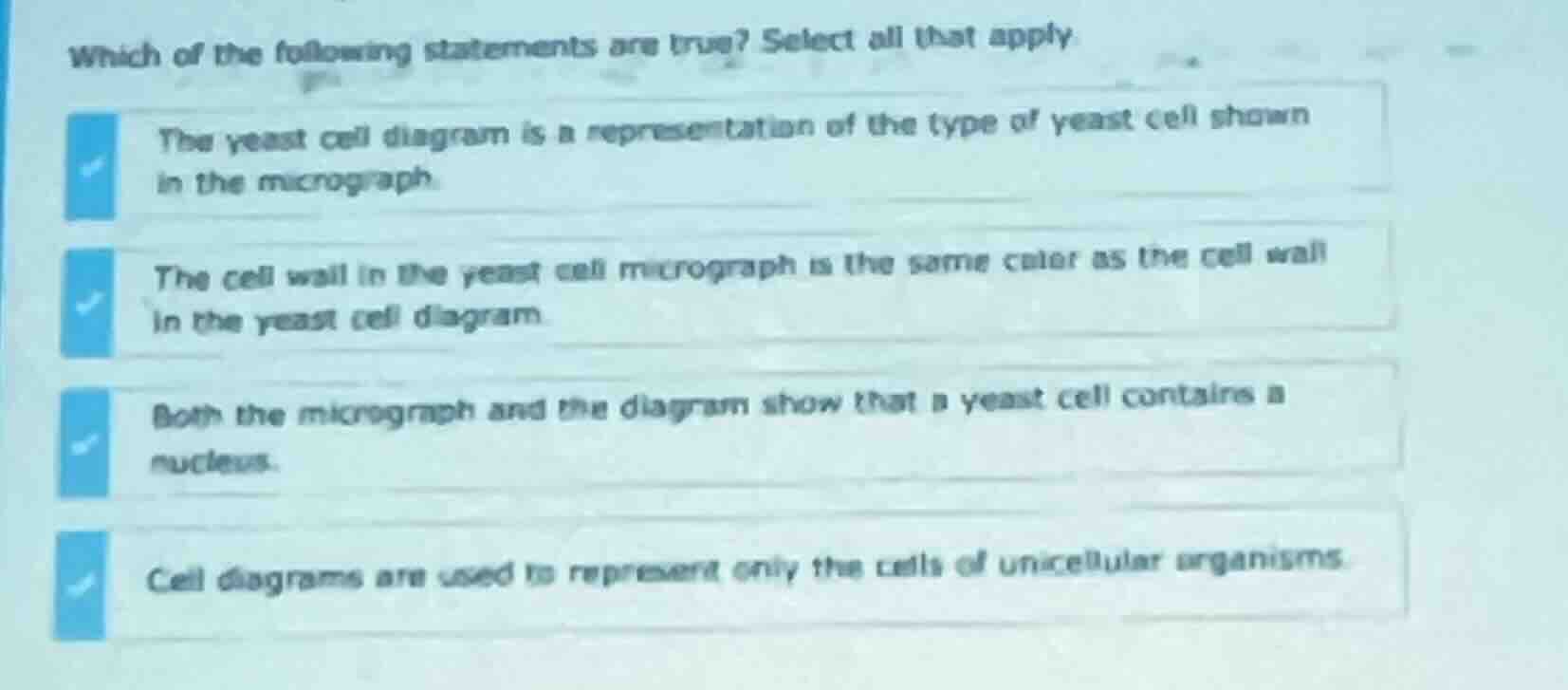
which of the following statements are true? select all that apply
the yeast cell diagram is a representation of the type of yeast cell shown in the micrograph.
the cell wall in the yeast cell micrograph is the same color as the cell wall in the yeast cell diagram.
both the micrograph and the diagram show that a yeast cell contains a nucleus.
cell diagrams are used to represent only the cells of unicellular organisms.
Brief Explanations
- For the first statement: A yeast cell diagram is typically a representation (simplified or detailed) of the yeast cell seen in a micrograph, so this is true.
- For the second statement: Micrographs (actual images) and diagrams (representations) can have different color schemes for the same structure (cell wall here), so this is false (the original check might be incorrect, but based on biological knowledge, micrograph color vs diagram color for cell wall is not necessarily same).
- For the third statement: Yeast cells are eukaryotic and have a nucleus, both micrograph (if properly stained) and diagram (which labels structures) can show the nucleus, so this is true.
- For the fourth statement: Cell diagrams are used for both unicellular (like yeast) and multicellular organisms' cells (e.g., plant, animal cells), so this is false (original check is incorrect).
Correct true statements:
- The yeast cell diagram is a representation of the type of yeast cell shown in the micrograph.
- Both the micrograph and the diagram show that a yeast cell contains a nucleus.

Snap & solve any problem in the app
Get step-by-step solutions on Sovi AI
Photo-based solutions with guided steps
Explore more problems and detailed explanations
- The yeast cell diagram is a representation of the type of yeast cell shown in the micrograph.
- Both the micrograph and the diagram show that a yeast cell contains a nucleus.