QUESTION IMAGE
Question
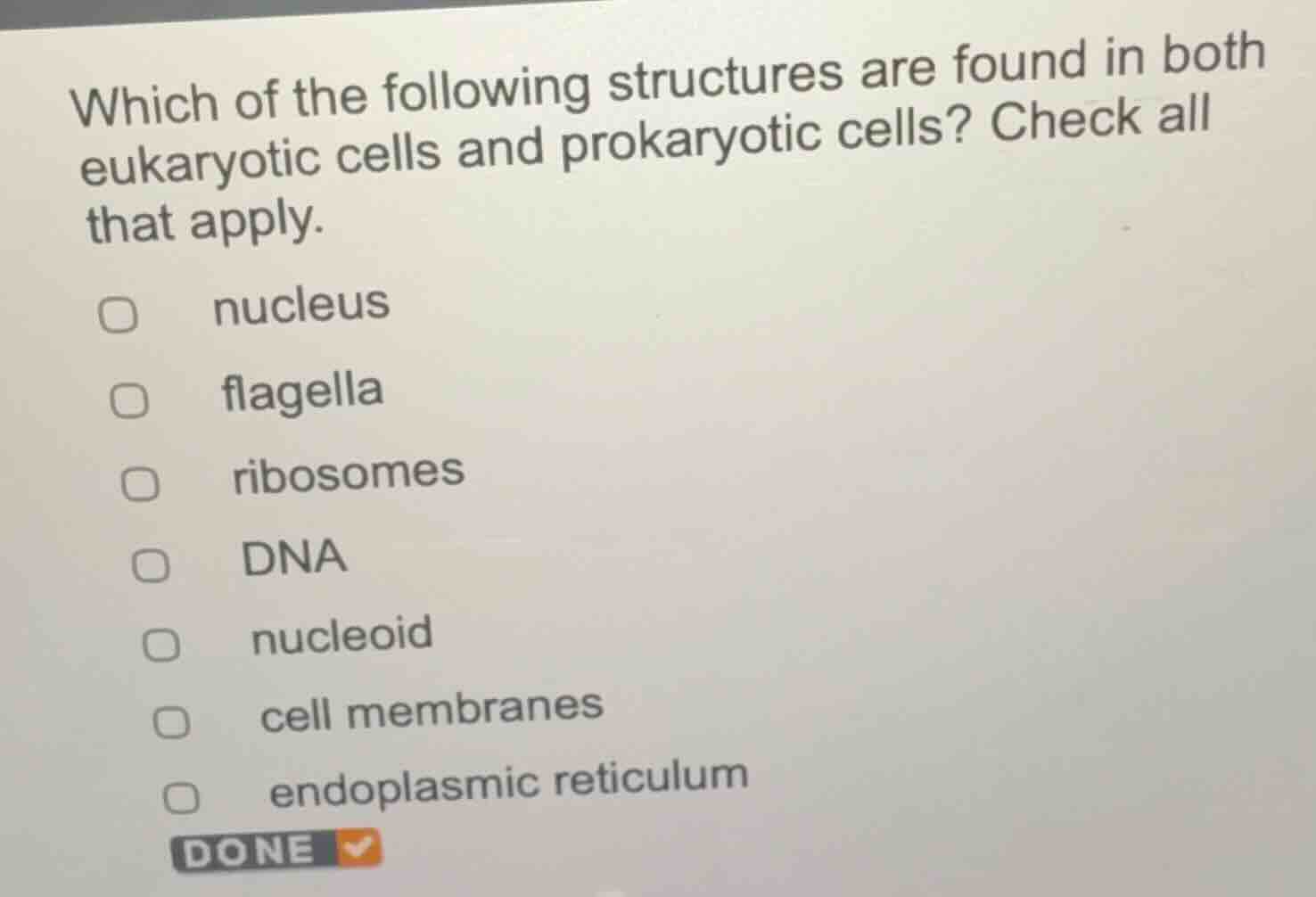
which of the following structures are found in both eukaryotic cells and prokaryotic cells? check all that apply.
□ nucleus
□ flagella
□ ribosomes
□ dna
□ nucleoid
□ cell membranes
□ endoplasmic reticulum
done
Brief Explanations
- Nucleus: Only eukaryotic cells have a nucleus (a membrane - bound organelle containing genetic material). Prokaryotic cells do not have a nucleus, instead they have a nucleoid region. So nucleus is not in both.
- Flagella: Some prokaryotic cells (like bacteria) and some eukaryotic cells (like certain protists and sperm cells) have flagella. Flagella can be used for cell movement in both types of cells.
- Ribosomes: Ribosomes are responsible for protein synthesis. Both prokaryotic and eukaryotic cells need to synthesize proteins, so both have ribosomes (although prokaryotic ribosomes are smaller - 70S and eukaryotic are 80S).
- DNA: Both prokaryotic and eukaryotic cells have DNA as their genetic material. Prokaryotic DNA is usually circular and in the nucleoid, while eukaryotic DNA is linear and in the nucleus, but DNA is present in both.
- Nucleoid: The nucleoid is a region in prokaryotic cells where their circular DNA is located. Eukaryotic cells do not have a nucleoid (they have a nucleus), so nucleoid is not in both.
- Cell membranes: The cell membrane (plasma membrane) is a fundamental structure that encloses the cell, separating the internal environment from the external environment. Both prokaryotic and eukaryotic cells have a cell membrane.
- Endoplasmic reticulum: The endoplasmic reticulum is a membrane - bound organelle. Only eukaryotic cells have membrane - bound organelles, so prokaryotic cells do not have an endoplasmic reticulum.

Snap & solve any problem in the app
Get step-by-step solutions on Sovi AI
Photo-based solutions with guided steps
Explore more problems and detailed explanations
- flagella
- ribosomes
- DNA
- cell membranes