QUESTION IMAGE
Question
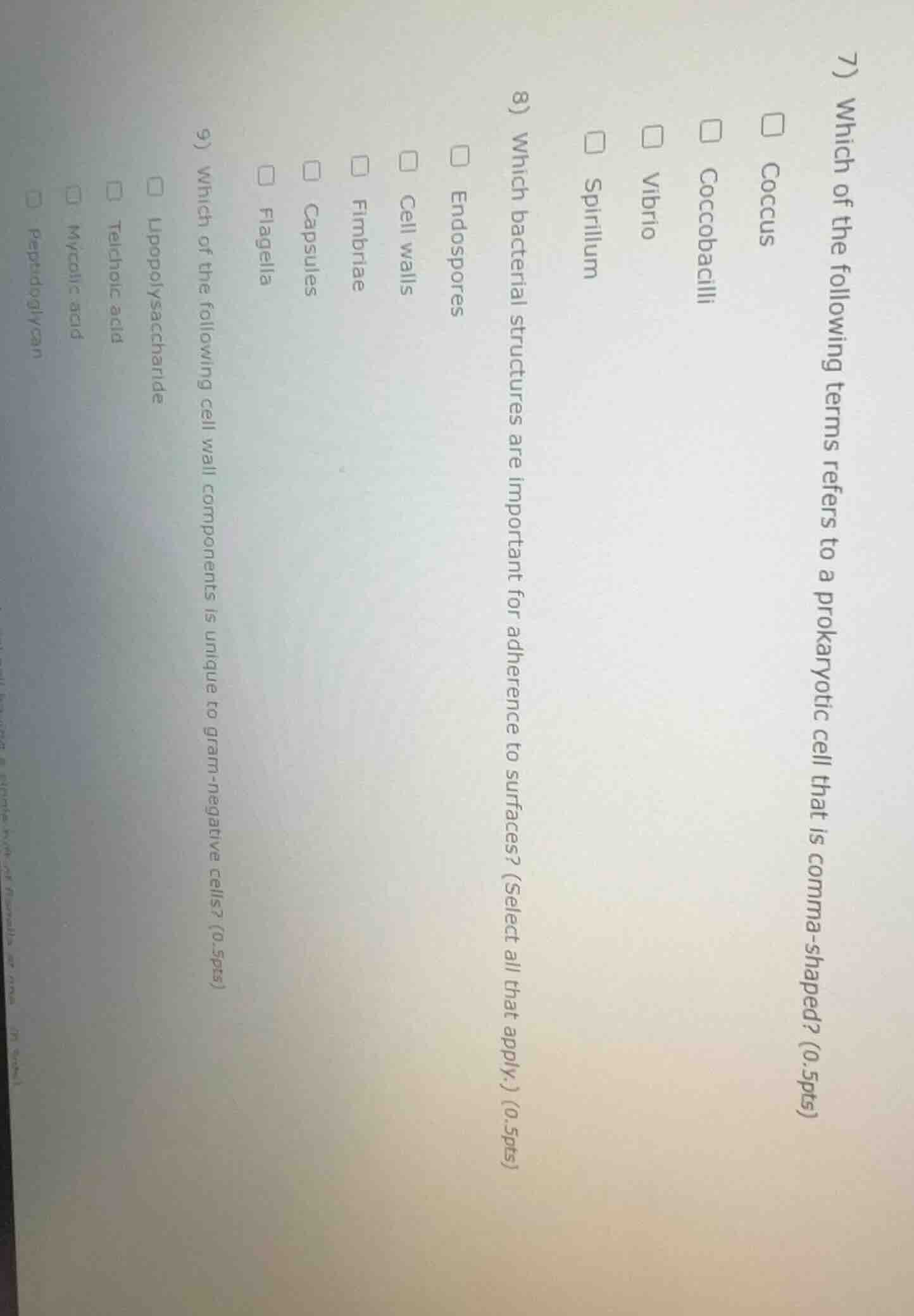
- which of the following terms refers to a prokaryotic cell that is comma - shaped? (0.5pts)
□ coccus
□ coccobacilli
□ vibrio
□ spirillum
- which bacterial structures are important for adherence to surfaces? (select all that apply.) (0.5pts)
□ endospores
□ cell walls
□ fimbriae
□ capsules
□ flagella
- which of the following cell wall components is unique to gram - negative cells? (0.5pts)
□ lipopolysaccharide
□ teichoic acid
□ mycolic acid
□ peptidoglycan
Brief Explanations
- Bacterial shapes are categorized by their morphology; comma-shaped prokaryotes are defined as Vibrio.
- Fimbriae are hair-like structures used by bacteria to adhere to surfaces, and capsules (a sticky outer layer) also aid in adherence to surfaces and host cells. Endospores are for survival, cell walls for structure, and flagella for motility.
- Gram-negative cell walls have an outer membrane containing lipopolysaccharide, which is not present in gram-positive cell walls. Teichoic acid is gram-positive specific, mycolic acid is for acid-fast bacteria, and peptidoglycan is present in both gram types (thinner in gram-negative).

Snap & solve any problem in the app
Get step-by-step solutions on Sovi AI
Photo-based solutions with guided steps
Explore more problems and detailed explanations
- □ Coccus
□ Coccobacilli
✅ Vibrio
□ Spirillum
- □ Endospores
□ Cell walls
✅ Fimbriae
✅ Capsules
□ Flagella
- ✅ Lipopolysaccharide
□ Teichoic acid
□ Mycolic acid
□ Peptidoglycan