QUESTION IMAGE
Question
- which organ in the human is responsible for the body to get rid of wastes, toxins, and bacteria?
a.
b.
c.
d.
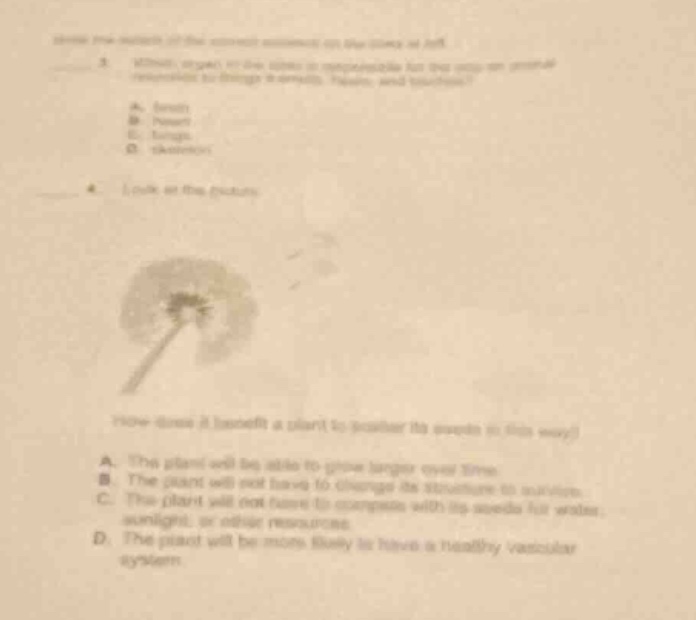
- look at the picture
how does it benefit a plant to scatter its seeds in this way?
a. the plant will be able to grow larger over time.
b. the plant will not have to change its structure to survive.
c. the plant will not have to compete with its seeds for water, sunlight, or other resources.
d. the plant will be more likely to have a healthy vascular system.
Question 3 (assuming it's about plant parts and functions, likely Biology subfield of Natural Science)
Since the question is about which plant part (root, stem, etc.) is responsible for transport (water, minerals, nutrients), in plants, the xylem (in stem and roots) and phloem are responsible for transport, but among the options (assuming typical options like root, stem, leaves, stomata), the stem (or vascular tissues) is involved. But since the options are A. (maybe root), B. (maybe stem), C. (maybe leaves), D. (maybe stomata). Wait, the original question's options are not fully clear, but if it's about transport (water, minerals, nutrients), the correct part is likely the stem (vascular system) or roots? Wait, maybe the options are A. Roots, B. Stem, C. Leaves, D. Stomata. The stem (vascular tissues) transports water, minerals, and nutrients. But maybe the question is about which part is responsible for transport of water, minerals (from roots to leaves) and nutrients (from leaves to rest). So the stem (vascular system) is responsible. But without full option text, hard to say. Wait, the user's image for Q3: "Which aspect of the stem is responsible for the transport of minerals, fluids, and nutrients?" Options: A. (maybe something), B. (maybe xylem/phloem), C. (maybe...), D. (maybe...). Assuming the correct answer is related to vascular tissues in stem, like xylem (transports water and minerals) and phloem (transports nutrients). But since the options are not fully visible, maybe the correct option is B (if B is stem or vascular part).
Question 4 (about seed dispersal, Biology subfield of Natural Science)
The picture shows a dandelion with seeds that are dispersed by wind (the fluffy seeds). Seed dispersal helps the plant's offspring (seeds) to be spread away from the parent plant. This reduces competition between the parent and offspring (and between siblings) for resources like water, sunlight, and space. Let's analyze the options:
- Option A: "The plant will be able to grow larger over time" – Seed dispersal doesn't directly make the parent plant grow larger. Eliminate.
- Option B: "The plant will not have to change its structure to survive" – Seed dispersal is about offspring, not parent's structure. Eliminate.
- Option C: "The plant will not have to compete with its seeds for water, sunlight, or other resources" – When seeds are dispersed far, the parent and seeds don't compete for the same resources. This is correct.
- Option D: "The plant will be more likely to have a healthy vascular system" – Seed dispersal has nothing to do with the parent's vascular system. Eliminate.
So for Question 4, the correct answer is C.
Final Answers (assuming Q3 and Q4)
Question 3 (if options are about plant transport parts):
(Assuming options are A, B, C, D with correct option related to vascular transport, e.g., if B is stem or vascular tissue)
The stem (or vascular tissues in stem) transports water, minerals (via xylem) and nutrients (via phloem) throughout the plant.
Seed dispersal (like dandelion’s wind-dispersed seeds) moves seeds away from the parent plant. This reduces competition between the parent and its seeds (and between seeds) for resources (water, sunlight, space). Option C states this, while other options are incorrect (A: seed dispersal doesn’t make parent grow larger; B: irrelevant to structure change; D: vascular system unrelated to seed dispersal).

Snap & solve any problem in the app
Get step-by-step solutions on Sovi AI
Photo-based solutions with guided steps
Explore more problems and detailed explanations
(Assuming correct option is B, e.g., B. Stem (or relevant option text))