QUESTION IMAGE
Question
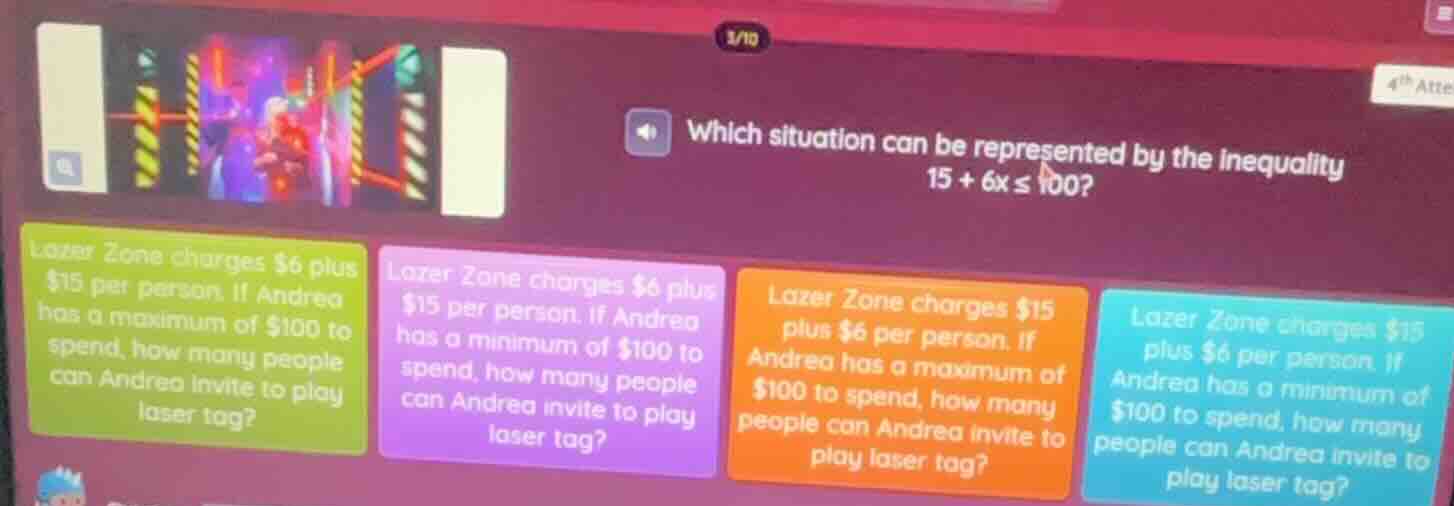
which situation can be represented by the inequality 15 + 6x ≤ 100? lazer zone charges $6 plus $15 per person. if andrea has a maximum of $100 to spend, how many people can andrea invite to play laser tag? lazer zone charges $6 plus $15 per person. if andrea has a minimum of $100 to spend, how many people can andrea invite to play laser tag? lazer zone charges $15 plus $6 per person. if andrea has a maximum of $100 to spend, how many people can andrea invite to play laser tag? lazer zone charges $15 plus $6 per person. if andrea has a minimum of $100 to spend, how many people can andrea invite to play laser tag?
Step1: Analyze the inequality structure
The inequality is \(15 + 6x\leq100\). Here, \(15\) is a fixed cost, \(6\) is the cost per person (so \(6x\) is the cost for \(x\) people), and \(\leq100\) means the total cost is at most (maximum) \(100\).
Step2: Analyze each option
- Green option: Says \(\$6\) plus \(\$15\) per person. But our inequality has \(15 + 6x\), so this is reversed. Eliminate.
- Purple option: Talks about minimum of \(\$100\) to spend, but our inequality is \(\leq100\) (maximum), so eliminate.
- Orange option: Says \(\$15\) plus \(\$6\) per person (matches \(15 + 6x\)) and maximum of \(\$100\) to spend (matches \(\leq100\)). This fits.
- Blue option: Talks about minimum of \(\$100\), which doesn't match \(\leq100\) (maximum). Eliminate.

Snap & solve any problem in the app
Get step-by-step solutions on Sovi AI
Photo-based solutions with guided steps
Explore more problems and detailed explanations
Orange option: Lazer Zone charges \$15 plus \$6 per person. If Andrea has a maximum of \$100 to spend, how many people can Andrea invite to play laser tag?