QUESTION IMAGE
Question
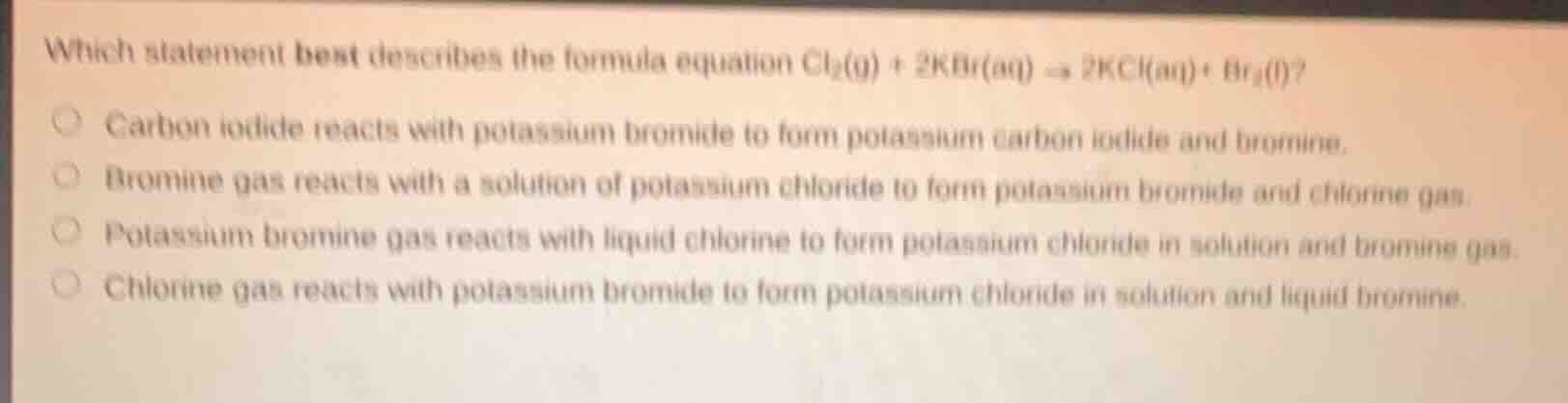
which statement best describes the formula equation $\ce{cl_2(g) + 2kbr(aq) -> 2kcl(aq) + br_2(l)}$?
- carbon iodide reacts with potassium bromide to form potassium carbon iodide and bromine.
- bromine gas reacts with a solution of potassium chloride to form potassium bromide and chlorine gas.
- potassium bromine gas reacts with liquid chlorine to form potassium chloride in solution and bromine gas.
- chlorine gas reacts with potassium bromide to form potassium chloride in solution and liquid bromine.
Brief Explanations
- Analyze the reactants and products from the chemical equation $\ce{Cl_{2}(g) + 2KBr(aq) \to 2KCl(aq) + Br_{2}(l)}$:
- Reactants: Chlorine gas ($\ce{Cl_{2}(g)}$) and potassium bromide ($\ce{KBr(aq)}$).
- Products: Potassium chloride ($\ce{KCl(aq)}$) and liquid bromide ($\ce{Br_{2}(l)}$).
- Evaluate each option:
- First option: Incorrect reactants (mentions carbon iodide, which is not in the equation).
- Second option: Incorrect reactants (bromine gas is a product, not a reactant; potassium chloride is a product, not a reactant).
- Third option: Incorrect reactants (potassium bromine gas is not a valid species, and chlorine is gas, not liquid here).
- Fourth option: Correctly identifies reactants (chlorine gas, potassium bromide) and products (potassium chloride in solution, liquid bromine) as per the equation.

Snap & solve any problem in the app
Get step-by-step solutions on Sovi AI
Photo-based solutions with guided steps
Explore more problems and detailed explanations
D. Chlorine gas reacts with potassium bromide to form potassium chloride in solution and liquid bromine.