QUESTION IMAGE
Question
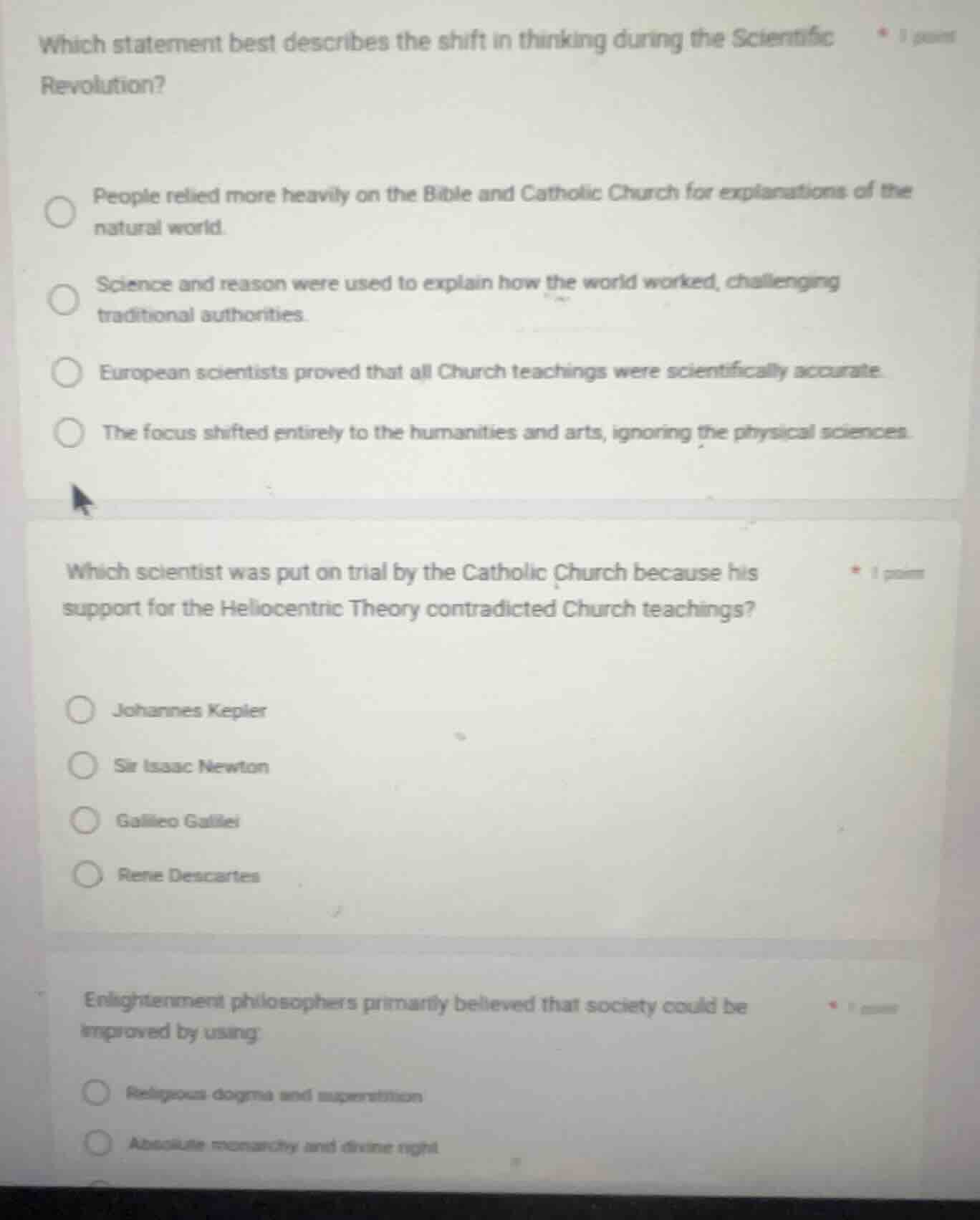
which statement best describes the shift in thinking during the scientific revolution?
people relied more heavily on the bible and catholic church for explanations of the natural world.
science and reason were used to explain how the world worked, challenging traditional authorities.
european scientists proved that all church teachings were scientifically accurate.
the focus shifted entirely to the humanities and arts, ignoring the physical sciences.
which scientist was put on trial by the catholic church because his support for the heliocentric theory contradicted church teachings?
johannes kepler
sir isaac newton
galileo galilei
rene descartes
enlightenment philosophers primarily believed that society could be improved by using:
religious dogma and superstition
absolute monarchy and divine right
First Question (Which statement best describes the shift in thinking during the Scientific Revolution?)
- The first option is incorrect because the Scientific Revolution moved away from relying on the Bible/Church for natural world explanations.
- The second option is correct: The Scientific Revolution emphasized using science and reason to explain the world, which challenged traditional authorities like the Church.
- The third option is incorrect as scientists often found Church teachings (like geocentrism) scientifically inaccurate.
- The fourth option is incorrect as the Scientific Revolution focused on physical sciences, not ignoring them.
- Johannes Kepler contributed to heliocentric theory but was not tried by the Church.
- Sir Isaac Newton worked on gravity and mechanics, not tried for heliocentrism.
- Galileo Galilei supported heliocentrism and was tried by the Catholic Church.
- Rene Descartes was a philosopher/mathematician, not tried for heliocentrism.

Snap & solve any problem in the app
Get step-by-step solutions on Sovi AI
Photo-based solutions with guided steps
Explore more problems and detailed explanations
B. Science and reason were used to explain how the world worked, challenging traditional authorities.