QUESTION IMAGE
Question
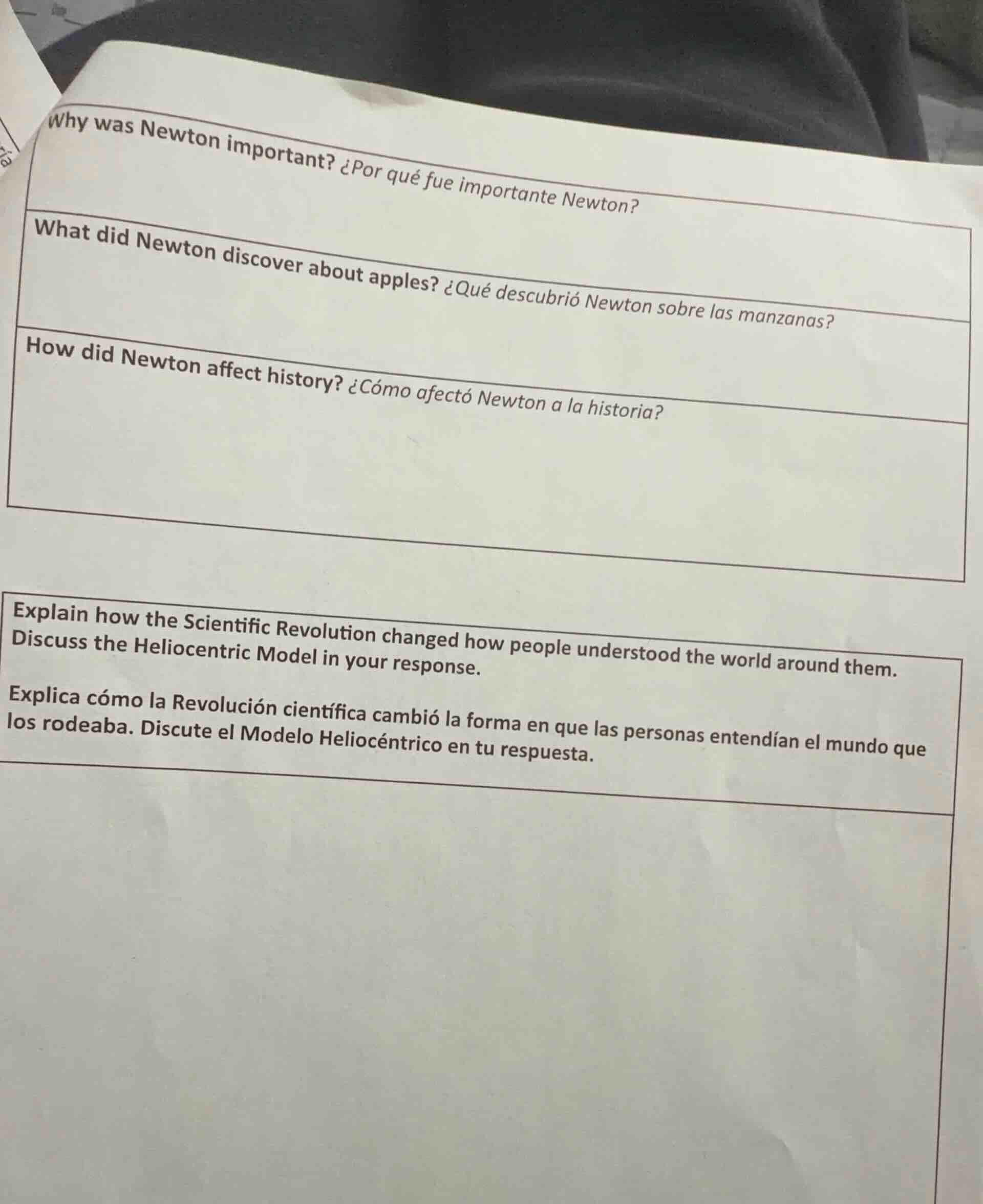
why was newton important? ¿por qué fue importante newton?
what did newton discover about apples? ¿qué descubrió newton sobre las manzanas?
how did newton affect history? ¿cómo afectó newton a la historia?
explain how the scientific revolution changed how people understood the world around them. discuss the heliocentric model in your response.
explica cómo la revolución científica cambió la forma en que las personas entendían el mundo que los rodeaba. discute el modelo heliocéntrico en tu respuesta.
- For Newton's importance: He laid foundational laws for physics and math, unifying celestial and terrestrial mechanics, and developed calculus.
- For the apple discovery: The apple's fall inspired his theory of universal gravitation, that a single force pulls objects toward Earth and governs celestial bodies.
- For Newton's historical impact: His work shifted science from qualitative observation to mathematical analysis, enabling modern physics, engineering, and scientific method advancement.
- For the Scientific Revolution: It replaced religious/traditional explanations with empirical, evidence-based inquiry. The heliocentric model (sun-centered solar system, replacing the Earth-centered geocentric model) was a core shift, showing the universe follows predictable, mathematical laws, empowering people to question authority and seek testable truths about the natural world.

Snap & solve any problem in the app
Get step-by-step solutions on Sovi AI
Photo-based solutions with guided steps
Explore more problems and detailed explanations
- Why was Newton important?
Newton was a foundational figure in physics and mathematics; he established the three Laws of Motion, the law of universal gravitation, and co-developed calculus, unifying celestial and terrestrial physical laws and creating critical tools for scientific and mathematical analysis.
- What did Newton discover about apples?
The legend of the falling apple inspired his development of the law of universal gravitation: he realized the same gravitational force that pulls an apple toward the Earth also governs the motion of celestial bodies like the moon.
- How did Newton affect history?
Newton's work revolutionized scientific thought by prioritizing mathematical, empirical evidence over traditional or philosophical reasoning. His laws became the basis for classical physics, enabling technological advancements in engineering, astronomy, and other fields, and establishing the modern scientific method as a standard for understanding the natural world.
- Explain how the Scientific Revolution changed how people understood the world around them. Discuss the Heliocentric Model in your response.
Before the Scientific Revolution, most people understood the world through religious doctrine and ancient authorities (like Aristotle), which promoted the geocentric model (Earth as the center of the universe). The Scientific Revolution shifted this to a system based on empirical observation, experimentation, and mathematical proof. The heliocentric model (first advanced by Copernicus, supported by Galileo and later explained by Newton's gravity laws) was a pivotal shift: it proved the sun, not Earth, was the center of our solar system. This challenged long-held religious and cultural beliefs, showing the universe follows predictable, natural laws rather than being centered on human or Earthly concerns. It encouraged people to question established authority and seek testable, evidence-based explanations for natural phenomena, laying the groundwork for modern science and a more objective understanding of the world.