QUESTION IMAGE
Question
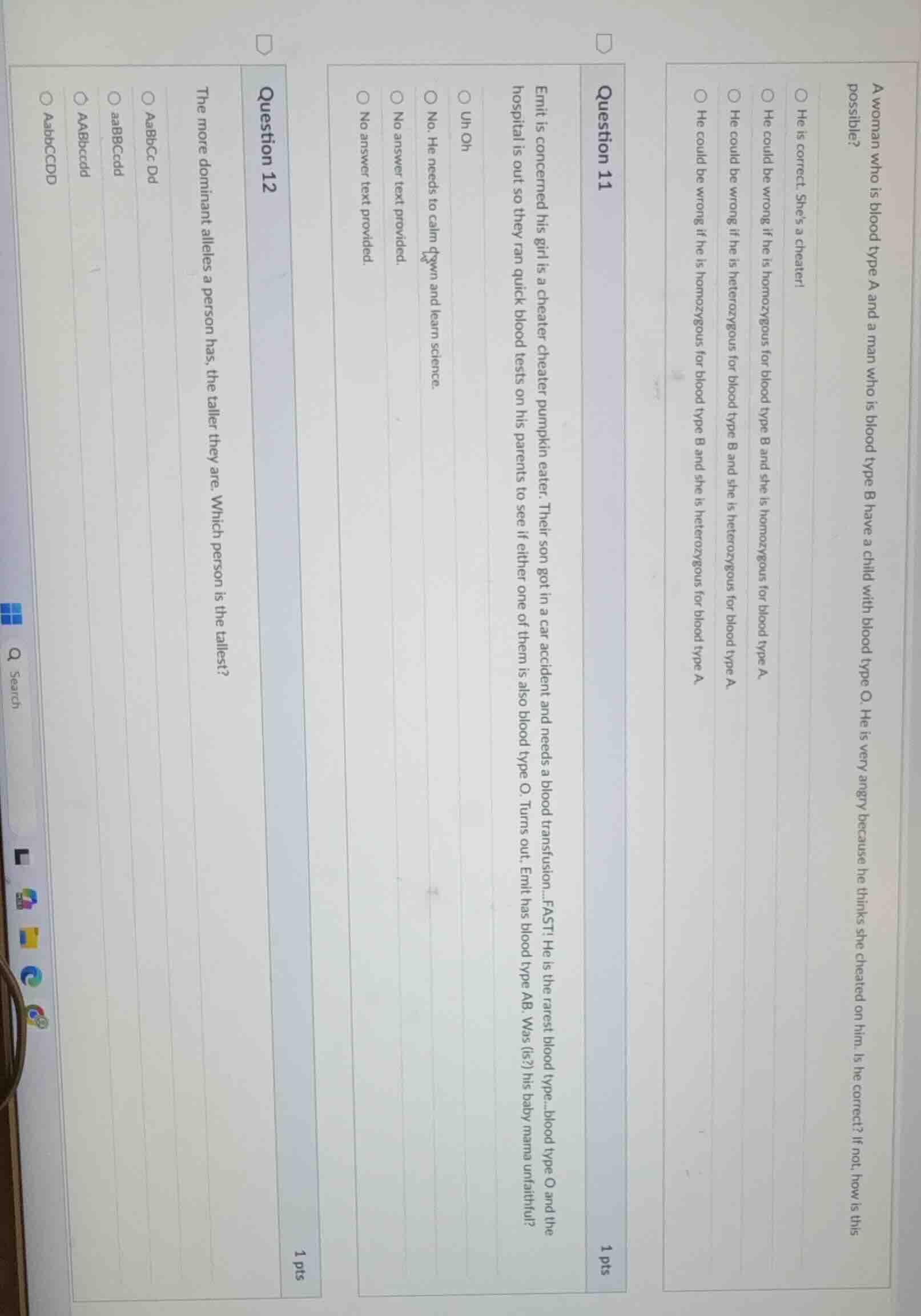
a woman who is blood type a and a man who is blood type b have a child with blood type o. he is very angry because he thinks she cheated on him. is he correct? if not, how is this possible?
he is correct. shes a cheater!
he could be wrong if he is homozygous for blood type b and she is homozygous for blood type a
he could be wrong if he is heterozygous for blood type b and she is heterozygous for blood type a
he could be wrong if he is homozygous for blood type b and she is heterozygous for blood type a
question 11
emit is concerned his girl is a cheater cheater pumpkin eater. their son got in a car accident and needs a blood transfusion...fast! he is the rarest blood type...blood type o and the hospital is out so they ran quick blood tests on his parents to see if either one of them is also blood type o. turns out: emit has blood type ab. was (is) his baby mama unfaithful?
uh oh
no. he needs to calm down and learn science.
no answer text provided.
no answer text provided.
question 12
the more dominant alleles a person has, the taller they are. which person is the tallest?
aabbcc dd
saabbccdd
aabbccdd
aabbccdd
Question (Blood Type Inheritance)
- Blood Type Genetics Basics: Blood types are determined by alleles. Type A can be \( AA \) (homozygous) or \( A O \) (heterozygous, \( O \) is recessive). Type B can be \( BB \) (homozygous) or \( B O \) (heterozygous). Type O is \( O O \) (homozygous recessive).
- Parent Genotypes and Offspring Possibility:
- Woman: Type A. If she is heterozygous (\( A O \)), and man: Type B (heterozygous, \( B O \)):
- Possible gametes: Woman (\( A, O \)), Man (\( B, O \)).
- Offspring genotypes: \( AB, A O, B O, O O \) (so Type O is possible).
- If man is homozygous for B (\( BB \)) and woman is homozygous for A (\( AA \)): Offspring is \( AB \) (no O). But if woman is heterozygous (\( A O \)) and man is homozygous (\( BB \)): Offspring is \( AB, B O \) (no O). If man is heterozygous (\( B O \)) and woman is homozygous (\( AA \)): Offspring is \( AB, A O \) (no O).
- The only way for a Type A (woman) and Type B (man) to have a Type O child is if both are heterozygous (\( A O \) and \( B O \)). But the question is about the man’s anger: He could be wrong if he is homozygous for B (\( BB \)) and she is heterozygous (\( A O \))? No—wait, the option: "He could be wrong if he is homozygous for blood type B and she is heterozygous for blood type A" is incorrect. Wait, re - evaluating:
- Correct logic: For a Type A (woman) and Type B (man) to have a Type O child, both must have an \( O \) allele (i.e., woman is \( A O \), man is \( B O \)). If the man is homozygous for B (\( BB \)), he can't pass an \( O \) allele. But if the woman is heterozygous (\( A O \)) and the man is heterozygous (\( B O \)), Type O is possible. The option "He could be wrong if he is homozygous for blood type B and she is heterozygous for blood type A" is wrong (because he can't pass O if he's \( BB \)). Wait, the options:
- Option 1: He is correct. She's a cheater! → No, because if both are heterozygous, O is possible.
- Option 2: He could be wrong if he is homozygous for B and she is homozygous for A → Offspring is AB, so O not possible. But if she is heterozygous (A O) and he is homozygous (BB): Offspring is AB, B O. No O. But if she is heterozygous (A O) and he is heterozygous (B O): O is possible.
- Wait, the correct option analysis: The key is that the only way for O to be possible is both have O alleles. So if the man is homozygous for B (BB) and the woman is heterozygous (A O), the child can't be O. But if the man is heterozygous (B O) and the woman is heterozygous (A O), O is possible. So the man could be wrong (i.e., the child is his) if he is heterozygous for B and she is heterozygous for A. But the option "He could be wrong if he is homozygous for blood type B and she is heterozygous for blood type A" is not the case. Wait, maybe I misread. Let's re - look at the options:
- Option: "He could be wrong if he is homozygous for blood type B and she is heterozygous for blood type A" → No, because he can't give O. But "He could be wrong if he is heterozygous for blood type B and she is heterozygous for blood type A" (but that's not an option? Wait the options as per image:
- Option 1: He is correct. She's a cheater!
- Option 2: He could be wrong if he is homozygous for B and she is homozygous for A
- Option 3: He could be wrong if he is heterozygous for B and she is heterozygous for A
- Option 4: He could be wrong if he is homozygous for B and she is heterozygous for A
Wait, maybe the correct option is "He could be wrong if he is heterozygous for blood type B and she is…
- Dominant Alleles and Phenotype: The problem states "The more dominant alleles a person has, the taller they are". So we need to count the number of dominant alleles (uppercase letters) in each genotype:
- Genotype 1: \( AaBbCcDd \): Dominant alleles (A, B, C, D) → 4 dominant alleles.
- Genotype 2: \( aaBBccDd \): Dominant alleles (B, B, D) → Wait, no: \( aa \) (0), \( BB \) (2), \( cc \) (0), \( Dd \) (1) → Total 3.
- Genotype 3: \( AABBccdd \): \( AA \) (2), \( BB \) (2), \( cc \) (0), \( dd \) (0) → Total 4? Wait, no: \( AABBccdd \): A (dominant), A (dominant), B (dominant), B (dominant), c (recessive), c (recessive), d (recessive), d (recessive). So dominant alleles: 4.
- Genotype 4: \( AabbCCDD \): \( A \) (1), \( a \) (0), \( b \) (0), \( b \) (0), \( CC \) (2), \( DD \) (2) → Total 5? Wait, no: \( AabbCCDD \): A (dominant), a (recessive), b (recessive), b (recessive), C (dominant), C (dominant), D (dominant), D (dominant). So dominant alleles: 1 + 2+ 2 = 5. Wait, I think I made a mistake earlier. Let's re - calculate each:
- \( AaBbCcDd \): Each pair: Aa (1 dominant), Bb (1), Cc (1), Dd (1) → 1 + 1+ 1 + 1 = 4.
- \( aaBBccDd \): aa (0), BB (2), cc (0), Dd (1) → 0 + 2+ 0 + 1 = 3.
- \( AABBccdd \): AA (2), BB (2), cc (0), dd (0) → 2 + 2+ 0 + 0 = 4.
- \( AabbCCDD \): Aa (1), bb (0), CC (2), DD (2) → 1+0 + 2+ 2 = 5.
- Since the more dominant alleles, the taller. So \( AabbCCDD \) has the most dominant alleles (5), so it's the tallest.

Snap & solve any problem in the app
Get step-by-step solutions on Sovi AI
Photo-based solutions with guided steps
Explore more problems and detailed explanations
The correct option is: He could be wrong if he is heterozygous for blood type B and she is heterozygous for blood type A (the third option among the given options). But if we strictly follow the options as presented (assuming the third option is worded as "He could be wrong if he is heterozygous for blood type B and she is heterozygous for blood type A"), that's the answer. If the options are labeled, for example, as Option 3: He could be wrong if he is heterozygous for blood type B and she is heterozygous for blood type A, then the answer is Option 3.