QUESTION IMAGE
Question
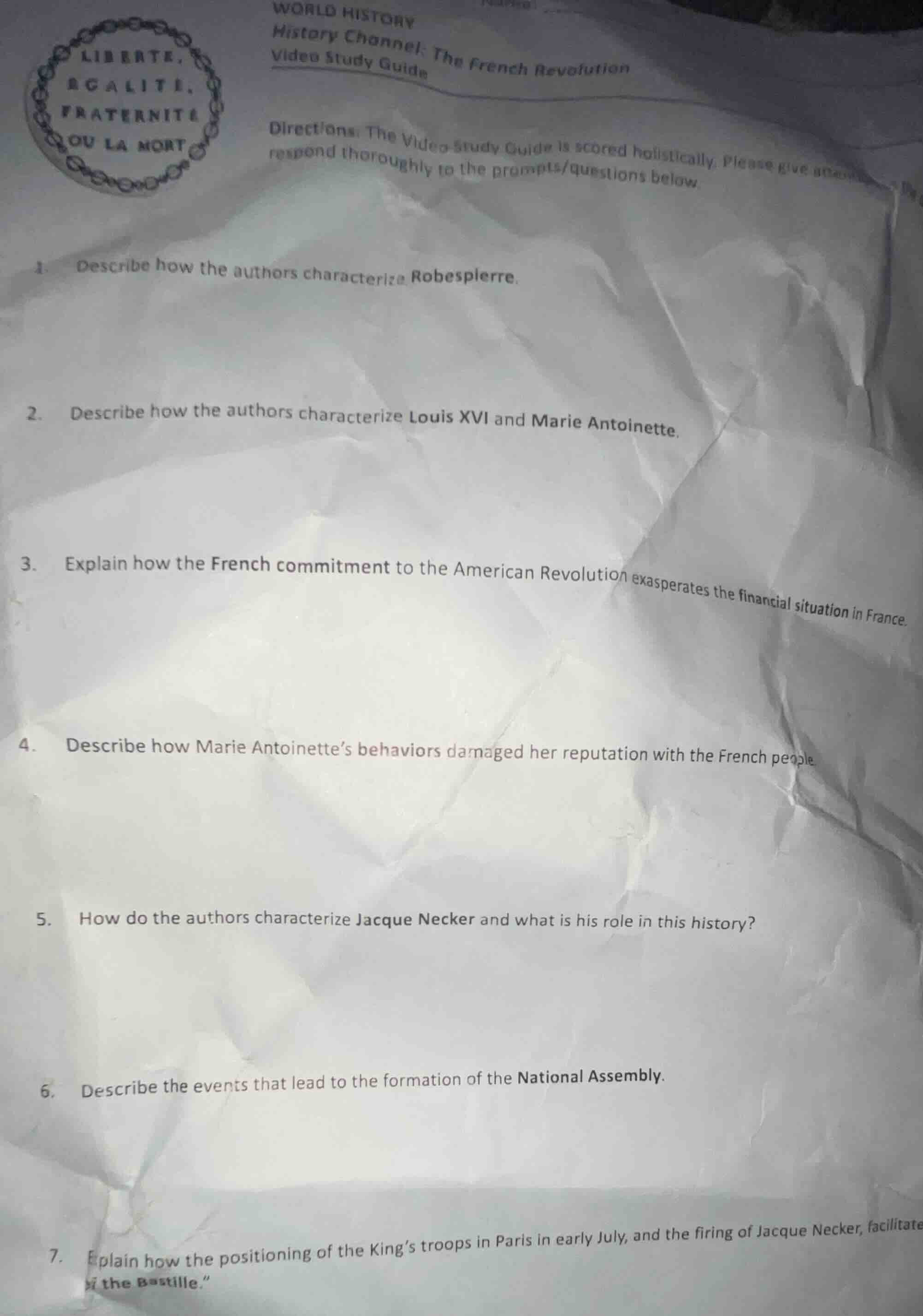
world history history channel: the french revolution video study guide directions: the video study guide is scored holistically. please give att respond thoroughly to the prompts/questions below. 1. describe how the authors characterize robespierre. 2. describe how the authors characterize louis xvi and marie antoinette. 3. explain how the french commitment to the american revolution exasperates the financial situation in france. 4. describe how marie antoinette’s behaviors damaged her reputation with the french people. 5. how do the authors characterize jacque necker and what is his role in this history? 6. describe the events that lead to the formation of the national assembly. 7. explain how the positioning of the king’s troops in paris in early july, and the firing of jacque necker, facilitate of the bastille.
To answer these questions, we analyze each one based on historical knowledge of the French Revolution:
Question 1: Characterize Robespierre
Robespierre was a key figure in the French Revolution, especially during the Reign of Terror. Authors often portray him as a radical, idealistic revolutionary committed to the principles of liberty, equality, and fraternity (seen in the emblem “Liberté, Égalité, Fraternité ou la Mort”). He was dedicated to purging counter - revolutionaries but is also criticized for the extreme violence of the Terror, with a complex legacy as both a defender of the revolution’s ideals and an architect of mass executions.
Question 2: Characterize Louis XVI and Marie Antoinette
- Louis XVI: Depicted as indecisive, weak - willed, and out of touch with the suffering of the French people. He struggled to address the financial and political crises, and his attempts at reform were often ineffective or poorly executed.
- Marie Antoinette: Portrayed as extravagant, out of touch, and seen as a symbol of royal excess. Rumors (whether true or not) of her lavish spending, such as the “Let them eat cake” myth (though likely apocryphal), and her Austrian heritage made her unpopular, with many viewing her as a drain on the treasury and a foe of the common people.
Question 3: French Commitment to American Revolution and French Finances
France’s support for the American Revolution (supplying troops, money, and naval aid) was extremely costly. France already had a large national debt from previous wars and royal spending. The additional expenses of the American Revolution exacerbated this debt. To pay for the war, the government had to raise taxes or borrow more, which angered the already - struggling Third Estate and contributed to the financial crisis that helped spark the French Revolution.
Question 4: Marie Antoinette’s Reputation Damage
Marie Antoinette’s reputation was damaged by her perceived extravagance (e.g., spending on palaces, fashion, and parties at Versailles while the people starved), her Austrian background (seen as a foreign influence), and rumors of immoral behavior (such as the Diamond Necklace Affair, a scandal where she was falsely accused of participating in a plot to steal a costly necklace). These factors made her a target of public anger and propaganda, painting her as a symbol of royal corruption.
Question 5: Characterize Jacque Necker and His Role
- Characterization: Necker was a reform - minded finance minister, seen as honest and sympathetic to the Third Estate. He tried to address France’s financial problems through reforms like publishing the royal accounts to show the true state of the debt.
- Role: He was a moderate voice, advocating for tax reforms that would make the nobility and clergy pay their fair share. His firing in 1789 (before the storming of the Bastille) was a major trigger for public outrage, as he was one of the few officials the people trusted to fix the financial crisis.
Question 6: Events Leading to National Assembly
The Estates - General was called in 1789 to address the financial crisis. The Third Estate (commoners), which represented the majority of the population, was frustrated with the traditional voting system (where each estate had one vote, meaning the First and Second Estates could always outvote the Third). The Third Estate declared itself the National Assembly in June 1789, claiming to represent the nation. When Louis XVI tried to lock them out of their meeting place, they moved to a tennis court and took the Tennis Court Oa…

Snap & solve any problem in the app
Get step-by-step solutions on Sovi AI
Photo-based solutions with guided steps
Explore more problems and detailed explanations
To answer these questions, we analyze each one based on historical knowledge of the French Revolution:
Question 1: Characterize Robespierre
Robespierre was a key figure in the French Revolution, especially during the Reign of Terror. Authors often portray him as a radical, idealistic revolutionary committed to the principles of liberty, equality, and fraternity (seen in the emblem “Liberté, Égalité, Fraternité ou la Mort”). He was dedicated to purging counter - revolutionaries but is also criticized for the extreme violence of the Terror, with a complex legacy as both a defender of the revolution’s ideals and an architect of mass executions.
Question 2: Characterize Louis XVI and Marie Antoinette
- Louis XVI: Depicted as indecisive, weak - willed, and out of touch with the suffering of the French people. He struggled to address the financial and political crises, and his attempts at reform were often ineffective or poorly executed.
- Marie Antoinette: Portrayed as extravagant, out of touch, and seen as a symbol of royal excess. Rumors (whether true or not) of her lavish spending, such as the “Let them eat cake” myth (though likely apocryphal), and her Austrian heritage made her unpopular, with many viewing her as a drain on the treasury and a foe of the common people.
Question 3: French Commitment to American Revolution and French Finances
France’s support for the American Revolution (supplying troops, money, and naval aid) was extremely costly. France already had a large national debt from previous wars and royal spending. The additional expenses of the American Revolution exacerbated this debt. To pay for the war, the government had to raise taxes or borrow more, which angered the already - struggling Third Estate and contributed to the financial crisis that helped spark the French Revolution.
Question 4: Marie Antoinette’s Reputation Damage
Marie Antoinette’s reputation was damaged by her perceived extravagance (e.g., spending on palaces, fashion, and parties at Versailles while the people starved), her Austrian background (seen as a foreign influence), and rumors of immoral behavior (such as the Diamond Necklace Affair, a scandal where she was falsely accused of participating in a plot to steal a costly necklace). These factors made her a target of public anger and propaganda, painting her as a symbol of royal corruption.
Question 5: Characterize Jacque Necker and His Role
- Characterization: Necker was a reform - minded finance minister, seen as honest and sympathetic to the Third Estate. He tried to address France’s financial problems through reforms like publishing the royal accounts to show the true state of the debt.
- Role: He was a moderate voice, advocating for tax reforms that would make the nobility and clergy pay their fair share. His firing in 1789 (before the storming of the Bastille) was a major trigger for public outrage, as he was one of the few officials the people trusted to fix the financial crisis.
Question 6: Events Leading to National Assembly
The Estates - General was called in 1789 to address the financial crisis. The Third Estate (commoners), which represented the majority of the population, was frustrated with the traditional voting system (where each estate had one vote, meaning the First and Second Estates could always outvote the Third). The Third Estate declared itself the National Assembly in June 1789, claiming to represent the nation. When Louis XVI tried to lock them out of their meeting place, they moved to a tennis court and took the Tennis Court Oath, vowing not to disband until a new constitution was written. This was a direct challenge to royal authority and the start of the National Assembly’s role in the revolution.
Question 7: King’s Troops, Necker’s Firing, and the Bastille
- The positioning of the King’s troops in Paris in early July 1789 was seen as a threat to the revolutionaries and the people of Paris. It looked like the king was preparing to use force to suppress the growing unrest.
- The firing of Necker (a popular reformer) enraged the public, as they saw it as the king’s rejection of efforts to help the common people.
- Together, these events made the people fear a royal coup against the revolution. The storming of the Bastille on July 14, 1789, was a response: the Bastille was a symbol of royal tyranny, and seizing it was an act of defiance against the king’s authority, marking the start of violent revolution and the people’s assertion of power.
These answers are based on historical analysis of the French Revolution, using primary and secondary source interpretations of the key figures and events.